
AI is no longer just about algorithms and automation; it has become a more advanced and intelligent system. It can think, learn, and act smartly; it is changing the way businesses operate, interact, and innovate. According to BCG, top-performing companies are already allocating 15% of their AI budgets to agents, with one-third of them actively using agents, compared with 12% of companies that are only scaling AI. This clearly explains the need to build AI agents, and businesses that invest in it will gain a powerful advantage to increase productivity and growth.
Unlike traditional automation tools, AI agents can analyze, learn, and act autonomously within dynamic business environments. They go beyond rule-based execution, continuously analyzing context, adapting to new information, and making intelligent decisions. This empowers organizations to automate complex workflows and deliver personalized experiences, making them a modern enterprise.
In this blog, we’ll explore what AI agents are, their types, the key steps involved to build AI agents, and how Salesforce Agentforce is helping enterprises develop, deploy, and manage trusted AI agents that transform your business.
What is an AI Agent?
An AI Agent is an intelligent software system developed to perceive its environment, analyze information, make decisions, and take actions autonomously to complete given tasks. It uses artificial intelligence and machine learning technologies to understand goals, plan steps, and act with minimal human intervention. They can process both structured and unstructured data like text, voice, video, audio, code, and more simultaneously; they can converse, reason, learn, and make decisions. AI agents do not follow a predefined set of rules; they are adaptive, context-aware, and proactive.
AI agents help organizations analyze data, interpret user intent, and respond intelligently. They can easily handle customer queries, automate workflows, or generate impactful business insights. Building an AI agent offers organizations an added advantage to enhance human capabilities, increase speed, and intelligent approach to achieve complex goals. AI agents help in personalization to tailor experiences based on customer needs, behavioral insights, and real-time data. Further, it enables businesses with faster decision-making, improved customer satisfaction, and growth.
Different Types of AI Agents
AI agents are classified based on their level of intelligence, decision-making approach, and how they perceive and respond to their environment to achieve desired results. Some agents act on predefined rules, while others adopt a continuous learning approach. Understanding different types of AI agents helps you determine the right agent for your business. The five main types of AI agents are:
Simple Reflex Agents
These are the most basic forms of AI agents. They work based on predefined rules and condition-action rules, meaning they respond to current input without any memory of past actions or data. They are fast and reliable for repetitive, predictable tasks, but cannot handle complex or changing environments. The common use cases include basic chatbots, automated alerts, or rule-based quality checks.
Model-Based Reflex Agents
This is a more advanced version of the AI agent. Unlike simple reflex agents, model-based agents maintain an internal model or representation of the world. This internal model allows them to track unobservable aspects of the environment and make more informed decisions. These agents are ideal for situations where decisions depend on both current conditions and past context. They are mainly used in robotics and autonomous vehicles.
Goal-Based Agents
Goal-Based AI agents include planning and search to achieve specific, predefined objectives. These agents can consider future outcomes, adapt to changing conditions, and adopt a sequence of actions. They evaluate multiple possible actions and select the one that best moves them closer to their goal. They are more flexible in handling complex problem-solving and adapting to new challenges. The key use cases include route optimization and recommendation systems.
Utility-Based Agents
Utility-based agents adopt the concept of preference and satisfaction into their decision-making. They aim to achieve goals along with maximizing utility, a deciding factor on how beneficial or optimal an outcome is. These agents assess multiple variables and choose the most effective action according to a predefined utility function. They are highly useful in dynamic, data-rich environments and are used in price optimization, portfolio management, and logistics planning.
Learning Agents
Learning agents are the most advanced and autonomous type of AI agents. They enhance performance by adapting to new data, trends, and user behavior. They do not depend on predefined rules or functions; rather use machine learning and reinforcement learning techniques. This helps to improve their decision-making abilities and enables organizations to evolve continuously. They are effective for building AI-powered chatbots, predictive analytics, and fraud detection.
The Key Steps Involved to Build AI Agents
The idea of implementing an AI agent is indeed great. Now, what you need to do is to make it a real product that works for your business.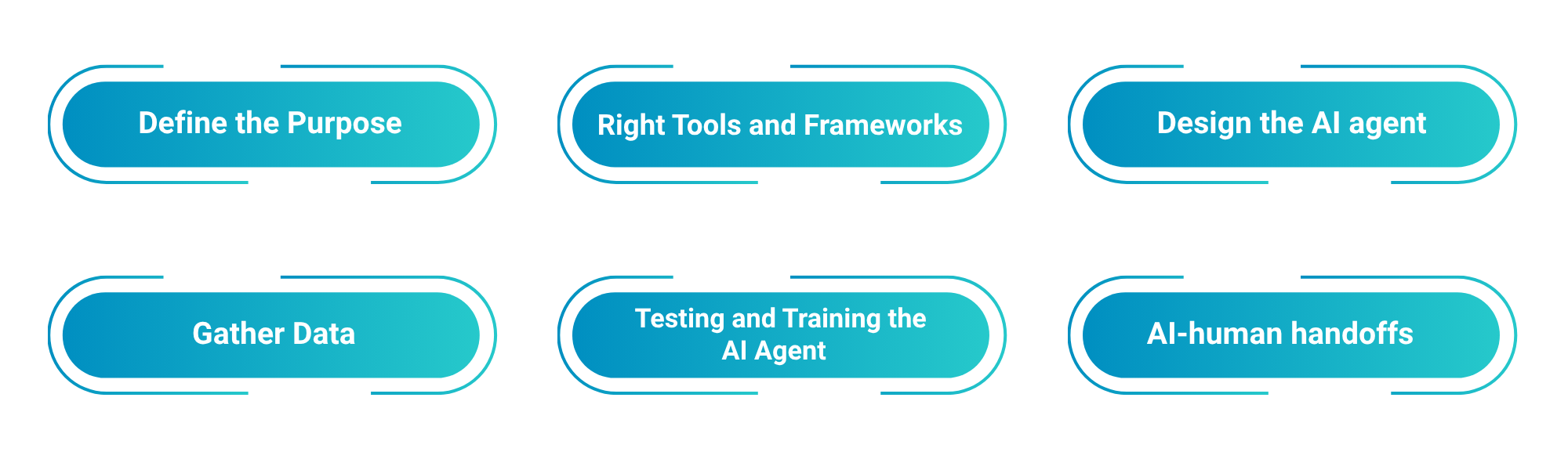
Define the Purpose of an AI Agent
Building a reliable and effective AI agent begins with a well-defined purpose. Businesses need to clearly define what they are aiming to achieve using AI agents. So, start by identifying the specific problem your agent will solve, for example, it can include automating customer queries, optimizing sales processes, gaining real-time analytics, or enhancing customer service. It helps determine the type of agent you want to build and the possible advantage it provides. Establish parameters early to ensure the AI agent aligns with business goals and ethical considerations from the start. Once you’ve set the purpose, move to the next steps.
Choosing the Right Tools and Frameworks
Selecting the right tools for developing AI agents is essential as it impacts complexity, ease of use, and performance. Depending on your agent’s complexity and needs, like processing text, analyzing images, handling conversations, or making predictions, select AI development frameworks. Also consider other factors like technical expertise of the team, integration needs, performance and scalability, and data security.
The ideal framework provides ready-to-use components for faster development and flexibility options to customize solutions for specific business needs. Another important aspect is choosing a robust data and infrastructure platform. Cloud platforms like Snowflake or Google Cloud AI can host data pipelines, while Salesforce provides an enterprise-ready foundation for secure, trusted AI development.
Gather data
Data is the foundation of any AI agent. High-quality and relevant datasets are essential for training agents to make accurate and reliable decisions. Collect high-quality data to enhance the effectiveness and performance of AI agents. This may include customer interactions, transaction records, sensor data, or any contextual input necessary for training. Clean, label, and structure the data to eliminate inconsistencies and biases, ensuring your agent learns effectively and produces accurate outputs. Consider privacy regulations like GDPR or HIPAA while using sensitive data, and regularly update the data used to train your AI model.
Design the AI agent
The design phase involves defining your agent’s architecture. It includes how AI agents perceive, process, and act within their environment. Identify specific input sources like text, images, sensor data, and output channels, chat, dashboards, or APIs. Build decision-making logic, which could include rule-based reasoning, supervised learning, or other learning models. When using an LLM, write clear and effective instructions to guide the agent’s behavior and performance. For complex agents, a modular architecture allows different parts to be updated independently. A well-designed AI agent integrates intelligence, usability, and adaptability to deliver the best results.
Testing and Training the AI Agent
No AI agent is perfect; it needs continuous training and testing to deliver the required results. The organization should test its performance in a controlled environment before full deployment. Train your AI agents with different types of data sets to understand and modify their outputs. Split your dataset into training, validation, and testing sets to evaluate accuracy, precision, and recall. Testing step involves a mix of methods like automated tests, user testing, and A/B testing to analyze its performance and identify improvement areas before and after deployment. Regular updates and continuous improvement are essential to keep your agents relevant in a changing environment, improve accuracy, and performance.
Smooth AI-human handoffs
The main purpose of building an AI agent is to help employees optimize their tasks and deliver faster results. Even the most advanced AI agents should collaborate with humans. Organizations should provide clear instructions on when, how, and why an AI agent transfers a task to a human operator. The process is referred to as Human-in-the-Loop (HITL); it prevents friction in workflows and enhances user experience. Consider providing clear escalation paths, context-sharing protocols, and feedback mechanisms. Continuous improvement helps to refine the handoff process and the AI agent’s capabilities. It helps businesses maintain trust, empathy, and efficiency in every interaction.
Agentforce: Your Trusted AI Partner for the Enterprise
Agentforce brings digital labor to every employee, department, and business process to augment employees and improve customer experience. Salesforce Agentforce empowers organizations to manage, deploy, and build AI agents at scale. It is easy to deploy Agentforce as it works seamlessly with your existing applications, business logic, and tools like APIs, automation flows, and low-code frameworks. This helps to create autonomous agents that are smart and achieve goals.
Trust is critical when deploying AI into your business. Agentforce incorporates multiple layers of safeguards to ensure secure, reliable, and ethical AI usage. Businesses can customize privacy policies to prevent agents from providing biased or inappropriate outputs. Advanced mechanisms feature zero data retention, contextual grounding, and real-time content moderation to minimize risks. Built on Salesforce’s secure platform, Agentforce benefits enterprise-grade reliability, disaster recovery, access controls, and compliance capabilities. Organizations can enforce governance policies while retaining flexibility to manage, encrypt, monitor, and audit data according to business needs.
Conclusion
The journey to building AI agents is not just about adopting technology. It’s about enabling intelligence that works with humans to drive efficiency, personalization, and growth. AI agents help organizations automate complex processes, deliver measurable impacts, and adapt to changing business needs. For building reliable and trustworthy AI agents, Salesforce Agentforce stands out as the most trusted platform. Agentforce allows businesses to build AI agents that act responsibly, learn continuously, and deliver results with precision.
With Kasmo as your Salesforce implementation partner, you can effectively adopt Agentforce. With our deep expertise in Salesforce, we help you design and deploy intelligent AI agents specifically tailored to your business needs. We enable AI-driven transformation, all built on a foundation of trust and innovation.