
Introduction
2026 is shaping up to be the year agents start running the enterprise. What began as simple assistants is rapidly evolving into autonomous AI workers that plan, decide, and execute tasks with minimal human input. According to Forrester’s recent survey, 74% of B2B and B2B2C organizations have already adopted AI agents, with another 14% set to join them. By 2026, this surge in adoption will reshape how businesses prioritize automation, decision-making, and operational workflows.
Companies are no longer asking how to use AI for efficiency; they’re looking for muti agent systems and self-optimizing systems. This shift marks a turning point where agentic AI becomes central to business strategy. As agentic AI moves deeper into enterprise architecture, it provides new possibilities in different sectors, including retail, manufacturing, healthcare, and more.
How are business priorities shifting with agentic AI adoption in 2026?
By 2026, organizations across industries are shifting their strategic priorities as agentic AI moves from experimentation to enterprise-wide adoption. Businesses are looking at agentic AI as a foundation for rethinking entire workflows, decision cycles, and value creation models. Leaders are prioritizing automation that collaborates with humans to enable faster response times, reduced operational bottlenecks, and continuous optimization across functions. This shift reflects a broader move toward autonomous systems that augment human expertise rather than simply support it.
Another major shift is the growing focus on connected, real-time decision-making. Instead of relying on fragmented data systems and manual reporting, enterprises are investing in AI agents that operate on unified data layers and can proactively trigger actions across departments. This is reshaping priorities around data strategy, governance, and cross-functional collaboration. Leading companies are adopting Salesforce Agentforce, which allows multiple agents to work together across sales, service, operations, supply chain, and field teams. As a result, organizations are designing workflows that are predictive, context-aware, and self-improving.
The Top Agentic AI Trends to Watch in 2026
Below are a few impactful Agentic AI trends to observe-
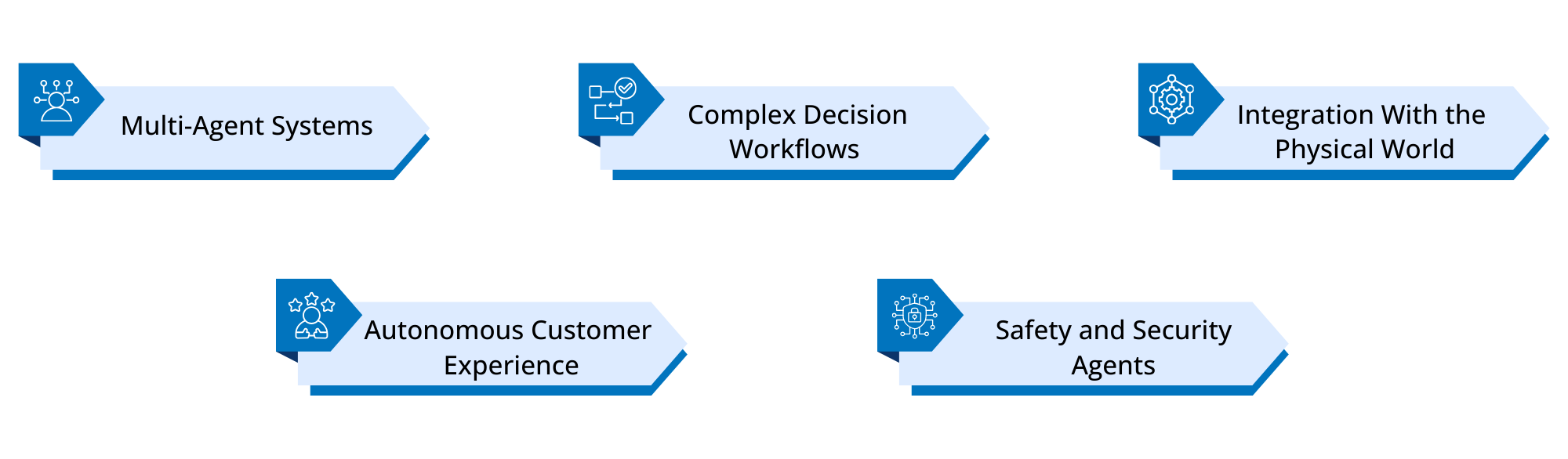
Multi-Agent Systems Become Standard
Enterprises are shifting from isolated AI assistants to interconnected networks of AI agents that collaborate autonomously. Instead of a single AI assistant, businesses now rely on multiple specialized agents, like forecasting agents, customer service agents, supply chain agents, and security agents, each designed for a specific domain but able to collaborate. These multi-agent systems share information, divide tasks, and coordinate actions across departments. The result is a self-orchestrating enterprise where tasks move seamlessly from one agent to another, reducing manual work, improving process accuracy, and accelerating end-to-end execution. In 2026, enterprises will treat multi-agent ecosystems as a core operating model, not an experimental technology.
Agents Take Over Complex Decision Workflows
Agentic AI is evolving beyond simple task execution to handling decisions that previously required expert judgment. Using large context windows, real-time data, domain grounding, and chain-of-thought reasoning, agents can evaluate scenarios, weigh trade-offs, and choose the best action plan. They don’t just analyze data; they reason through trade-offs, predict outcomes, and recommend or perform the next best action. This shift enables companies to automate high-value decisions like production planning, pricing optimization, risk evaluation, and customer routing. The biggest impact is speed; decisions that once took hours now happen instantly, with far greater accuracy.
Integration of AI Agents With the Physical World
The digital and physical enterprise worlds are converging as AI agents gain the ability to monitor, control, and optimize hardware systems. Through IoT networks, robotics, sensors, and connected infrastructure, agents can interact with machines, environments, and physical assets. AI Agents integrate with IoT devices, robotics, shop-floor systems, and industrial equipment. This connection allows agents to monitor real-time physical conditions, temperature, vibration, throughput, quality readings, and respond immediately. They can adjust machine parameters, halt defective runs, reroute work orders, or even coordinate robot actions autonomously. This convergence of digital intelligence with physical operations creates safer factories, smarter supply chains, and dramatically reduced downtime.
Autonomous Customer Experience
Customer-facing AI agents are transforming how brands engage with consumers. Ahead of chatbots or scripted workflows, autonomous CX agents can understand intent, personalize recommendations, resolve service issues, manage returns, initiate transactions, and do more with less human intervention. This helps businesses ensure a 24/7, consistent experience that minimizes wait times and reduces operational workload. By 2026, autonomous CX will become a competitive differentiator across retail, financial services, telecom, and healthcare.
AI Safety and Security Agents
As agentic AI becomes deeply embedded into core business operations, ensuring safe and controlled automation becomes a strategic priority. New categories of governance agents and security agents emerge to monitor, audit, and regulate other AI agents. These agents enforce organizational policies, ensure alignment with compliance frameworks, block unauthorized actions, and continuously evaluate risks. They provide oversight by detecting anomalies, hallucinations, data leakage attempts, or deviation from approved workflows. Enterprises rely on these safety mechanisms to maintain trust and prevent operational or reputational risks associated with autonomous systems.
 Industry Examples: How Agentic AI Will Transform Key Sectors by 2026
Manufacturing
Agentic AI will fundamentally reshape factory operations by acting as an autonomous decision layer across production, quality, maintenance, and supply chain processes. AI agents will monitor machines through IoT data, detect anomalies, and trigger corrective actions before failures occur, significantly reducing downtime. Multi-agent systems will coordinate production schedules, optimize material flows, and adjust resource allocation. Human workers will collaborate with agents through voice or chat interfaces to retrieve insights, run diagnostics, or initiate workflows instantly. By 2026, manufacturers will rely on AI agents as virtual supervisors that keep operations stable, efficient, and resilient amidst fluctuating demand and supply chain uncertainty.
Healthcare
In healthcare, agentic AI can deliver a transformative impact for both medical teams and patients, with 2026 marking a major shift toward widespread adoption. Unlike traditional chatbots that assist with single tasks, AI agents will manage entire care pathways, from gathering patient history to coordinating treatment plans, aftercare instructions. Administrative agents will automate tasks like prior authorizations, appointment scheduling, claim routing, and discharge coordination. Patient-interaction agents will deliver personalized guidance, answer queries, and monitor care progress across digital channels. They help hospitals and care teams operate to provide smoother care delivery, reduced processing time, and enhanced patient outcomes.
Retail
In retail, agentic AI will transform how companies manage inventory, engage customers, and optimize supply chains. Retailers will rely on AI agents to run more accurate merchandising strategies, deliver seamless omnichannel experiences, and boost customer loyalty through hyper-personalization.
- Demand forecasting agents will monitor sales trends, weather patterns, and supply signals to optimize stock levels and prevent shortages.
- Store operations agents will coordinate workforce schedules, track patterns, and identify operational inefficiencies.
- Customer-facing agents will provide real-time product recommendations, resolve service queries instantly, and support personalized journeys across eCommerce and physical stores.
Travel and Hospitality
Agentic AI is set to transform the travel and hospitality landscape by embedding intelligence across guest services, operations, and real-time decision-making. Customer service agents will manage booking updates, handle itinerary changes, and proactively resolve issues like flight delays or room preferences. Operational agents will optimize housekeeping schedules, track maintenance needs, and coordinate front-desk tasks to reduce check-in friction. In airports and hotels, AI agents will act as real-time intelligence hubs, analyzing crowd flow, predicting demand spikes, and orchestrating staff allocation. All these specific agents improve travel experience and handle operations end-to-end.
The Salesforce Advantage in the Agentic AI Revolution
Salesforce stands at the forefront of the agentic AI movement by offering a unified, trusted platform designed to deploy autonomous AI agents at enterprise scale. Salesforce combines data, automation, workflows, and intelligence in one interoperable system. With Einstein 1, Agentforce, and Agnetforce 360, Salesforce enables organizations to deploy autonomous, domain-specific AI agents that can act across sales, service, marketing, commerce, and operations. This integrated architecture ensures that every AI agent operates with clean, governed, real-time data while maintaining enterprise-grade security, auditability, and control.
Instead of isolated chatbots, enterprises gain AI agents that can understand customer intent, execute multi-step workflows, access CRM data, trigger backend actions, and collaborate with human teams. Salesforce also integrates seamlessly with enterprise systems, enabling multi-agent orchestration across platforms and business units. Customer 360 apps, Field Service, Revenue Cloud, and industry-specific clouds give AI agents immediate access to established business logic, historical records, customer context, and operational processes. As organizations shift toward autonomous enterprise models in 2026, Salesforce provides the most reliable foundation to build, deploy, and maintain AI agents.
Challenges Enterprises Must Solve Before Adopting agentic AI Trends
While agentic AI promises autonomous workflows and exponential productivity, enterprises must address foundational gaps before deploying agents. These challenges span data quality, governance, security, operational readiness, and cultural adoption. A few points to consider are-
Low-Quality Data: Agentic AI relies on accurate and quality data to make autonomous decisions. If data lives in silos or contains inconsistencies, agents may generate incorrect actions or recommendations. Enterprises must unify and clean data to ensure reliable agent behavior.
Clear Governance and Control: AI agents act independently, which increases the need for strict oversight. Without governance, autonomy can introduce compliance risks or unintended actions.
Security and Risks Management: Agents interact with sensitive systems, customer data, and operational workflows. Enterprises must implement least-privilege access policies for all agent types.
Operational Readiness: Many legacy processes are not built for autonomous execution. To scale agentic AI, enterprises must re-engineer workflows, modernize systems, and clearly define the tasks agents can safely own.
Workforce Adaptation: Employees must understand how to work alongside AI agents and trust their decisions. Without proper training and change management, teams may resist adoption or misuse of agent capabilities.
Conclusion
Agentic AI has become the foundation of next-generation enterprises. AI agents evolve from simple task automation to autonomous, multi-agent ecosystems. Salesforce is enabling this transformation with Agentforce, trusted and enterprise-ready AI agents. Salesforce enables multi-agent ecosystems that can work across sales, service, marketing, operations, and industry clouds.
As a Salesforce Summit Partner and winner of the Partner Innovation Award, Kasmo helps enterprises with deep expertise in AI, automation, and industry-specific transformation. We help enterprises design AI-ready data foundations, build secure multi-agent workflows, and implement Salesforce Agentforce solutions. Together, Salesforce and Kasmo empower businesses to adopt agentic AI trends and drive measurable outcomes.