Introduction
For years, pharmaceutical innovation has been constrained by fragmented data, manual analysis, and long, uncertain development timelines. The pharmaceutical industry is undergoing a profound transformation. These limitations are now amplified by the growing complexity of modern drug pipelines, like advanced biologics, gene therapies, targeted specialty drugs, supply chain complexities, etc. Clinical trials have become larger, more diverse, and more adaptive, demanding faster patient matching, real-time monitoring, and earlier detection of risks that traditional tools cannot provide. So, pharmaceutical companies require advanced systems that guide decisions with scientific and operational intelligence.
AI and predictive analytics have emerged as critical enablers to achieve them. Instead of reacting to these challenges, pharma companies can now anticipate them, transforming how drugs are discovered, tested, manufactured, and delivered to patients.
In this blog, we explore why AI and predictive analytics have become essential for pharmaceutical organizations, the challenges they help overcome, and how Snowflake enables advanced analytics with a unified and scalable data foundation.
Why Pharma Needs Predictive Analytics for Decision Making
The pharmaceutical industry operates in one of the most complex and high-stakes environments, where every decision, from molecule selection to commercial distribution, has scientific, financial, and regulatory consequences. Traditional manual processes and legacy analytical tools cannot meet the rising development costs and growing demand for personalized therapies.
One of the biggest challenges pharma companies face is the sheer volume and fragmentation of data across research labs, clinical trials, patient systems, manufacturing plants, and global supply chains. AI and predictive analytics enable organizations to unify and interpret this data, which transforms data into actionable intelligence instead of overwhelming complexity.
Another challenge is the prolonged and uncertain drug development cycle, where low-probability success and high attrition rates slow progress. AI can analyze molecular interactions and past trial outcomes to help identify promising drug ratios earlier and reduce time spent on compounds. Operationally, pharma companies struggle with supply chain complexities, stringent quality requirements, and the need for real-time visibility across global manufacturing networks. Apart from these, the increasing need for personalized medicine requires a higher precision that manual processes cannot deliver. AI and predictive analytics help pharmaceutical companies address these challenges and take AI-powered decisions.
Where AI and Predictive Analytics Create Real Business Value in Pharma
Accelerating Drug Discovery and Molecular Design
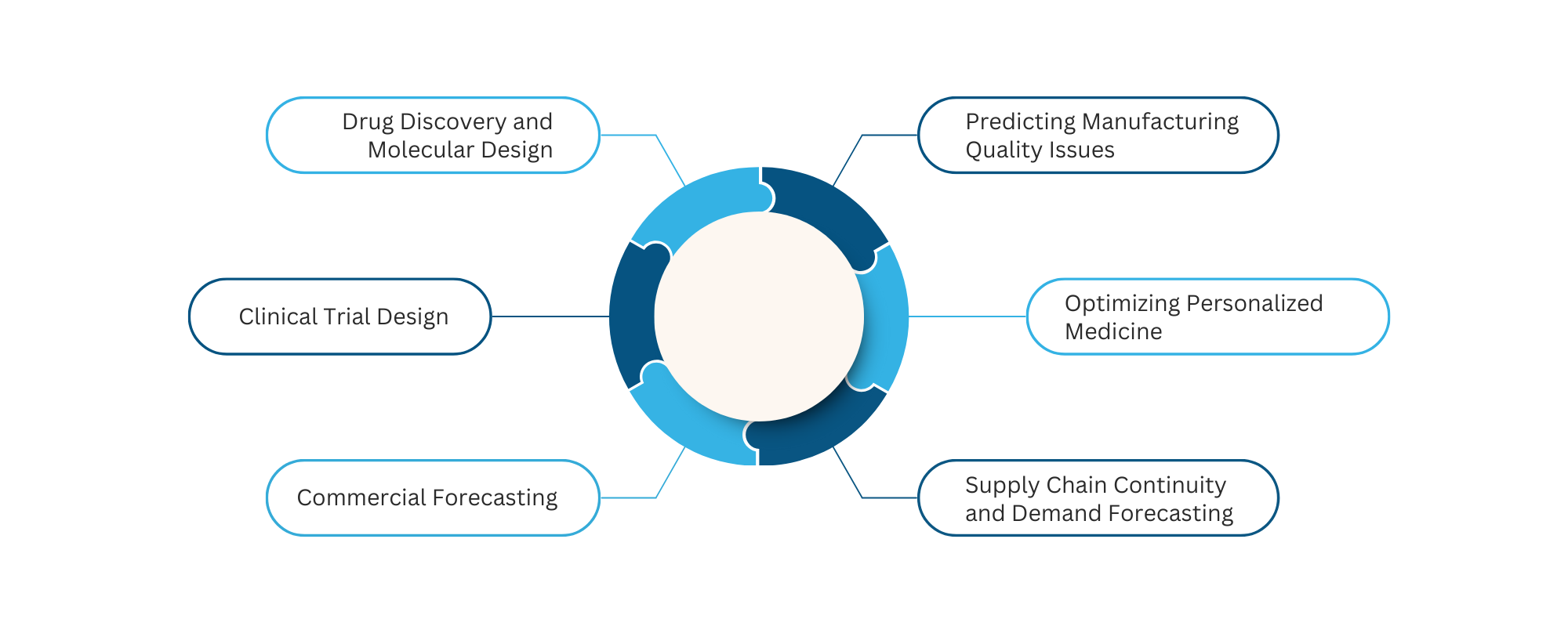
Drug discovery is one of the most time-consuming and costly phases in pharma, but AI speeds it up. Predictive analytical models can analyze millions of molecular combinations, identify potential drug candidates, and forecast how these molecules will behave in the body long before lab experiments are conducted. Pharma companies can even predict the products’ demands in the market to prioritize their development. AI-driven simulations reduce trial-and-error by identifying high-probability compounds and enabling faster discovery. This reduces R&D cost and improves the likelihood of breakthrough therapies hitting the pipeline.
Enhancing Clinical Trial Design
Clinical trials often face delays due to poor patient matching, manual protocol design, and high recruitment costs. AI solves this by analyzing patient records, biomarker data, and historical trial outcomes to match the right participants with the right studies. Predictive analytics forecast enrollment challenges, recruitment costs, and flag potential risks before the trial begins. This accelerates trial timelines, minimizes resource wastage, and increases the probability of regulatory approval.
Predicting Manufacturing Quality Issues
Pharma manufacturing requires strict consistency, yet quality deviations can occur due to minor fluctuations in equipment, raw materials, or environmental conditions. Predictive analytics continuously monitors these variables to anticipate potential failures before their occurrence and shows in QA tests. AI models detect subtle anomalies, notify plant teams of early warning signs, and recommend corrective actions.
Supply Chain Continuity and Demand Forecasting
Global pharma supply chains face frequent disruptions like shortages of raw materials, regulatory constraints, temperature-controlled logistics, and fluctuating patient demand. AI-driven demand forecasting models use real-time data from distributors, hospitals, pharmacies, and market signals to predict demand accurately at SKU, region, and channel levels. This allows companies to prevent stockouts of life-saving medications and reduce expensive overproduction. Predictive analytics benefits by identifying supply chain risks to avoid geopolitical events or supplier delays.
Optimizing Personalized Medicine
Personalized medicine requires matching therapies to patient-specific characteristics such as genomics, lifestyle, and disease progression. AI analyzes these complex datasets to predict how different patients will respond to certain therapies, enabling precision treatment planning. Predictive analytics help to identify the most effective drug regimen, dosage, or combination therapy for individuals. This leads to improved patient outcomes and more efficient use of high-cost specialty drugs.
Improving Commercial Forecasting
Commercial teams often struggle with unpredictable demand, shifting competition, and complex market access dynamics. AI and predictive analytics evaluate sales trends, prescriber behavior, and population health data to improve revenue forecasting and market planning. AI helps to identify regions with growth potential and evaluate the ROI of pharma marketing investments. The result is more accurate planning, efficient resource allocation, and stronger commercial performance.
Data Modernization: The Foundation for AI and Predictive Analytics in Pharma
In many pharmaceutical organizations, data remains trapped in legacy systems, departmental silos, and outdated formats limit accessibility and slow down research and operational processes. AI and predictive analytics require high-quality, unified, and real-time data to generate reliable insights. Modernizing the data allows pharma companies to consolidate clinical, operational, commercial, and other data into a single system to analyze. This foundation ensures accuracy, reduces manual work, and enables seamless collaboration across research, manufacturing, and supply chain teams.
A modern data platform, especially cloud-native ecosystems like Snowflake, enables scalable storage, secure data sharing, and advanced computational capabilities. Snowflake’s ability to integrate structured, semi-structured, and health data provides the agility needed for AI models, ML workflows, and predictive algorithms. With automated data pipelines and governed access, pharma teams gain accurate insights, like predicting trial bottlenecks, forecasting demand, identifying supply risks, and accelerating R&D discoveries. So, data modernization transforms an organization’s data assets, which power faster innovation and more efficient drug development cycles.

Snowflake: The Data Engine Powering AI and Predictive Analytics
The accuracy and effectiveness of AI and predictive analytics depend on the quality, availability, and trustworthiness of data. Pharma data is often scattered across clinical systems, R&D labs, manufacturing sites, supply chain partners, regulatory platforms, etc., making unified analytics extremely challenging. Snowflake addresses this by acting as the central data backbone that powers advanced analytics, ML models, and real-time decision-making across the value chain.
Unified Data Foundation for All Pharma Functions
Pharma generates massive volumes of structured and unstructured data, from genomic sequencing and lab notebooks to clinical trial results and EHR integrations. Snowflake can ingest, store, and process all formats at scale, giving scientists and analysts a complete data picture essential for accurate predictions and ML-driven insights.
Snowpark Enables in-platform AI/ML with Zero Data Movement
Snowflake’s elastic architecture scales instantly, giving data scientists the ability to run feature engineering, large-scale model training, and real-time inference without worrying about infrastructure limits. With Snowpark, teams can bring AI models directly to the data, minimize data movement, and improve model accuracy.
Powering omnichannel and commercial insights
Sales reps, digital channels, HCP engagement, and patient support programs generate large datasets that traditional data warehouses cannot process easily. Snowflake supports rapid ingestion and analytics of commercial data, from CRM events to prescription trends and pharma marketing. AI-driven insights built on Snowflake help pharma organizations personalize HCP engagement, refine targeting, and predict therapy adoption.
Governance and Compliance for AI
Pharma operates under strict regulations (GxP, FDA, EMA), and AI systems must be traceable and auditable. Snowflake’s built-in governance, audit trails, data lineage, and encryption ensure that sensitive clinical and health data remains compliant. This regulated environment enables pharma companies to scale responsible and trustworthy AI.
Conclusion
AI and predictive analytics have become the key to accelerating breakthroughs, improving operational reliability, and ensuring smarter decisions across the pharma industry. By transforming disconnected data into real-time intelligence, AI strengthens every function from R&D and clinical operations to manufacturing and commercialization. Snowflakes help pharma companies transform this ecosystem from end to end. It gives the agility and scale needed to build reliable AI models, automate analytics, and support regulated workflows. This ensures that the right therapies move from discovery to patients with greater precision and efficiency.