Introduction
Healthcare claims may look straightforward to members and providers, but payers represent one of the most complex operational challenges in the system. Even small bottlenecks ripple across the entire reimbursement cycle, delaying payments, inflating operational costs, and hurting both provider trust and member satisfaction.
Behind every claim is a maze of data sources, evolving regulations, manual validations, and decision points that must be executed with absolute accuracy. As claim volumes rise and compliance requirements tighten, traditional systems are mounting an administrative burden. Manual intervention at every step introduces delays, inconsistencies, and errors, while growing fraud patterns and rising member expectations. So, AI has quickly become a viable way to manage this complexity with speed and precision.
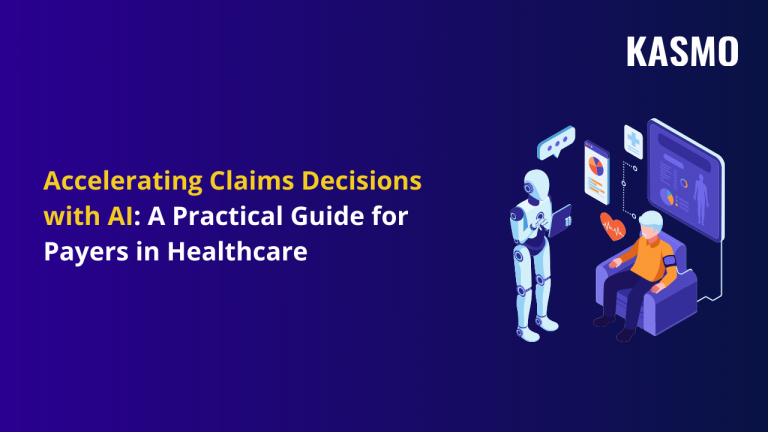
In this blog, we explore how AI transforms each stage of the healthcare claims lifecycle and how Snowflake empowers payers to operationalize intelligent, efficient, and scalable claims processing.
What Claims Processing Looks Like for Payers in Healthcare?
Healthcare claims processing is one of the most critical operations for payers, involving the review, validation, and adjudication of millions of claims submitted by providers. While the workflow may appear linear on paper, in reality, it is a multilayered, highly regulated, and data-intensive process. Here’s what it involves and where complexity arises.
 Multi-Step Workflow with High Manual Dependency
Claims pass through intake, eligibility checks, coding validation, payment posting, and appeals. At many of these handoffs, humans still verify data, correct codes, and resolve exceptions. The manual process creates delays, introduces variability in decisions, and scales poorly as claim volumes spike. Manual steps also create bottlenecks where one backlogged queue can stall downstream processes, increasing cycle time and operational cost.
Fragmented High-volume data sources
A single claim draws data from EHRs, practice management systems, lab reports, prior authorizations, patient benefit files, and provider contracts. These sources use different formats and update frequencies, so reconciling them requires complex mapping and validation. The sheer volume of records monthly means small data mismatches multiply into frequent processing errors, denials, and rework unless automated cleaning and matching are in place.
Complex Rules and Regulatory Variation
Adjudication must apply benefit rules (deductibles, copays), payer-provider contract terms, medical necessity guidelines, and state or federal regulations. These rules update frequently and include exceptions or bundled rate logic. Encoding and maintaining this logic is difficult; even small policy changes demand system updates and retraining. The complexity increases the chance of incorrect payments or denials and raises compliance risk.
High risk of errors and denials
Coding mistakes, missing documentation, or mismatched member eligibility lead to denials or partial payments. Each denied claim triggers investigations, provider outreach, corrections, and resubmission, consuming staff time and delaying provider reimbursement. Rework also reduces throughput and inflates the unit cost per claim, while damaged provider relationships and member dissatisfaction have business consequences beyond direct processing costs.
Fraud, waste, and abuse (FWA) detection
Fraud patterns constantly evolve. Mule accounts, upcoding, phantom services, and collusive provider networks can be subtle and distributed across many small transactions. The traditional rule-based health insurance claim process generates many false positives or misses sophisticated schemes. Effective FWA control requires pattern detection across large datasets, link analysis, and near-real-time triage to stop losses before payment, capabilities that are hard to implement without advanced analytics and integrated data.
How AI helps across the Healthcare Claims Management Lifecycle
Claims Intake and Data Capture
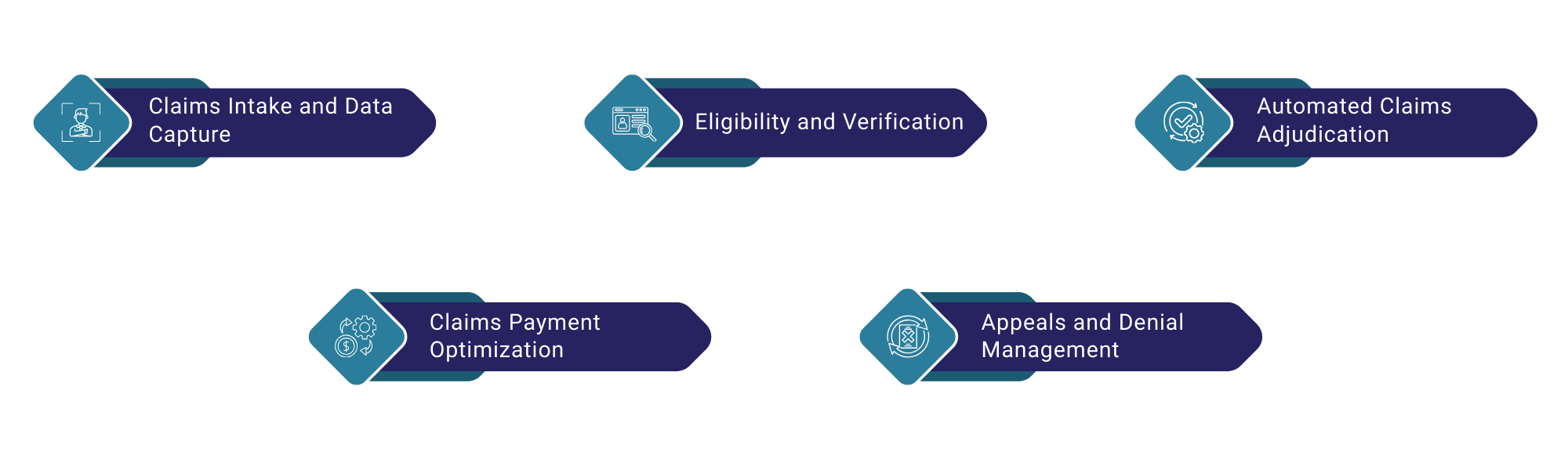
AI streamlines the very first step by automating the extraction, classification, and validation of claim information from files, portals, EHR systems, faxes, and documents. This enables faster first-pass throughput and higher data accuracy. AI helps to:
- Use OCR and NLP to read claim forms, physician notes, lab reports, and attachments.
- Automatically identify missing fields (e.g., CPT/ICD codes, patient info).
- Reduces manual data entry errors and accelerates intake.
- Converts unstructured data into structured, system-ready formats.
Eligibility and Verification
AI in healthcare claims enhances the verification process by automatically checking benefit details, plan coverage, and policy validity across multiple payer systems. AI streamlines real-time cross-referencing and highlights inconsistencies before the claim progresses. This improves accuracy and significantly reduces avoidable denials related to eligibility issues. AI helps with payer with-
- Automated policy and coverage validation.
- Detection of mismatches like expired plans or incorrect subscriber info.
- Predictive alerts for outdated or missing member data.
- Fewer eligibility-related denials and reduced rework effort.
Intelligent Medical Coding & Documentation Review
AI improves coding accuracy by interpreting clinical documentation and mapping it to appropriate CPT, ICD-10, and DRG codes. This eliminates many manual coding errors and highlights gaps that could lead to medical necessity denials. By ensuring that coding aligns with documented patient care, AI reduces compliance risks and improves reimbursement accuracy.
Automated Claims Adjudication
This is the most rule-heavy step, where multiple factors must align. AI accelerates adjudication by applying payer policies, pricing logic, and clinical rules automatically. It predicts claim outcomes based on historical decisions and flags anomalies or conflicts before a claim is finalized. This ensures faster, more consistent decisions and increases auto-adjudication rates.
Claims Payment Optimization
AI ensures the final settlement is accurate, timely, and aligned with business rules. It improves accuracy in payment calculation by verifying contracted rates, benefit structures, and allowed amounts. This reduces overpayments, underpayments, and provider disputes. How AI helps:
- Validates claim payment amounts against fee schedules and agreements.
- Detect anomalies in pricing, bundling, or modifier use.
- Prevent payment errors before settlement.
- Improve payer-provider relationships through accurate payments.
Appeals and Denial Management
AI accelerates denial resolution by analyzing the root cause of denials, predicting which cases have the highest likelihood of being overturned, and recommending the appropriate appeal actions. It identifies missing documents, highlights coding or authorization gaps, and suggests the specific information needed to strengthen the appeal. By auto-generating appeal letter drafts and prioritizing high-value cases, AI significantly reduces turnaround time, improves recovery rates, and minimizes repetitive denials for payers in healthcare.
Key Benefits of AI-Driven Claims Automation for Payers
AI-driven automation is transforming how players manage the end-to-end claims lifecycle. Instead of navigating high volumes of paperwork, coding errors, and repeated touchpoints, payer teams can rely on intelligent systems. This helps to lower operational costs, improve compliance, transparency, and member satisfaction. Below are the key benefits AI brings to claims processing for payers:
- AI reduces manual touchpoints across intake, adjudication, and validation, enabling claims to move through the system much faster.
- Automating repetitive tasks cuts down the labor hours required for claims processing. This results in cost savings and allows teams to focus on high-value exceptions instead of routine work.
- AI easily reads, classifies, and validates data. With more accurate inputs, payers reduce claim corrections, denials, and compliance-related risks.
- AI-powered healthcare models allow payers to intervene early, prevent leakage, and ensure only legitimate claims are approved.
- Faster approvals and fewer documentation clarifications help to deliver a smoother experience for both members and providers.
- Predictive insights provide real-time intelligence on claim data, which enables payers to improve processes, forecast workloads, and optimize resource planning.
 Snowflake: The Modern Data Backbone Enabling AI for Payers
Snowflake gives payers a unified, high-performance foundation to modernize healthcare claims management with AI. AI Data Cloud acts as a unified, secure, and scalable data platform that centralizes all payer data, including claims, eligibility, provider records, clinical notes, and unstructured documents, into a single source of truth. By consolidating fragmented data, Snowflake ensures AI and ML models have accurate information to detect fraud, predict denials, automate claim adjudication, and reduce errors.
With Snowpark, payers can run AI/ML workflows directly within Snowflake, eliminating the need to move sensitive data externally. Data scientists can build models for claim classification, denial prediction, duplicate claim detection, cost estimation, and risk scoring. The AI Data Cloud enables secure, governed data collaboration with providers, PBMs, labs, health information exchanges, and analytics vendors. Its elastic architecture ensures an AI-driven solution that allows payers to scale processing during peak claims. As a result, payers can accelerate the entire claims lifecycle, using AI models powered data cloud. In short, Snowflake empowers payers to streamline healthcare claims management, accelerate settlement, minimize risks, and deploy AI-driven insights efficiently.
Conclusion
AI is advancing the claims process for payers in healthcare. It helps in turning long, manual, and error-prone processes into fast and accurate workflows. From improving eligibility checks to reducing denials, AI automates the entire claims process lifecycle. When combined with technologies like NLP, predictive modeling, and anomaly detection, payers gain real-time visibility of claims data.
Kasmo helps payers in this process by building scalable, Snowflake-powered AI foundations. As a Snowflake Premier Partner and award-winning implementation provider, Kasmo brings deep expertise in healthcare data, AI workflows, and claims automation. With Kasmo, payers can accelerate claims modernization, reduce leakage, strengthen compliance, and deliver smarter and more efficient operations across the entire claims lifecycle.