
Introduction
Every day, service representatives in banks navigate a maze of disconnected systems, compliance checks, repetitive documentation, and customer interactions. A simple query about a transaction dispute or loan status can require switching between multiple screens, verifying policy rules, and escalating approvals. To meet high expectations, customer service in banking should do more than resolve tickets. They need to deliver fast, secure, and context-aware support without compromising trust.
This is possible by using agentic AI in banking customer service. They do not replace service agents, but empower them with intelligence that analyzes, retrieves context, and guides actions in real time. With Agentforce built on Salesforce, banks can embed this into service workflows, enabling faster resolutions, better engagement, and governed automation.
In this blog, we explore how Agentforce advances service operations by adopting agentic AI in banking; the measurable business benefits it unlocks, and how it reduces service reps’ burden.
The Core Customer Service Challenges in Banking
Customer service in banking operates at the intersection of high customer expectations, strict regulations, and complex systems. While customers expect instant, personalized support, service teams must navigate fragmented data, compliance constraints, and rising interaction volumes. This disconnect creates operational strain and inconsistent experiences across channels.
Fragmented Customer Data Across Banking Systems
Banking customer information is typically spread across core banking platforms, CRM systems, loan servicing tools, and dispute management apps. Service representatives often switch between multiple systems just to understand a customer’s context. This fragmentation slows response times, increases errors, and prevents service teams from delivering truly personalized support.
Rising Service Volumes
As banks expand digital offerings, customer service interactions have increased. Customers reach out via branches, call centers, mobile apps, chat, and email, often for the same issue. Managing high volumes across channels without unified visibility leads to duplicated effort, longer queues, and inconsistent resolutions.
Manual Case Handling
Many banking service processes still rely on manual triage, rule-based workflows, and reactive decision-making. Service reps must interpret policies, check eligibility, and coordinate with back-office teams for approval. This slows resolution, increases dependency on experienced staff, and limits the bank’s ability to scale service efficiently.
Regulatory and Compliance Complexity
Every service interaction in banking must adhere to strict regulatory, data privacy, and audit requirements. Reps don’t just resolve issues but also ensure compliance at every step. This adds cognitive load, increases the risk of mistakes, and often leads to over-processing or unnecessary escalations.
Pressure to Deliver Consistent
Customers expect consistent and relevant service regardless of channel, product, or geography. Delayed processes, uneven data access, and varying skill levels across teams make it difficult to deliver uniform experiences. This inconsistency directly impacts customer trust and long-term loyalty.
Introducing Agentic AI in Banking to Empower Service Reps
Traditional AI and automation in banking customer service are designed to respond to triggering workflows, routing tickets, or answering predefined questions. While helpful, these systems remain limited to rules and historical patterns. Agentic AI in banking goes a step further by reasoning, deciding, and acting autonomously within defined guardrails, making it far better suited for the complexity and accountability required in proactive customer service.
Agentic AI continuously evaluates customer intent, transaction context, service history, and policy constraints in real time. Instead of waiting for explicit instructions, it proactively determines the next best action, whether that’s resolving an issue instantly, gathering missing information, escalating to the right team, or preventing a problem before it impacts the customer. This capability enables banks to update service models to an anticipatory, outcome-driven service.
The benefits are significant for customer service in banking. Agentic AI reduces handling times by minimizing manual decision-making, improves accuracy by enforcing compliance-aware actions, and delivers consistent experiences across channels. Most importantly, it allows service teams to focus on high-value interactions while the AI manages repetitive, high-volume service tasks. The result is faster resolution, improved customer trust, and service operation.
Agentforce: Bringing Agentic AI to Banking Service Operations
Agentforce introduces agentic AI in banking service; it eliminates scripted automation to provide intelligent and consistent service execution. Instead of simply responding to requests, Agentforce understands customer intent, reasons across banking data, and takes action across systems. This enables banks to deliver faster and more personalized customer service.
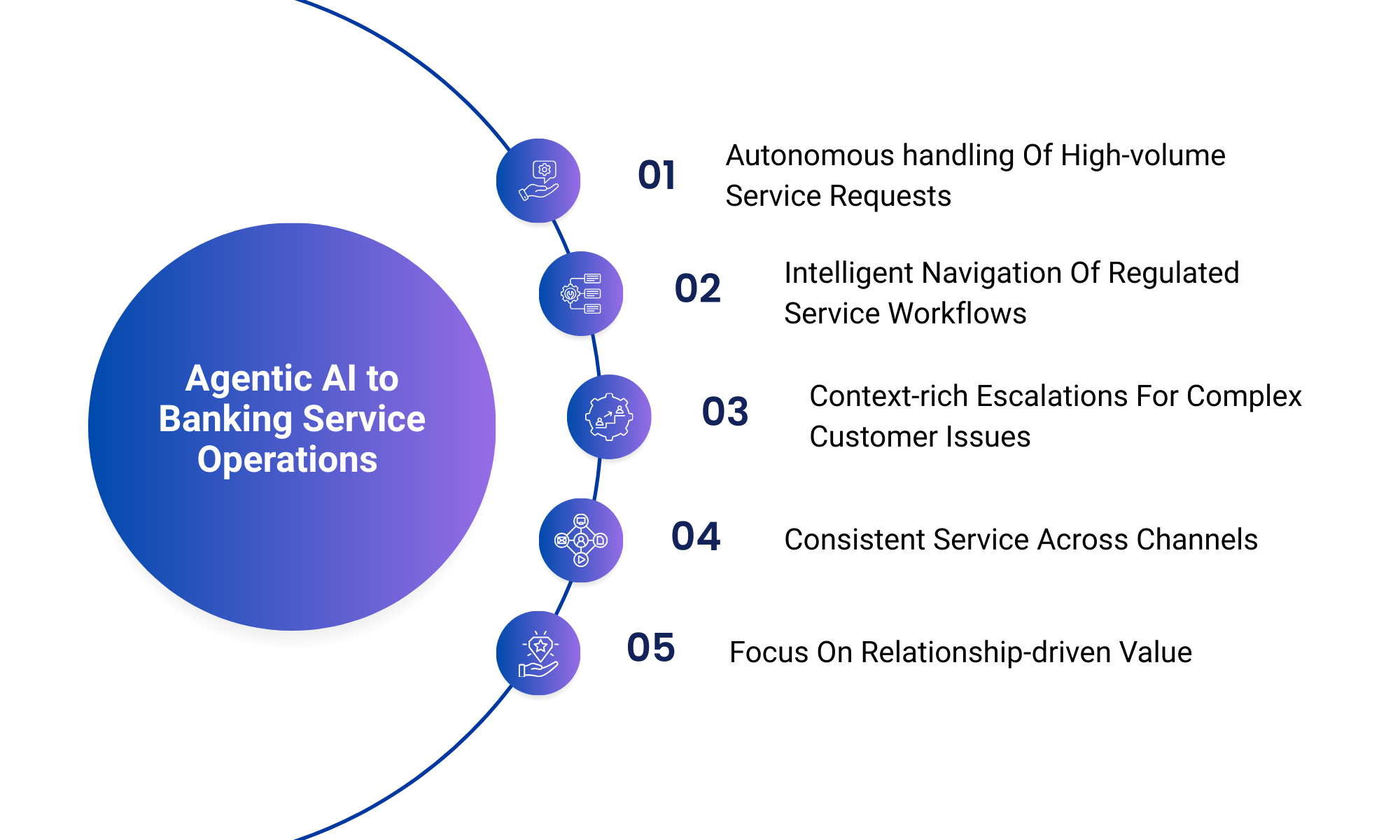
Autonomous Handling Of High-volume Service Requests
Retail and commercial banks receive massive volumes of routine inquiries regarding account balances, transaction clarifications, card issues, payment status, or fee explanations. Agentforce can independently resolve many of these requests by accessing customer profiles, transaction histories, and policy rules in real time. This reduces dependency on human agents for repetitive work while ensuring responses remain accurate and contextual to the customer’s relationship with the bank. This results in less customer wait time, enables faster case closure, and improves customer loyalty.
Intelligent Navigation Of Regulated Service Workflows
Banking service processes are tightly governed by compliance rules, approvals, and documentation requirements. Agentforce reasons through these workflows end-to-end, guiding customers through form submissions, validating required information, and ensuring mandatory steps are completed. This minimizes service errors, reduces rework, and helps banks maintain audit readiness without slowing down response times.
Context-rich Escalations For Complex Customer Issues
When a customer issue requires human intervention like disputes, fraud investigations, or relationship-based decisions. Agentforce ensures the escalation is seamless. Agentic AI in banking assembles a complete service context. With advanced reasoning capabilities, it brings together context and prior case histories within seconds.
- Instant case reconstruction: Automatically compiles interaction history, account activity, service requests, and related documentation into one contextual view.
- Real-time policy alignment: Evaluates the situation against compliance rules and internal guidelines to recommend accurate, risk-aware actions.
- Automated response support: Drafts tailored customer communications and schedules follow-ups to ensure nothing is overlooked.
With this approach, escalations no longer feel chaotic. This helps service reps gain focus on building trust and delivering accurate support.
Consistent Service Across Channels
Bank customers interact through multiple channels, like mobile apps, chats, call centers, and branches. Agentforce maintains continuity across these touchpoints by carrying context forward as customers switch channels. Whether a request starts in self-service or ends with a live agent, the experience remains consistent, eliminating the frustration of repeating information.
Focus On Relationship-driven Value
By absorbing operational service load, Agentforce enables banking service teams to focus on higher-value interactions. To provide effective financial guidance, retention conversations, and trust-building moments. This shift improves employee productivity while elevating the quality of customer service in banking from transactional support to relationship-centric engagement.
Benefits of Agentforce for Banking Customer Service
Agentforce enables agentic AI capabilities in Salesforce Financial Cloud and Service Cloud to provide context-driven engagement. Unified Customer 360 data, real-time analytics, workflow automation, and governed AI reasoning strengthen operational performance while maintaining compliance and customer trust. Below are the core business benefits of using agentic AI in banking.
Intelligent Orchestration: Agentforce uses Salesforce’s unified data model to automatically classify, prioritize, and route cases. For banks, this reduces Average Handle Time (AHT), minimizes back-and-forth transfers, and accelerates resolution.
Personalization with Customer 360: Built on Financial Services Cloud, Agentforce operates on a consolidated Customer 360 profile. This enables AI-driven recommendations and contextual responses tailored to the customer’s needs.
Churn Prevention: Agentforce analyzes service patterns, transactional signals, and sentiment indicators to identify early signs of dissatisfaction. Through Salesforce automation and predictive insights, banks can initiate early communication before customers escalate issues. This reduces churn risk and strengthens long-term relationships.
Reduced Burnout: Agentforce acts as a digital co-pilot within Service Cloud. It summarizes cases, retrieves relevant knowledge articles, and automates post-interaction documentation. For contact center teams, this reduces repetitive administrative tasks and cognitive overload from switching between systems.
Service Performance Insights: Through Salesforce dashboards and analytics, Agentforce continuously monitors service KPIs like resolution time, customer satisfaction (CSAT), and case deflection rates. AI-driven insights highlight process bottlenecks and improvement opportunities.
Conclusion
Customer expectations are rising, regulations are stronger, and service volumes continue to grow, making intelligent transformation essential. Agentic AI in banking enables proactive customer service with advanced analytics and reasoning. Agentforce helps banks move beyond basic automation to intelligent service operations that empower reps to eliminate customer service challenges. The result is improved trust, reduced handling time, and a scalable service model built for the digital-first customer.
As a Salesforce Summit Partner, Kasmo brings deep expertise in Financial Services Cloud and Agentforce to help banks design secure, compliant, and outcome-driven service solutions. With unified Customer 360 implementation, workflow automation, industry-specific accelerators, and governed AI deployment, Kasmo helps financial institutions adopt agentic AI with Agentforce.