Introduction
Imagine a global enterprise running thousands of stored procedures, legacy scripts, and tightly coupled reporting systems built over decades. The decision to migrate to the cloud promises agility and cost optimization, but the reality is daunting. Rewriting code manually is time-consuming. Missing a single dependency could disrupt business operations. This is the challenge many organizations face when embarking on data warehouse modernization initiatives: balancing speed, accuracy, and risk in a high-stakes migration journey.
SnowConvert AI was built to address exactly this complexity. By combining semantic code analysis with AI-driven refinement, it transforms migration from a manual overhaul into an intelligent, structured process. In this blog, we will explore how SnowConvert AI redefines migration strategies and empowers enterprises to modernize with confidence and scale.
The Challenge: Roadblocks in Traditional Data Warehouse Modernization
Modernizing a legacy data warehouse is rarely a simple lift-and-shift process. Enterprises face structural, operational, and technical barriers that slow down transformation and increase risk. Below are a few challenges organizations encounter:
Legacy Code and Platform Lock-In
Traditional data warehouses, like on-premises Teradata, Oracle, or Redshift environments, often contain thousands of stored procedures, SQL script, ETL workflows, and platform-specific customizations. These workloads are tightly coupled with the underlying infrastructure and specific features. When organizations initiate modernization efforts, translating this logic into cloud-native architectures becomes highly complex. Manual code conversion is time-consuming and error-prone. Even minor syntax differences or unsupported functions can break downstream reporting and analytics processes that increase migration risk.
Incomplete Metadata and Poor Documentation
Many legacy systems have evolved over 10-15 years with limited documentation. Data lineage, transformation logic, dependency mappings, and data models may exist only in fragmented documents. Without complete metadata visibility, modernization teams struggle to assess impact or prioritize critical workloads. This creates uncertainty in data warehouse modernization planning and increases the probability of missing hidden dependencies, leading to post-migration failures.
High Cost and Time-Intensive Manual Process
Traditional modernization efforts rely heavily on manual assessment, code rewriting, testing, and validation. This approach requires large cross-functional teams working over extended timelines for enterprise-scale data warehouse migration. The longer the migration takes, the more expensive it becomes. Organizations incur parallel infrastructure costs, consulting expenses, and opportunity costs.
Data Quality and Validation Complexity
Modern data platforms emphasize near real-time analytics, AI readiness, and scalable performance. But migrating historical data and transformation logic without compromising data integrity is technically complex. Ensuring row-level reconciliation, transformation accuracy, and performance parity requires validation frameworks.
Organizational and Skill Gaps
Cloud-native data platforms require different skill sets, like modern SQL optimization, data engineering, DevOps automation, and more. Teams accustomed to legacy systems may face a learning curve when adapting to serverless architectures, elastic compute models, and modern CI/CD pipelines. This skills gap slows adoption and limits performance optimization.
SnowConvert AI: An AI-Assisted Modernization Accelerator
SnowConvert AI is Snowflake’s AI-assisted migration engine that helps enterprises automate the modernization of legacy data warehouses into Snowflake’s Data Cloud platform. Moving beyond the manual and error-prone code translation, SnowConvert uses AI and metadata-driven analysis. This helps to understand, interpret, and convert legacy SQL dialects, stored procedures, views, and data transformation logic into Snowflake-ready artifacts. It transforms modernization from a prolonged technical project into an automated and end-to-end data migration process.
At its core, SnowConvert AI ingests metadata from a source environment; it can be Teradata, Oracle, SQL Server, Netezza, or other platforms. Then it performs deep analysis of object definitions, query structures, and procedural logic. Unlike basic regex scripts or simple find-and-replace utilities, SnowConvert AI operates with a far more intelligent and structured approach to code conversion. It combines advanced transpiler technology with a deep semantic understanding of the source system. Instead of scanning text line by line, it parses the entire codebase to build an Abstract Syntax Tree (AST) and a Symbol Table.
The AST breaks the source code into its structural components, while the Symbol Table maps variables, objects, data types, and references across the system. Together, they create a complete semantic model of how the code actually behaves. On top of this foundation, agentic AI enhances the process by reasoning business logic, resolving ambiguities, refining translations, and optimizing outputs for the target platform. The result is functionally equivalent code that aligns with Snowflake’s architecture and best practices.
Why Use SnowConvert AI and Its Benefits
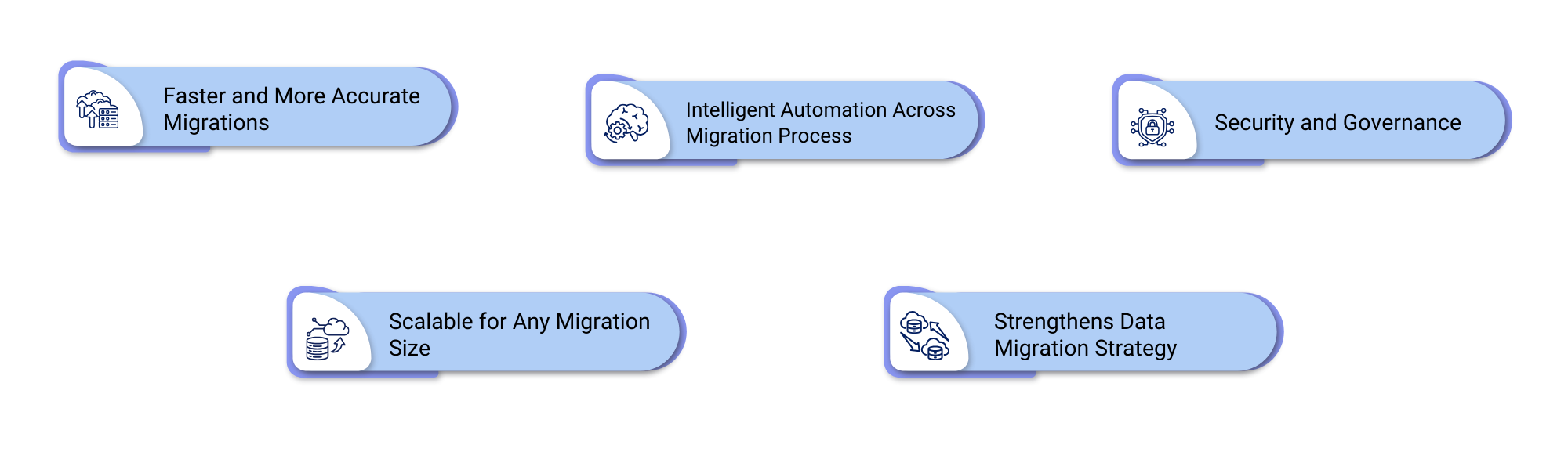
SnowConvert AI accelerates every phase of modernization, from discovery and analysis to code generation, testing, and deployment. Here are five high-impact benefits that make it a strategic asset for large-scale modernization initiatives:
Faster, More Accurate Migrations
SnowConvert AI accelerates transformation initiatives by automating complex code conversion with semantic precision rather than simple syntax replacement. Building structural and logical models of legacy systems before translating them, it minimizes functional gaps and reduces post-migration remediation. This results in significantly shorter timelines, improved code fidelity, and faster realization of value from data warehouse modernization initiatives.
Intelligent Automation Across the Migration Process
Traditional tools often require heavy manual intervention when edge cases or unsupported patterns arise. SnowConvert AI enhances the migration process with AI-driven refinement and contextual recommendations, enabling teams to resolve issues dynamically and adapt logic to Snowflake’s architecture. This reduces dependency on scarce legacy expertise and ensures smoother execution across phases.
Security and Governance
Security is embedded into the architecture. All AI-driven analysis and recommendations are executed within the customer’s Snowflake environment, ensuring sensitive code and metadata never leave governed boundaries. This helps organizations to –
- Maintain strict governance controls
- Protect sensitive business logic and data assets
- Enable secure enterprise data migration without compromising compliance
Scalable for Any Migration Size
Whether migrating hundreds or thousands of objects, SnowConvert AI delivers consistent, repeatable performance. It supports both focused workload transitions and large, system-integrator-led transformations without compromising accuracy. Its scalable design ensures predictable outcomes even in high-volume, multi-schema environments, reducing risk during large modernization programs.
Strengthens Data Migration Strategy
Beyond code conversion, SnowConvert AI provides assessment reports and actionable insights that inform planning, resource allocation, and risk mitigation. By highlighting complexity, identifying optimization opportunities, and surfacing dependencies early, it enables organizations to execute a more structured and outcome-driven data migration strategy, turning migration from a technical exercise into a strategic transformation initiative.
Kasmo as Your Implementation Partner
As a Snowflake Elite Partner, Kasmo brings proven expertise in delivering complex migration and modernization programs with measurable outcomes. With deep technical capabilities across Snowflake architecture, AI-powered automation, and enterprise-scale transformations, Kasmo ensures SnowConvert AI is implemented strategically. From initial assessment and workload analysis to conversion validation and optimization, the team drives measurable outcomes aligned with business objectives.
What sets Kasmo apart is our hands-on execution combined with industry experience across large-scale enterprise environments. We don’t just deploy tools; we operationalize them. This results in a streamlined transition to Snowflake that improves performance, enhances scalability, and lays a strong foundation for long-term data innovation.
Conclusion
SnowConvert AI transforms migration from a time-consuming, error-prone initiative into a streamlined, intelligent transformation journey. By combining advanced transpiler technology with agentic AI, it delivers functionally accurate code conversion and reduces manual effort in data warehouse modernization. Rather than treating migration as a one-time technical shift, SnowConvert AI enables a structured and future-ready foundation.