Introduction
Efficiency alone no longer defines manufacturing excellence; intelligence does. The lean manufacturing process has long helped organizations eliminate waste, streamline workflows, and improve productivity. In today’s volatile market, where demand shifts rapidly and supply chains face constant disruption, traditional lean systems are being pushed to their limits. Manufacturers must now operate with precision, speed, and adaptability, balancing cost optimization with resilience.
According to McKinsey, companies have made significant improvements to manufacturing, service, and maintenance operations through lean techniques, eliminating waste, inflexibility, and variability in their systems and reducing costs by up to 50% in the process. The foundation is strong, but the next phase of lean evolution demands smarter, real-time decision support.
Instead of relying solely on manual monitoring and reactive analysis, manufacturers can adopt agentic AI systems that reason and adapt dynamically to changing conditions. Salesforce Agentforce embeds intelligent orchestration into lean processes, helping in waste reduction and proactive optimization. In this blog, we explore the role of Agentforce in lean manufacturing, how it advances core lean principles, and enables organizations to build intelligence in 2026.
Understanding Lean Manufacturing
Lean manufacturing is a systematic approach to improving production processes by eliminating waste, maximizing value, and continuously optimizing workflows. Lean focuses on delivering exactly what the customer needs, in the right quantity, at the right time. This helps in minimizing excess inventory, defects, waiting time, overproduction, unnecessary motion, and inefficient processes. At its core, the lean manufacturing process is built on five principles: identifying customer value, mapping the value stream, creating continuous flow, adopting pull-based production (Just-in-Time), and pursuing continuous improvement (Kaizen).
Lean is not just a cost-cutting method; it is a cultural discipline that empowers teams to identify inefficiencies and improve processes consistently.
Example: Consider an automotive parts manufacturer producing brake components. Without lean practices, the factory might produce parts in large batches to maximize machine usage, resulting in excess inventory and storage costs. With lean principles like Just-in-Time production and value stream mapping, the manufacturer produces components based on real customer demand. This helps with fewer inventory holding costs, waste reduction, and improves cash flow.
The Evolving Challenges in Lean Manufacturing
While lean principles remain highly relevant, modern manufacturing automation has become far more complex. Several new challenges are making it harder to sustain lean excellence.
Demand Volatility and Market Uncertainty: Global demand patterns fluctuate rapidly due to economic shifts, geopolitical disruptions, and changing customer preferences. Lean systems that rely on stable forecasts can struggle when there are sudden demand spikes or drops, which leads to either stockouts or idle capacity.
Increasing Supply Chain Complexity: Manufacturers now depend on global supplier networks, multi-tier sourcing, and cross-border logistics. A delay from one supplier can disrupt entire production schedules, making Just-in-Time execution more difficult to maintain.
Data Fragmentation Across Systems: Production data often resides across ERP, MES, CRM, quality management, and supply chain platforms. Without unified visibility, identifying bottlenecks or inefficiencies becomes difficult.
Workforce Skill Gaps and Labor Shortages: Lean relies heavily on empowered and skilled teams. But many manufacturers face workforce shortages and limited access to experienced operators, which affects problem-solving speed and continuous improvement initiatives.
Rising Quality Requirements: Regulatory pressures, traceability standards, and customer quality expectations are increasing across industries. Maintaining lean flow while ensuring strict compliance adds operational complexity.
Why Agentic AI Matters for Lean Manufacturing
Lean manufacturing is built on speed, precision, and continuous improvement. Agentic AI introduces intelligence that actively reasons across operational data, identifies patterns, and recommends or initiates actions within defined guardrails. In the lean manufacturing process, this means adopting proactive optimization. Agentic AI enhances visibility, accelerates decision-making, and ensures that lean principles are sustained at scale.
Real-Time Waste Detection: Identifies inefficiencies, delays, and bottlenecks as they occur rather than after performance declines.
Predictive Problem Solving: Anticipates equipment failures or quality deviations before they disrupt production flow.
Smarter Production Alignment: Continuously adjusts schedules based on demand, supply constraints, and operational conditions.
Data-Driven Continuous Improvement: Surfaces performance trends and recurring issues to accelerate Kaizen initiatives.
Reduced Manual Coordination: Automates routine workflows and decision approvals, freeing teams to focus on value-added activities.
Agentforce: Elevating Lean Manufacturing with Agentic Intelligence
The lean manufacturing process has always depended on disciplined processes, real-time visibility, and empowered teams. But in 2026, operational complexity has outpaced manual coordination. So, Agentforce brings a new layer of intelligence. Built within the Salesforce ecosystem, Agentforce embeds agentic AI into manufacturing workflows. This enables systems to reason across data, recommend next-best actions, and automate decisions within governed guardrails.
Unlike traditional automation that follows fixed rules, Agentforce operates with contextual awareness. It connects data from Manufacturing Cloud, Service Cloud, ERP integrations, IoT systems, and supply chain platforms into a unified Customer 360 and Operations 360 view. Instead of waiting for daily reports or manual escalations, teams receive real-time insights and guided actions directly within Salesforce workflows.
How Agentforce Strengthens Core Lean Principles
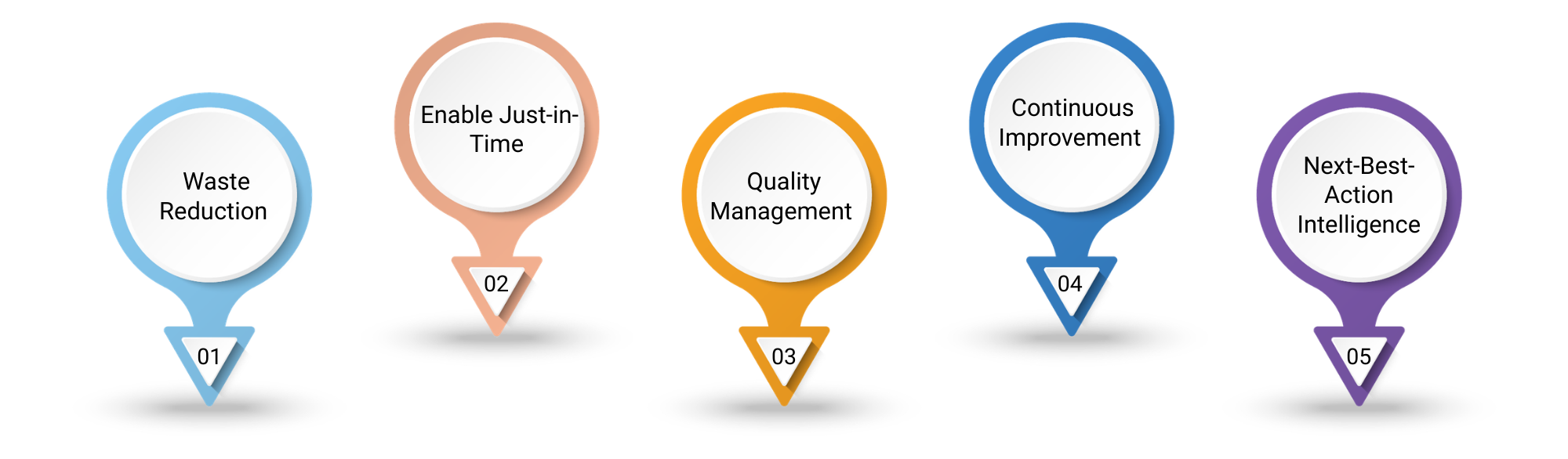
Waste Reduction Through Workflow Automation
The lean manufacturing process focuses on eliminating non-value-added activities like waiting time, redundant approvals, and manual coordination. Agentforce leverages Salesforce Flow and intelligent case orchestration to automate repetitive operational processes, from total productive maintenance to supplier communications. By analyzing process delays and routing tasks dynamically, it reduces motion waste, administrative bottlenecks, and ensures smoother production flow across teams.
Enabling Just-in-Time (JIT) with Demand Signals
Just-in-Time manufacturing depends on accurate demand forecasting and synchronized supply planning. Agentforce integrates Manufacturing Cloud forecasts, CRM demand signals, and supply chain data to recommend optimized production schedules. Using real-time data ingestion and predictive insights, it dynamically adjusts production plans when customer orders change or supply disruptions occur, preventing overproduction and excess inventory.
Strengthening Quality with Proactive Monitoring
Lean emphasizes detecting defects early in the process rather than correcting them later. Agentforce analyzes production, service, and quality data within Salesforce to identify anomalies before they escalate into costly defects. Through automated alerts, guided corrective actions, and compliance workflows, it supports first-pass improvement and reduces rework, scrap, and warranty claims.
Scaling Continuous Improvement (Kaizen)
Kaizen thrives on identifying patterns and continuously refining processes. Agentforce uses Salesforce analytics and AI-driven insights to surface recurring bottlenecks, downtime patterns, and performance deviations across plants. By consolidating operational metrics into real-time dashboards and recommending targeted improvements, it transforms Kaizen from isolated plant-level initiatives into enterprise-wide optimization.
Next-Best-Action Intelligence
Agentforce acts as a digital co-pilot for supervisors and operations leaders by summarizing operational data, highlighting risks, and recommending next actions within Salesforce interfaces. This reduces decision fatigue, accelerates response time during disruptions, and ensures lean principles are executed consistently across teams.
Conclusion
Lean manufacturing remains the gold standard for operational excellence. As it is built on waste elimination, continuous improvement, and delivering maximum customer value with minimal resources. Lean principles backed with real-time intelligence, connected data, and adaptive decision-making help to drive greater outcomes. Agentforce elevates the lean manufacturing process by enabling manufacturers to anticipate disruptions, optimize production, and scale continuous improvement. By combining lean discipline with Salesforce-powered intelligence, organizations can self-optimize operations.
Successfully deploying Agentforce requires expertise in Salesforce for seamless integration and a clear transformation roadmap. Kasmo partners with manufacturers to design and implement Agentforce within existing CRM/ERP ecosystems, ensuring secure data integration and measurable business outcomes. From identifying high-impact lean use cases to configuring intelligent workflows, our team accelerates adoption while minimizing operational disruption. With the right strategy and execution, manufacturers can transform lean practices into an intelligent operating model.