
Introduction
A promising enterprise account downloads a whitepaper, attends a webinar, and engages with multiple emails, which shows clear buying intent. Marketing sees strong engagement signals, but sales reach out days later without context, unaware of the prospect’s interests. The result is a delayed conversation, a disengaged buyer, and often a lost opportunity. This is due to a lack of b2b marketing and sales alignment, leading to missed signals and slower pipeline progression.
As B2B buying journeys grow longer and more complex, connecting marketing and sales teams becomes essential for revenue growth. Teams need shared visibility into account activity, lead qualification, and pipeline status to act at the right moment with the right message. Adopting Salesforce brings Marketing Cloud and Sales Cloud together, enabling seamless handoffs and coordinated engagement.
In this blog, we explore the differences between sales and marketing, why alignment is essential for B2B growth, and how Salesforce enables organizations to build a connected, revenue-driven strategy.
Why Sales and Marketing Alignment Is a Revenue Imperative
In B2B organizations, revenue growth depends on how effectively sales and marketing work together across the entire buyer journey. Today’s buyers interact with multiple touchpoints before ever speaking with a sales representative. Marketing plays a critical role in nurturing these buyers, while sales build on that engagement to convert interest into revenue. When these teams operate in silos, valuable context is lost, leads are not followed up on in a timely manner, and opportunities are slowed or disappear. B2B marketing and sales alignment ensures that both teams share the same goals, enabling faster responses, more relevant conversations, and higher conversion rates.
Alignment also improves efficiency and accountability across the revenue pipeline. Marketing can focus on generating high-quality, sales-ready leads, while sales can prioritize accounts with demonstrated intent. With shared metrics, coordinated outreach, and a unified platform, organizations gain clear visibility into which campaigns drive pipelines and revenue.
Core Functional Differences Between Sales and Marketing
Marketing
Builds Awareness and Generates Qualified Pipeline
Marketing is responsible for creating demand and attracting the right target accounts through digital campaigns, industry events, webinars, and content. In B2B, this often includes account-based marketing (ABM), where marketing engages multiple stakeholders within a company and nurtures them.
Nurtures and Qualifies Prospects
Marketing tracks engagement signals like content downloads, website visits, and email interactions to understand buyer interest. Using automation tools like Marketing Cloud, nurture prospects with relevant messaging and qualify them before passing them to sales. This ensures sales teams focus on high-intent opportunities.
Sales
Converts Qualified Leads
Sales teams take qualified leads and engage directly with decision-makers to understand business needs, present solutions, and move opportunities through the pipeline. In B2B environments, this involves managing long sales cycles, coordinating with multiple stakeholders, and demonstrating ROI.
Manages Relationships and Closes Deals
The sales process is responsible for building trust with prospects, handling negotiations, and guiding deals to closure. They maintain ongoing account relationships, identify expansion opportunities, and contribute directly to revenue generation and customer retention.
While marketing creates a pipeline and sales converts it, both teams share accountability for revenue outcomes. Marketing supports sales with targeted campaigns and insights, while sales provide feedback on lead quality and customer needs, helping refine future marketing strategies.
How Salesforce Unifies Sales and Marketing into One Revenue Platform
Lack of b2b marketing and sales alignment directly affects revenue goals. So, Salesforce solves this challenge by providing an integrated platform where Marketing Cloud and Sales Cloud operate on shared data, workflows, and intelligence. This unified approach ensures marketing can generate and nurture a qualified pipeline while sales can act on real-time engagement insights to convert opportunities faster.
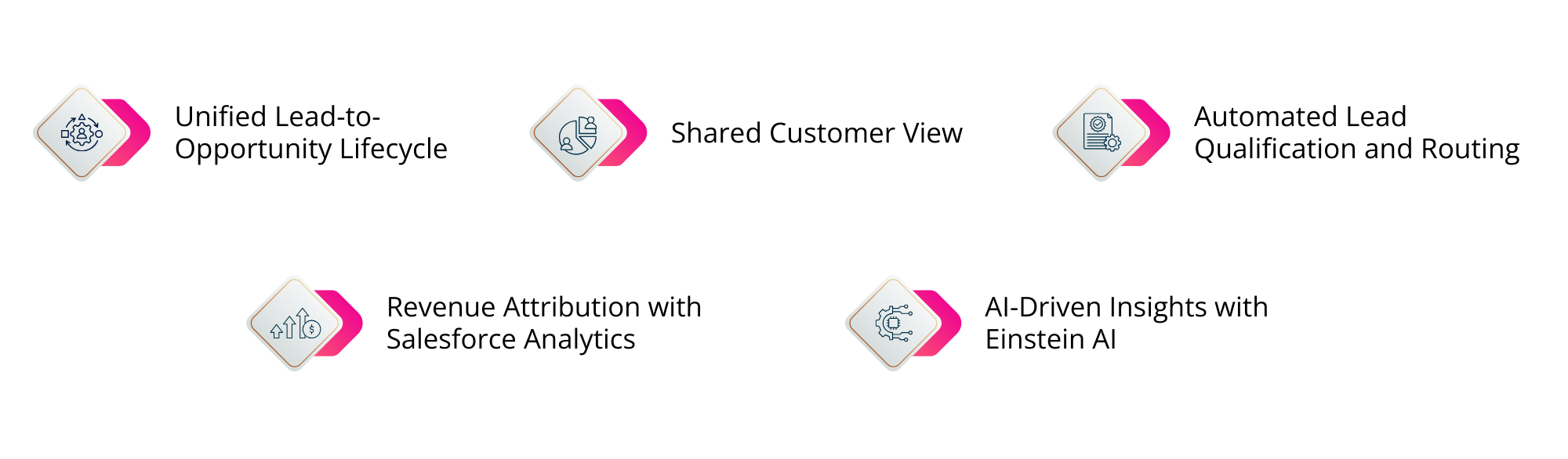
Unified Lead-to-Opportunity Lifecycle with Marketing Cloud and Sales Cloud
Salesforce connects Marketing Cloud engagement data into Sales Cloud CRM records, ensuring every lead generated through campaigns automatically flows into the sales pipeline. Marketing can nurture prospects until they meet qualification criteria, and once ready, sales teams receive complete visibility into engagement history. This b2b marketing and sales alignment allows for more informed outreach.
Shared Customer View Through Customer 360
Salesforce Customer 360 creates a single, unified profile of each account by combining marketing interactions, sales activities, and opportunity data. In B2B environments with multiple decision-makers, this allows both teams to track account-level engagement, understand stakeholder roles, and coordinate outreach strategies.
Automated Lead Qualification and Routing
Using Salesforce Account Engagement and Marketing Cloud automation, leads can be scored based on behavior, firmographics, and engagement levels. Once a lead reaches a predefined score or qualification threshold, Salesforce automatically assigns it to the appropriate sales representative in Sales Cloud, ensuring faster follow-up and reducing the risk of missed opportunities.
Revenue Attribution with Salesforce Analytics
Salesforce provides real-time analytics and reporting that connect marketing campaigns directly to pipeline and revenue outcomes. Marketing teams can see which campaigns generate qualified opportunities, while sales leaders gain visibility into conversion rates and deal progression, enabling more accurate forecasting and better investment decisions.
AI-Driven Insights with Einstein AI
Salesforce Einstein AI analyzes engagement patterns, opportunity data, and historical performance to recommend the best next actions for both marketing and sales. Marketing teams can identify high-value accounts to target, while sales teams receive predictive insights on deals, helping prioritize opportunities most likely to close and improve revenue efficiency.
Best Practices for Revenue-Driven Alignment with Salesforce
Define shared lead qualification criteria: Salesforce marketing automation establishes clear definitions for MQLs (Marketing Qualified Leads) and SQLs (Sales Qualified Leads) using lead scoring and engagement data. This ensures marketing delivers sales-ready leads, and sales focus on opportunities.
Connect campaign engagement to Sales Cloud: Sync Marketing Cloud campaigns with Sales Cloud opportunities, so sales teams can see prospect interactions, improving outreach timing and relevance.
Align both with shared account-based strategies: Use Salesforce marketing automation to target the same high-value accounts with coordinated campaigns and sales outreach. This ensures marketing builds engagement while sales advance conversations with the same stakeholders.
Standardize sales lifecycle stages: Configure consistent lifecycle stages in Salesforce so both teams track prospects using the same funnel definitions. This improves pipeline clarity and reduces gaps between marketing handoff and sales follow-up.
Create feedback loops: Use Salesforce reports and opportunity data to help marketing understand which campaigns generate real opportunities and which leads fail to convert, enabling continuous improvement.
Conclusion
Disconnected sales and marketing processes often result in lost pipeline visibility, slower conversions, and missed revenue opportunities. Salesforce enables this alignment by connecting Marketing Cloud and Sales Cloud on a shared data foundation, ensuring marketing engagement, lead qualification, and sales activities are fully synchronized. This unified visibility allows teams to identify high-intent accounts, engage prospects at the right time, and track the impact of campaigns on revenue.
As a Salesforce Summit Partner, Kasmo helps in effective b2b marketing and sales alignment by optimizing Sales Cloud and Marketing Cloud. From designing lead management frameworks and automated nurturing journeys to enabling pipeline visibility, AI-driven insights, and revenue attribution, Kasmo ensures seamless integration tailored to each client’s sales and marketing processes. This enables organizations to improve lead quality, accelerate conversions, and build a scalable foundation for long-term revenue growth.