
Introduction
The financial services industry is entering a period of rapid transformation as technology, regulation, and customer expectations evolve. Over the past decade, financial institutions have invested heavily in digital platforms, cloud infrastructure, and data modernization initiatives to remain competitive. But the next wave of innovation is being shaped by advances in intelligent data platforms and Agentic AI. As institutions continue to modernize their technology stacks, the ability to harness data effectively and deploy AI-driven capabilities is becoming a defining factor.
Looking ahead to fintech predictions 2026, the industry is expected to lean towards intelligent, data-driven financial ecosystems. Organizations are beginning to shift from experimentation with AI agents to embedding intelligent systems across omnichannel banking experience, risk, compliance, and customer experience workflows. In this blog, we explore the key predictions shaping the financial services industry in 2026 and how emerging technologies are redefining the future of fintech.
Evolution of Financial Services
Over the past few years, banks, fintech companies, and financial institutions have accelerated their adoption of technologies, including AI, cloud-based data platforms, and open banking frameworks. These innovations have enabled organizations to modernize legacy systems, streamline operations, and deliver more digital-first experiences for customers. At the same time, rising regulatory complexity, cybersecurity risks, and evolving customer expectations are pushing financial institutions to rethink how they operate, compete, and innovate in an increasingly digital financial ecosystem.
As financial organizations strengthen their data and AI capabilities, the industry is moving toward a more intelligent and connected model of financial services. These advancements are not only transforming internal operations but also redefining how financial services are delivered across digital platforms and ecosystems. Fintech predictions 2026 are shaped by several factors.
Key Expected Fintech Predictions 2026
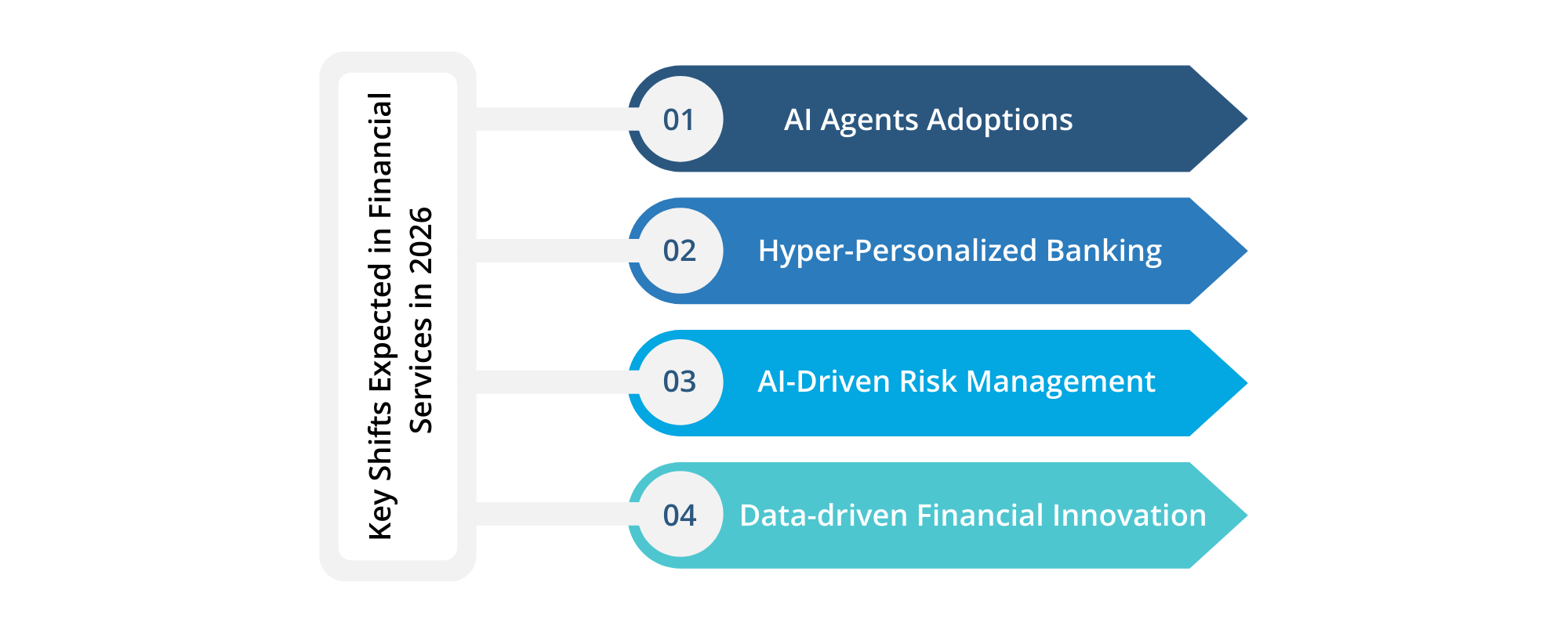
AI Agents Will Transform Core Banking Operations
In 2026, AI in financial services will shift from isolated pilots and experimentation to becoming a core operational capability. Financial institutions will increasingly deploy AI agents that can analyze data, reason across complex financial scenarios, and execute multi-step workflows. AI for fraud detection, risk analysis, loan underwriting, and compliance monitoring. AI systems help to assist in decision-making and automate operational processes, enabling faster responses to market changes and regulatory requirements.
According to McKinsey research, agentic AI has the potential to generate $450 billion to $650 billion in additional annual revenue by 2030, representing a 5 to 10 percent revenue uplift in advanced industries.
As AI agents become embedded within financial platforms, they will transform how institutions manage day-to-day operations. Fintech companies will rely on these intelligent systems to monitor transactions in real time, detect anomalies, generate reports, and support analysts with contextual insights. This shift will allow organizations to reduce manual effort, improve accuracy in financial decision-making, and operate with better speed and efficiency. This makes a clear transition from AI as an experimental technology to AI as the operational backbone of modern financial services.
Hyper-Personalized Banking Will Become the New Standard
Financial institutions are rapidly moving toward hyper-personalized omnichannel banking experiences powered by advanced analytics and behavioral data. Instead of offering generic financial products, banks and fintech companies aim to deliver personalized services, offers, and financial advice. By 2026, personalization will extend across the entire customer journey, including onboarding, product recommendations, wealth management, and lending decisions.
Fintech platforms are playing a major role in accelerating this shift. Through AI-driven insights and real-time data processing, financial institutions can predict customer needs and deliver recommendations. For example, best suitable savings plans, investment opportunities, or credit options at the right moment. This personalization improves customer engagement while strengthening trust and long-term loyalty. As digital-native consumers increasingly expect seamless and tailored financial experiences, hyper-personalization will become a key differentiator for financial institutions competing in a fintech ecosystem.
AI Risk Management Will Evolve Toward Operational Robustness
Risk management has always been a fundamental responsibility for financial institutions, but the rapid adoption of AI and automation is introducing a new category of operational risk. As AI models and intelligent agents begin supporting high-value financial processes like fraud detection, credit decisions, trading insights, and compliance monitoring, institutions must ensure that these systems operate with reliability, transparency, and regulatory accountability. The focus is now on how AI systems are governed, monitored, and integrated into financial operations.
In 2026, financial organizations for AI risk management require stronger data governance frameworks, improved data context through metadata management, and a standardized semantic model. Institutions will also invest in deeper observability and data lineage capabilities to track how data flows into AI models and how decisions are generated. With regulators increasing scrutiny on AI-driven systems, organizations will prioritize resilient data architectures that support traceability, secure access to external market data, and continuous monitoring of AI performance. These capabilities will allow financial institutions to deploy AI at scale while maintaining operational stability, regulatory compliance, and long-term trust in intelligent financial systems.
Fintech Predictions 2026 – Data for Innovation
As financial institutions adopt AI, automation, and advanced analytics, the ability to manage and effectively use large volumes of data is becoming critical. Banks, insurance companies, and fintech organizations generate enormous amounts of structured and unstructured data from transactions, trading systems, customer interactions, and regulatory processes. As the data remains siloed across different systems, it limits the potential to drive innovation and decision-making.
By 2026, financial organizations will increasingly invest in modern cloud data platforms that unify enterprise data, support real-time analytics, and enable AI-driven insights. These platforms provide a centralized foundation where institutions can analyze risk, detect fraud, optimize trading strategies, and personalize financial services at scale. In the fintech ecosystem, data platforms also enable stronger collaboration between banks and partners by providing secure data sharing and governance frameworks.

Snowflake Role in Building Future-Ready Financial Services
To successfully adopt these emerging trends, financial institutions need a strong data and AI foundation. Snowflake’s AI Data Cloud for Financial Services becomes a critical enabler. It provides a unified platform where organizations can consolidate structured and unstructured financial data, run advanced analytics, and deploy AI-powered applications without moving data. With built-in capabilities for secure data sharing and governance, Snowflake allows financial institutions to break down data silos and create a single, trusted foundation for innovation.
Beyond data consolidation, Snowflake enables financial organizations to operationalize AI for fraud detection, risk management, regulatory compliance, and personalized customer engagement. Snowflake Intelligence and Cortex AI services enable Agentic AI and also allow to interact with enterprise data using natural language, automate analytical workflows, and generate real-time insights directly within the data platform. By enabling secure collaboration with partners, integrating external market data, and supporting enterprise-scale AI deployment, Snowflake helps financial institutions build resilient, data-driven ecosystems that drive exponential growth.
Conclusion
In 2026, financial institutions are entering a new era defined by intelligent automation, resilient risk management, and data-driven innovation. AI agents will increasingly power operational workflows, and advanced analytics will enable highly personalized financial services. To successfully navigate these changes, financial institutions need to adopt scalable, AI-ready data foundations. Snowflake capabilities for Financial Services enable this transformation with unified enterprise data, supporting secure collaboration and intelligent insights.
As a Snowflake Elite Partner, Kasmo helps financial institutions design and deploy scalable data and AI solutions that support next-generation financial services. Our expert teams help in implementing unified data foundations and industry-specific intelligence solutions. By combining deep domain expertise in financial services, Kasmo enables enterprises to accelerate innovation and transition toward an AI-driven financial future.