Introduction
In life sciences, a single breakthrough can take over a decade to reach the market. The amount of time it takes to move a therapy from research and discovery through preclinical testing, clinical trials, regulatory review, and final approval is 10 to 15 years on average. During this long cycle, organizations generate enormous volumes of clinical, genomic, laboratory, and real-world data. In an era where speed can mean saving lives, fragmented data is no longer sustainable.
To accelerate discovery and improve outcomes, life sciences organizations need a unified, intelligent data foundation. This is where Snowflake stands out. By enabling secure data integration, governed collaboration, and scalable analytics, Snowflake empowers teams with a single source of truth. Instead of spending years navigating data silos, organizations can focus on faster experimentation, smarter trials, and more efficient development pipelines.
In this blog, we explore how Snowflake helps organizations break down data silos and accelerate AI in life sciences.
Why Snowflake Is the Foundation for the Future of Life Sciences Innovation
Life sciences innovation depends on the ability to bring together massive volumes of clinical, genomic, real-world, and operational data. As research teams often rely on separate platforms for clinical trials, laboratory data, patient registries, and regulatory documentation, it is difficult to gain unified insights. This fragmentation slows drug discovery, delays clinical research data analysis, and slows new scientific findings.
Snowflake provides a scalable foundation through its AI Data Cloud, designed to centralize structured and unstructured. It allows pharmaceutical, biotechnology, and medical device companies to securely integrate diverse data sources. This unified data layer eliminates silos and ensures researchers, data scientists, and regulatory teams can access consistent, trusted data in real time, improving decision-making across the entire development lifecycle.
Breaking Down Data Silos Across Research and Clinical Systems
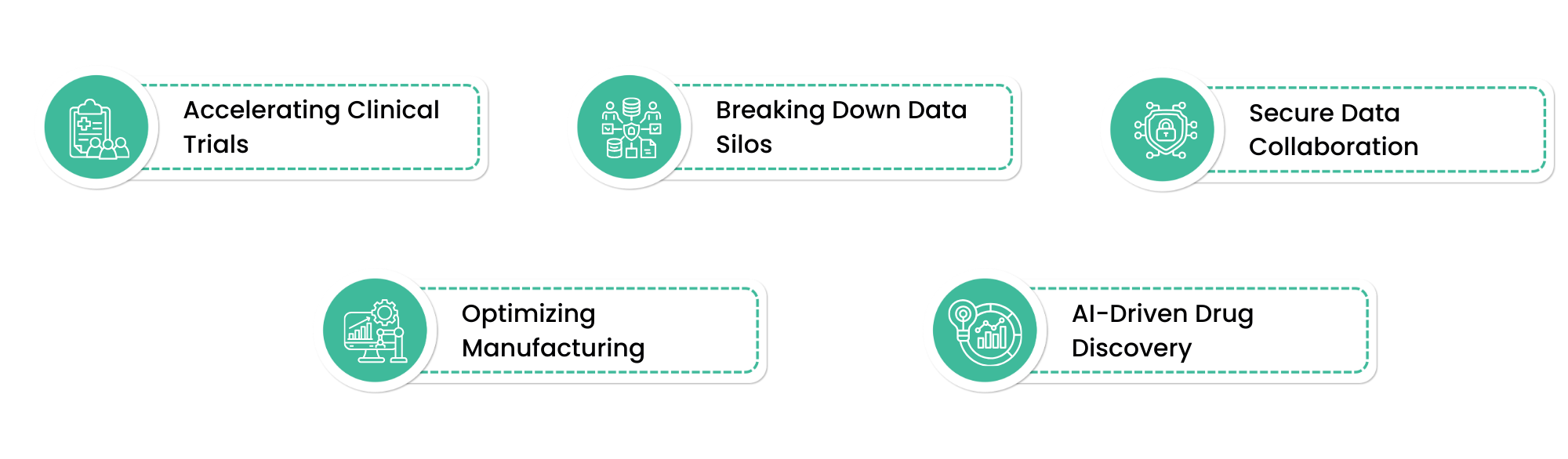
Life sciences organizations generate vast amounts of data across research laboratories, clinical trials, manufacturing systems, and real-world patient sources. This data is often stored in disconnected platforms like clinical trial management systems (CTMS), electronic data capture (EDC) tools, laboratory information management systems (LIMS), and electronic health records (EHRs). For example, a clinical operations team may not have immediate access to lab results stored in a separate system, delaying safety monitoring or trial adjustments.
Snowflake helps break down these silos by providing a centralized data platform from multiple research and clinical sources that can be integrated without complex migrations. Instead of moving data repeatedly between systems, organizations can connect and unify it within a single- governed environment. This ensures that researchers work from the same trusted data. By creating a single source of truth, life sciences organizations can accelerate clinical trial analysis, identify trends faster, and improve cross-functional collaboration.
Accelerating Clinical Trials with Connected Data
Clinical trials generate massive volumes of data across electronic data capture (EDC) systems, laboratory information systems, imaging platforms, wearable devices, and patient-reported outcomes. When this data remains fragmented or delayed, sponsors struggle to monitor trial progress, identify safety signals, and make timely protocol adjustments. Snowflake addresses this challenge of real-time ingestion and centralized access to trial data from multiple sources. AI in life sciences allows clinical teams to monitor enrollment and patient outcomes continuously. Faster visibility into trial metrics helps sponsors identify issues early, reduce delays, and accelerate time-to-submission.
Snowflake also supports scalable analytics and secure sharing, enabling contract research organizations (CROs) and research partners to collaborate. Advanced analytics and AI in life sciences can be applied directly to live datasets to detect anomalies, predict patient drop-off risks, and optimize site selection. With connected, real-time data pipelines, life sciences organizations can shorten trial cycles, improve data integrity, and accelerate the delivery of new therapies to patients.
Secure Data Collaboration Across the Life Sciences
Life sciences innovation depends on collaboration between pharmaceutical companies, biotech firms, research institutions, healthcare providers, and regulators. But strict privacy regulations and data security concerns often make sharing sensitive clinical research data analysis complex and slow. Snowflake enables secure, governed data sharing without copying or moving data. This ensures sensitive patient and research data remain protected while still being accessible to authorized stakeholders.
With role-based access controls, dynamic data masking, and secure data sharing, Snowflake allows organizations to collaborate with external partners in real time. Researchers can access shared datasets instantly, accelerate biomarker discovery, and validate findings across larger populations. This secure collaboration model reduces operational friction, improves research accuracy, and enables faster scientific breakthroughs.
AI in Life Sciences for Drug Discovery and Advanced Analytics
AI-driven drug discovery depends on access to large, diverse, and high-quality datasets, including genomic sequences, molecular structures, clinical outcomes, and real-world evidence. Traditionally, preparing this data for AI models requires extensive extraction, transformation, and manual preprocessing, which slows innovation. With Snowflake, life sciences teams can securely centralize and prepare multimodal datasets in a single environment. This eliminates delays, improves clinical data analysis, and ensures models are trained on complete, reliable datasets.
Snowflake’s scalable compute and native support for AI and data science workflows allow researchers to run complex analyses, like biomarker identification, patient cohort selection, and predictive modeling, without moving data across systems. Teams can collaborate on the same datasets in real time, accelerating hypothesis testing and insights-driven research.
Optimizing Manufacturing and Supply Chain
Pharmaceutical manufacturing and supply chains are highly complex, involving raw material sourcing, batch production, quality testing, cold-chain logistics, and global distribution. Data from manufacturing execution systems (MES), enterprise resource planning (ERP), quality systems, and logistics platforms are often fragmented, making it difficult to monitor production performance or predict disruptions. Snowflake’s AI data cloud enables organizations to unify operational, quality, and supply chain data into a single platform, providing real-time visibility into production processes, inventory levels, and supplier performance.
With this unified data foundation, manufacturers can apply analytics and AI to predict equipment failures, optimize production schedules, and proactively manage supply risks. For example, teams can identify quality deviations earlier, track batch performance across facilities, and ensure regulatory compliance with a complete audit. This improves manufacturing efficiency and reduces downtime.
Conclusion
The future of life sciences innovation depends on a unified, AI-ready data foundation that can securely connect research, clinical, and commercial ecosystems. Snowflake enables AI Data Cloud, secure data sharing, governed data collaboration, and scalable compute architecture. With capabilities like data clean rooms, native AI/ML integration, cross-cloud data replication, and robust role-based access controls, Snowflake provides the framework life sciences organizations need to accelerate drug discovery, streamline clinical trials, insights-driven research, and ensure regulatory compliance.
At Kasmo, we help life sciences organizations design and adopt advanced Snowflake solutions. From data architecture design and platform implementation to AI enablement and governed data sharing strategies, our experts ensure seamless deployment aligned with regulatory requirements. With deep domain expertise and a focus on scalable, compliant solutions, Kasmo partners with organizations to enable Snowflake and drive sustainable innovation across the life sciences ecosystem.