
Introduction
Imagine a shopper browsing an online store and instantly receiving product recommendations relevant to their style, budget, and past purchases. At the same time, the retailer systems automatically adjust inventory levels, predict demand for trending items, and ensure faster delivery. This is not a future vision; it represents the direction in which modern retail is rapidly evolving.
Retailers today are navigating a complex environment shaped by shifting consumer expectations, economic pressures, sustainability demands, and rapid technological innovation. From hyper-personalized cx to agentic shopping, several transformative trends are redefining how retail businesses operate and compete. In this blog, we explore the top trends in retail shaping 2026 and how retailers can prepare ahead.
Key Forces Influencing the Retail Industry
Before exploring the upcoming trends, it is important to understand the broader forces influencing automation in the retail landscape today.
Rising Customer Expectations: Consumers now expect faster delivery, personalized experiences, and consistent interactions across every touchpoint.
Cost Pressures and Margin Challenges: Retailers are managing rising operational costs, fluctuating demand patterns, and pricing pressures that require smarter inventory and pricing strategies.
Technology Adoption: Retailers are increasingly investing in automation and AI agents, analytics, and cloud platforms to improve efficiency, optimize customer engagement, and gain deeper insights into consumer behavior.
Economic and Pricing Pressures: Inflation and cost sensitivity are driving consumers to prioritize value when making purchasing decisions.
Rise of Data-driven Commerce: Retail decisions are increasingly powered by real-time data insights and predictive analytics.
Top Trends in Retail Shaping the Industry in 2026
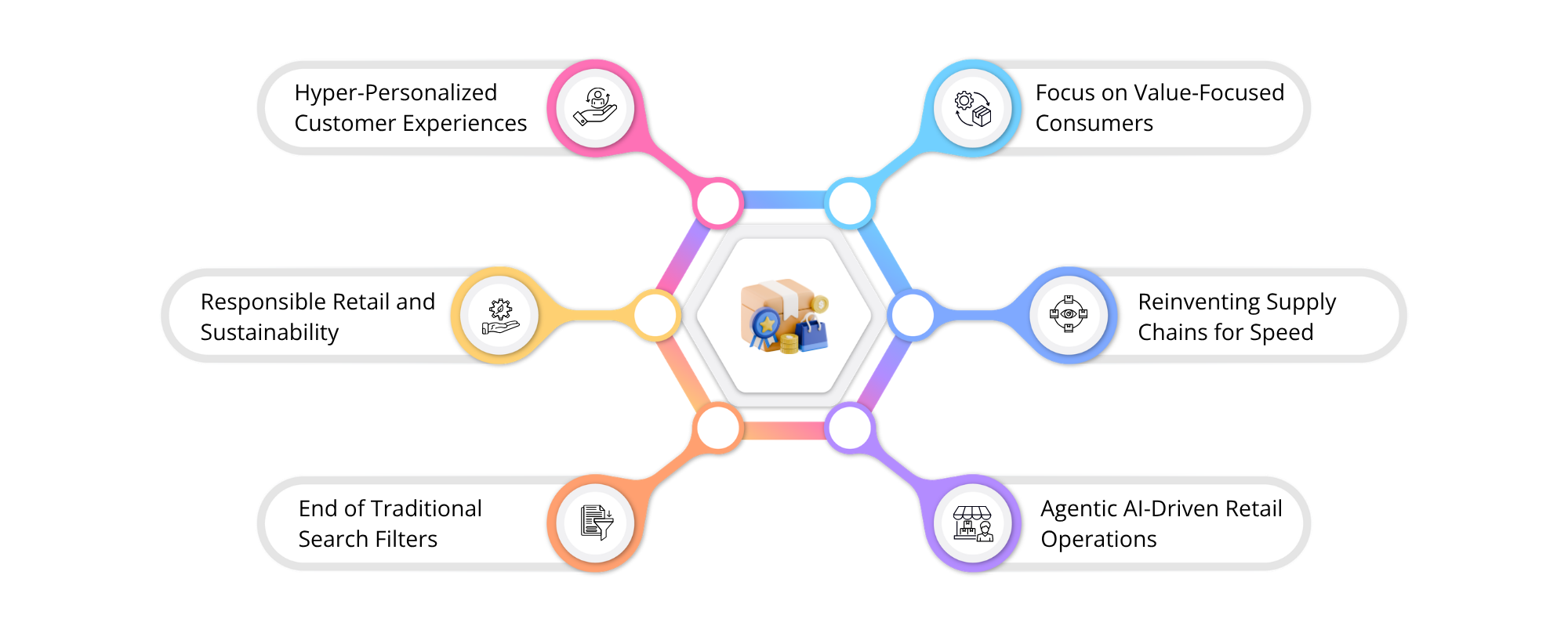
Hyper-Personalized Customer Experiences
Retail in 2026 will be defined by the ability to deliver highly personalized customer experiences across digital and physical channels. Advances in AI and customer data platforms are enabling retailers to understand individual shopping behaviors. Retailers can now use this intelligence to tailor product recommendations, dynamic pricing, targeted promotions, and marketing campaigns across channels. Deloitte research indicates that nearly 67% of retail executives expect to implement AI-driven personalization capabilities, allowing brands to deliver tailored experiences.
Beyond marketing, hyper-personalization will influence the entire retail journey, starting from discovery to post-purchase engagement. Retailers are deploying technologies like virtual shopping assistants and personalized loyalty programs that evolve based on customer behavior. This creates meaningful, contextual customer interactions that increase customer satisfaction and build long-term loyalty.
Focus on Value-Focused Consumers
Economic uncertainty and shifting consumer priorities are making shoppers more intentional about how they spend. Today’s consumers are carefully evaluating purchases, comparing options, and prioritizing products that offer the best balance of price, quality, and convenience. Deloitte Research shows that four in ten consumers now identify as deal-driven or cost-conscious. As a result, retailers are placing greater emphasis on delivering clear value through competitive pricing, strong product quality, and attractive loyalty programs.
Value is no longer defined by price alone. Convenience, product availability, customer service, and flexible shopping options also play an important role in shaping consumer perception of value. Retailers that can combine affordability with convenience will be better equipped to attract cost-conscious shoppers while maintaining brand loyalty.
Responsible Retail and Sustainability
Sustainability is becoming an essential part of retail strategy as consumers increasingly expect brands to operate responsibly. Retailers are being asked to provide greater transparency around sourcing practices, manufacturing processes, and environmental impact. This shift is pushing companies to adopt more sustainable materials, reduce packaging waste, and improve supply chain accountability.
Responsible change in retail also includes initiatives like circular commerce, resale programs, and product recycling. Integrating sustainability into both operations and product strategies helps retailers build stronger customer trust.
Reinventing Supply Chains for Speed
Global disruptions, geopolitical changes, and increasing logistics costs are pushing retailers to rethink traditional supply chain models. According to Deloitte, nearly 95% of retail executives expect rising global trade pressures to increase costs, prompting organizations to redesign supply networks.
To address these challenges, retailers are investing in technology-driven supply chains that provide real-time visibility into inventory, logistics, and demand patterns. AI-powered forecasting, predictive inventory management, and automation help organizations optimize stock levels. Strategies like nearshoring, supplier diversification, and data-driven demand planning help to build agile supply chains. This is one of the top trends in retail that will strengthen supply chain workflows.
End of Traditional Search Filters
The way consumers discover products is rapidly evolving beyond traditional keyword-based search and manual filters. With the rise of Agentic shopping, conversational models, etc., shoppers increasingly rely on AI-powered assistants to discover products and receive curated suggestions. These tools allow consumers to interact in natural language rather than navigating complex product filters.
Instead of browsing through hundreds of product listings, shoppers can receive curated suggestions based on preferences, past purchases, and real-time intent signals. This shift marks a transition from search-based automation in retail to AI-guided discovery, fundamentally changing how customers interact with digital storefronts.
Agentic AI-Driven Retail Operations
Retail operations are becoming increasingly complex as companies manage multiple sales channels, dynamic pricing, and rapidly changing consumer demand. Agentic AI introduces a new level of automation by enabling systems that can analyze data, make decisions, and take actions with minimal human intervention. Deloitte forecasts suggest that 68% of retailers expect to deploy agentic AI capabilities within the next 2 years, reflecting the growing importance of automation and AI systems in retail operations.
For retailers, this means operational processes like inventory replenishment, demand forecasting, and fraud detection can be managed with intelligence and automation. Agentforce continuously analyzes large volumes of retail data, identifies patterns, and triggers actions in real time. These capabilities help retailers respond more quickly to shifts in customer demand and streamline operational workflows.
How Salesforce Supports Retailers in Innovation
Salesforce enables retailers to bring together customer, commerce, and operational data into a single connected platform, allowing organizations to gain deeper insights into customer behavior and market trends. With solutions like Data Cloud, Commerce Cloud, and Marketing Cloud, retailers can create personalized shopping experiences, deliver targeted promotions, and build stronger customer relationships.
Beyond customer engagement, Salesforce also helps retailers modernize operations with AI-driven capabilities. Through Agentforce and Einstein AI, retailers can deploy intelligent agents that assist with demand forecasting, inventory optimization, customer service automation, and more. These capabilities allow organizations to respond faster to market shifts, improve operational efficiency, and gain new opportunities. Salesforce empowers retailers to build agile, customer-centric business models to support long-term growth.
Conclusion
As retail continues to evolve, organizations must rethink how they engage customers, manage operations, and deliver value in a rapidly changing market. To keep up with the change in retail, brands must adopt technologies that connect data across the enterprise and enable faster, smarter decision-making. Salesforce helps in this transformation by providing a unified ecosystem that supports customer engagement, operational intelligence, and innovation.
As a Salesforce Summit partner, PROLIM helps retailers translate these emerging trends into practical solutions with effective implementation. Our experts support organizations in building scalable, data-driven systems to improve efficiency and position retailers for sustainable growth.