
Introduction
Generative AI is projected to grow faster in healthcare than in any other sector. BCG analysis shows that the GenAI market in healthcare will grow at a compound annual rate of 85%—from $1 billion today to $22 billion by 2027.
For decades, pharmaceutical innovation has been constrained by fragmented data, lengthy experimentation cycles, and high failure rates. Today, the convergence of massive biomedical datasets and generative AI is redefining how new therapies are identified, validated, and brought to market. What once took years of manual analysis can now be accelerated through AI-driven insights.
GenAI in drug discovery requires a scalable, secure, and governed data platform for supporting advanced AI workloads. Snowflake enables pharmaceuticals with the unified data foundation needed to power AI-driven drug discovery. In this blog, we explore how GenAI is transforming drug discovery and how Snowflake makes it possible.
The Evolution of Drug Discovery in the Age of AI
Drug discovery has traditionally been a slow, expensive, and highly uncertain process. From target identification to clinical validation, the journey of bringing a new drug to the market can take more than a decade and cost billions of dollars, with high failure rates along the way. Conventional approaches rely heavily on trial-and-error experimentation, limited screening libraries, and linear research workflows. As diseases become more complex and data volumes grow exponentially, traditional methods do not meet the requirements and precision needed for modern pharmaceutical research.
Artificial intelligence is providing a transformative approach to how scientific insights are generated and applied. AI enables researchers to analyze massive volumes of biological, chemical, and clinical data to discover patterns and relationships. Machine learning models can predict protein structures, identify promising drug targets, and assess compound efficacy to improve the discovery process.
The evolution has accelerated further with the emergence of generative and evolutionary AI models. Instead of merely screening existing molecules, these models can design entirely new compounds optimized for specific therapeutic goals. Gen AI systems can continuously learn from experimental outcomes and refine their predictions, recommendations, and improve accuracy with each iteration. As a result, drug discovery is accelerating and increasing the likelihood of delivering effective therapies to patients.
How GenAI Transforms the Drug Discovery Lifecycle
GenAI using large language models is enhancing the drug development process by introducing intelligence, speed, and adaptability at every stage. In the pharmaceutical sector, where timelines are long and failure rates are high, GenAI enables a shift from sequential, experiment-heavy workflows to predictive and design-driven discovery. GenAI can learn from vast biomedical datasets to help scientists make more informed decisions earlier and reduce risk.
Accelerated Target Identification and Validation
GenAI analyzes genomics, proteomics, disease pathways, and drug target interactions. In pharma research, it is essential to understand complex diseases like cancer, neurodegenerative disorders, and other rare diseases. By modeling biological interactions and predicting target relevance, GenAI helps researchers prioritize targets with a high probability of success.
Molecule Design and Optimization
GenAI can generate new molecular structures to specific therapeutic goals, while the traditional screening method tests only the existing compound libraries. In drug discovery, this enables the design of molecules optimized for selectivity, safety, and other attributes. Pharma teams can rapidly iterate molecular designs and identify promising lead compounds faster than manual or rule-based approaches.
Lead Prioritization and Preclinical Decision-Making
GenAI integrates chemical data, biological responses, and experimental results to rank and refine candidates. Pharma researchers can focus resources on the most viable compounds while discontinuing weaker ones earlier. This data-driven prioritization improves R&D productivity and ensures that investments are directed toward candidates with the highest therapeutic and commercial potential.
Clinical Trials
In the clinical trial stage, GenAI supports smarter trial design, faster patient recruitment, and more adaptive execution. It helps pharmaceutical companies in analyzing historical trial data and patient records to identify optimal trial protocols, inclusion criteria, and success rates. During trials, GenAI monitors patient responses, adverse events, and protocol deviations in near real time, enabling faster adjustments and risk mitigation. This approach improves trial efficiency, enhances patient safety, and controls costs.
Continuous Learning Across the Discovery Pipeline
GenAI systems continuously learn from experimental outcomes, clinical insights, and real-world data. In pharmaceutical research, this creates a feedback loop where models improve over time, adapt to new findings, and evolve scientific understanding. This continuous learning capability enables organizations to build institutional intelligence, accelerate future discovery programs, and strengthen long-term innovation pipelines.

Why Data Foundation Matters for GenAI in Drug Discovery
A strong data foundation is the core requirement for applying GenAI in drug discovery because AI models need to be trained based on accurate data sets. Drug discovery relies on highly complex, diverse, and sensitive data sources, including molecular structures, genomic data, clinical outcomes, and more. When this data is fragmented across systems or poorly governed, it affects GenAI’s performance and productivity. A unified, high-quality data foundation ensures consistency, traceability, and contextual understanding, enabling GenAI models to accurately predict targets, optimize compounds, and reduce false positives early in the discovery pipeline.
Key Reasons a Strong Data Foundation Is Essential
- Drug discovery includes both structured and unstructured data. This requires a unified data foundation to enable GenAI to identify deeper scientific insights.
- Clean, standardized, and validated datasets reduce noise and bias in GenAI outputs, improving prediction accuracy for target identification, compound efficacy, and toxicity risks.
- As experimental data grows exponentially, a scalable data foundation allows GenAI models to process large datasets efficiently without performance bottlenecks.
- Pharmaceutical data is highly regulated. A strong data foundation enforces access controls, auditability, and data lineage, ensuring GenAI adoption aligns with regulatory and IP protection requirements.
- Centralized data enables cross-functional teams to work from a single source of truth, accelerating experimentation, reducing duplication, and shortening drug discovery timelines.
Snowflake as the Data Backbone for GenAI-Powered Drug Discovery
GenAI in drug discovery relies on massive volumes of diverse data, ranging from genomic sequences and molecular structures to clinical trial results and scientific literature. Snowflake provides a unified AI Data Cloud that brings all these data types together, enabling pharmaceutical and biotech companies to operationalize GenAI securely. It eliminates data silos and simplifies AI deployment, which advances the drug discovery process.
Key Snowflake Capabilities Powering GenAI in Drug Discovery
Data Platform for Clinical Data
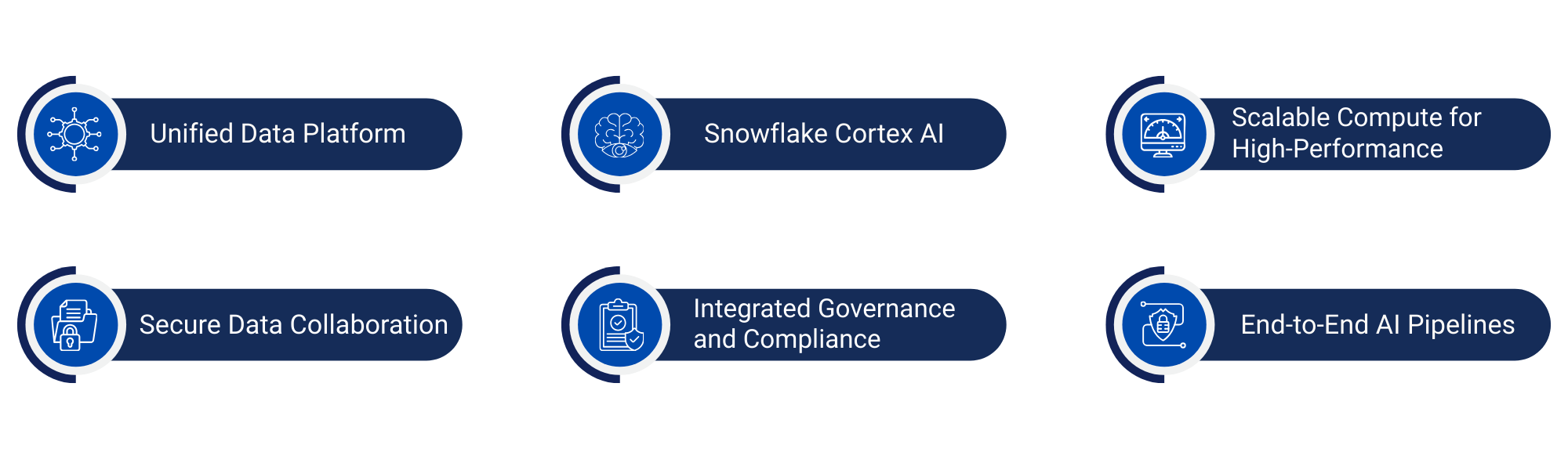
Snowflake enables seamless ingestion and storage of structured and unstructured data, consisting of genomics data, lab results, PDFs, research papers, and more. The unified view is effective for GenAI models that need a broad scientific context to generate accurate insights.
Snowflake Cortex AI
With Snowflake Cortex AI, teams can run LLM-powered analytics, inference, and AI-driven reasoning directly where the data lives. This allows researchers to apply GenAI for tasks like target identification, molecule prioritization, and report summarization without moving sensitive data outside the platform.
Scalable Compute for High-Performance
Snowflake’s separation of storage and compute allows organizations to scale GenAI experiments, simulations, and model inference independently. Drug discovery workloads can rapidly expand during peak research cycles without impacting analytical or operational systems.
Secure Data Collaboration
Drug discovery often involves collaboration between pharma companies, CROs, research institutions, and biotech partners. Snowflake Secure Data Sharing enables governed, real-time data collaboration without copying data, ensuring IP protection, regulatory compliance, and faster innovation.
Integrated Governance and Compliance
With built-in security, role-based access control, data masking, and auditing, Snowflake ensures GenAI initiatives comply with regulatory standards such as GxP, HIPAA, and GDPR. This is essential when working with sensitive patient data and proprietary research.
End-to-End AI Pipelines
Snowflake integrates with Python, ML frameworks, and external AI tools, enabling end-to-end pipelines from data ingestion and feature engineering to GenAI model deployment. This supports continuous learning and iteration across the drug discovery lifecycle.
Conclusion
Drug discovery has entered a new phase where generative AI augments scientific expertise at every stage of development. GenAI helps healthcare organizations to accelerate target identification, optimize molecular design, improve clinical trial efficiency, and gain insights to improve success rates. Snowflake enables pharmaceutical and biotech companies to operationalize GenAI across the entire drug discovery lifecycle by bringing data, AI, and governance together in one environment, turning scientific complexity into actionable intelligence.
Kasmo helps life sciences organizations translate this GenAI potential into real-world outcomes with Snowflake. As a true-blue Snowflake implementation partner, Kasmo supports end-to-end enablement. Our teams help with data modernization and pipeline design for Cortex AI adoption and GenAI integration. With compliant and scalable architectures tailored for drug discovery workloads, we ensure secure collaboration across research and accelerate time-to-value for AI-driven initiatives.