
Introduction
AI agents aren’t just another tech trend; they’re becoming a real competitive edge. According to a survey conducted by PWC, 73% of respondents agree that how they use AI agents will give them a significant competitive advantage in the next 12 months, and 75% express confidence in their company’s AI-agent strategy. This signals a fundamental shift in how enterprises expect autonomous AI agents to operate.
As business models evolve and operational complexity increases, enterprises are moving beyond dashboards and rule-based automation. They’re turning to Agentic AI that can understand context and take actions with minimal human intervention. These agents bridge the gap between speed and scale, making it possible for companies to operate with higher efficiency. But, central to this transformation is one critical question: How human should AI agents really be?
The Rise of Agentic AI: Why Autonomous Agents Are Redefining Enterprise Work?
Agentic AI represents the next major leap in enterprise automation, moving beyond traditional AI that does not act. These autonomous AI agents are capable of understanding goals, breaking them into tasks, making decisions, and executing workflows without needing constant human direction. In enterprises where complexity, speed, and scale matter, Agentic AI is reshaping how organizations operate, innovate, and compete.
What makes these agents different is their ability to communicate naturally with users. They process questions, understand context, and respond in conversational language, making complex systems feel surprisingly approachable. But despite this human-like interaction, the goal isn’t to mimic people; it’s to enhance productivity. Overly humanized agents can lead to unrealistic expectations; on the other hand, reliable AI agents build trust.
Why Is This Shift Significant?
For decades, businesses relied on rule-based automation and predictive analytics. These systems were useful, but rigid, reactive, and limited in scope. They couldn’t adapt when processes changed, exceptions occurred, or decision-making was required.
Agentic AI changes that paradigm. Instead of waiting for instructions, AI agents can interpret intent, analyze data in real time, and make decisions. They don’t just flag issues; they resolve them. They don’t depend on perfect inputs, but they learn from messy, shifting environments. Agentic AI manage workflows end-to-end, adjusting as new conditions arise, which makes them far more resilient and scalable than earlier forms of automation.
What Autonomous AI Agents Actually Need to Become Effective?
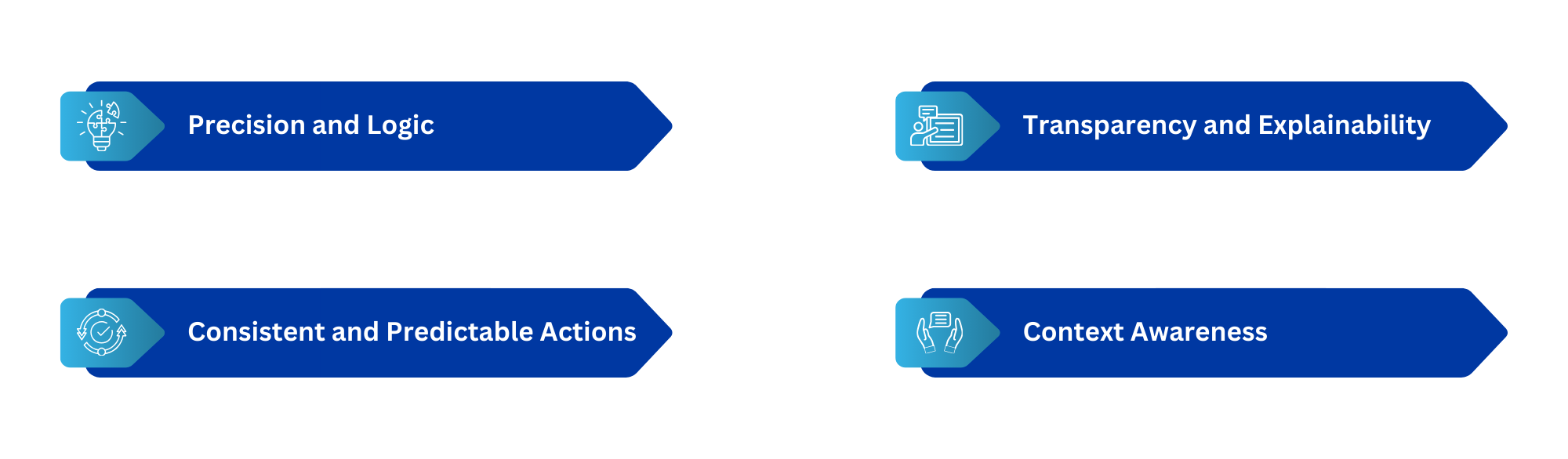
Precision and Logic Over Personality
When businesses deploy autonomous AI agents, the priority is accuracy. Enterprise decisions involve compliance, financial risk, data sensitivity, and operational dependencies. An AI agent that focuses on being conversational or emotionally expressive can distract from what matters most. Effective agents rely on clear reasoning, structured workflows, and consistent logic. They analyze data and perform actions without adding unnecessary human-like embellishments. This results in faster decisions, reduces errors, and leads to effective outcomes.
Transparency and Explainability
Transparency is essential in every automated action. Users need to understand why an AI agent approved a request, flagged an issue, triggered a workflow, or escalated an anomaly. If an AI agent behaves too humanly, it can create ambiguity and reduce users’ trust. Instead, autonomous agents should provide a clear explanation of what data was used, the reasoning path followed, and the rules or policies applied. This transparency and balance of human intelligence and artificial intelligence ensure governance, compliance, and collaboration.
Consistent and Predictable Actions
Trust in AI is built on reliability and consistency. Whether an agent processes invoices, replies to customers, or manages operations, users expect it to behave the same way every time. Human-like interactions, like humor, emotional phrasing, or tone variations, make the system feel unpredictable. AI agents work best when they deliver stable outputs and align with business rules.
Context Awareness
AI agents should clearly understand context, like business intent, user instructions, and operational constraints. But they don’t need emotional mimicry or personality traits to do this effectively. The goal is intelligent responsiveness, not human imitation. For example, prioritizing customer cases is based on severity or identifying dependencies before acting. Contextual intelligence ensures that actions are grounded in business logic, not simulated emotions.
Where Human-Like Interactions Do Help?
Human-like interactions can enhance the usability and adoption of AI agents when applied in the right way. The value does not come from making an agent behave like a person, but from making it easier, more natural, and more intuitive for people to collaborate with technology. Natural language communication lowers barriers, reduces learning curves, and allows users to focus on their tasks rather than dealing with complex systems. Conversational behavior can help guide users through complicated processes, offer gentle corrections, or surface-level insights.
- Natural language comprehension makes data access and task execution easier for non-technical users.
- Clear, structured communication reduces confusion and increases confidence in the agent’s output.
- Context-aware responses help users understand the next steps without interpreting cryptic messages.
- A polite, empathetic tone enhances user comfort without giving the illusion of real emotions.
Human like AI interaction is useful when it supports clarity, accessibility, and productivity, not while imitating human identity.
Where Human Like AI Becomes a Problem?
An AI agent design that appears too human can create confusion, unrealistic expectations, and ethical risks. When agents mimic emotions or personality traits, users may assume a level of reasoning, judgment, or understanding that the AI simply doesn’t possess. In workplace settings, this can distort accountability, blur professional boundaries, and erode user trust when the agent fails.
- Blurs emotional boundaries, especially in sensitive domains like healthcare, HR, and finance.
- Slows productivity when personality gets in the way of efficient task execution.
- Introduces ethical risks, as users may overshare or misinterpret emotional cues from the agent.
- Accountability gets complicated, and it gets difficult to trace who is responsible for decisions or actions.
Enterprises need AI agents that are transparent, dependable, and clearly machine, not artificial personalities that distort expectations.
Why Salesforce Agentforce is the Right AI Agents for Your Business?
Salesforce Agentforce represents the ideal balance between human-like interaction and enterprise-grade autonomy. Agentic AI shouldn’t try to mimic human personalities; Agentforce is built exactly on this principle. It uses natural language to make complex workflows intuitive, but it avoids ambiguity. This ensures employees and customers get clarity on interacting with an agent.
What makes Agentforce perfect is its ability to combine conversational intelligence with action-oriented autonomy. Unlike chatbots that simply respond, Agentforce agents can reason, plan, and execute multi-step workflows across Salesforce. They can resolve service cases, update CRM records, and trigger automations. For example, the moment a task requires human judgment or emotional intelligence, the agent transfers to the right human expert. Customers are clearly notified that a human is stepping in, maintaining clarity throughout the interaction. Every AI-generated interaction, like an email, message, or workflow update, has a disclosure indicating that the action was performed by an AI agent.
Most importantly, Agentforce delivers this capability within a secure, governed, and deeply integrated ecosystem. It is grounded in customer data through the Einstein 1 Platform, ensuring that every action is accurate, explainable, and compliant. The balance between human-like communication and enterprise autonomy makes Agentforce a trusted foundation for enterprise-grade agentic AI.
Conclusion
Agentic AI marks a turning point in the enterprise landscape. Businesses are no longer looking at automation as a supporting function; they’re treating autonomous AI agents as strategic partners in execution. But these systems don’t need emotional mimicry or human personas to succeed. They need clarity, transparency, reliability, and context-driven intelligence. Salesforce Agentforce adopts this principle, blending agentic capabilities with accuracy, governance, and autonomous action. This results in an AI agent that empowers human agents, builds trust, accelerates productivity, and transforms business outcomes.
Why Kasmo Is the Right Partner to Implement Salesforce Agentforce?
Implementing AI agents isn’t about switching on a feature; it’s about engineering a system where data, workflows, governance, and automation work in harmony. Kasmo brings the strategic depth and technical precision needed to make Agentforce operate at an enterprise scale. Our expertise ensures Agentforce deployment is aligned to business outcomes, rooted in strong data architecture through Einstein AI, adheres to security and governance, and delivers measurable ROI. With Kasmo, organizations can adopt Agentforce effectively and make it a high-performing, autonomous execution layer. This helps businesses in driving efficiency, enhancing accuracy, and improving customer experience.