Introduction
In manufacturing, a deal can be ‘closed’ and still fail to deliver profitable revenue. This happens when pricing, forecasting, and execution fall out of sync at critical moments. A discount approved too late, a quote misaligned with raw materials, or a forecast disconnected from operations can quietly turn a sales pipeline into missed revenue and shrinking margins.
Adopting agentic AI in manufacturing acts as an effective tool to close this execution gap. It brings intelligence into sales and revenue workflows that help to align selling decisions with operational reality.
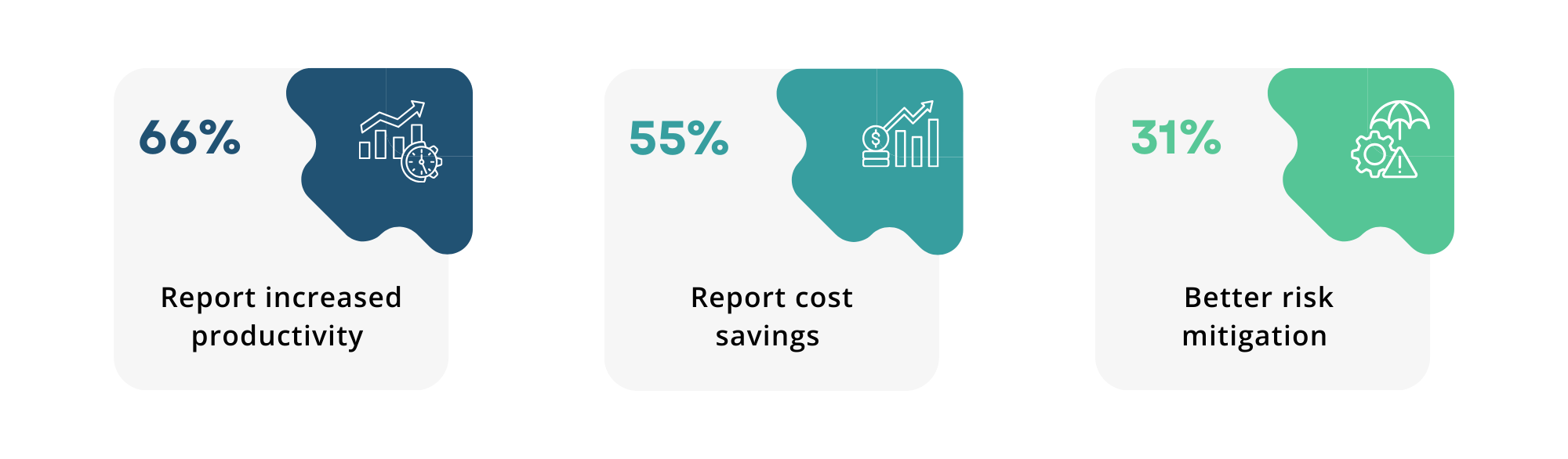
Based on the PwC AI Agent Survey, businesses that adopt AI agents see
With Salesforce’s Agentforce, manufacturers can enable agentic AI that guides decision-making with real-time pricing, approvals, and revenue actions within governed workflows. In this blog, we explore the capabilities of Agentforce in transforming sales and revenue management from planning to execution.
The Sales and Revenue Challenge in Manufacturing
In manufacturing sales, the biggest revenue risks often start upstream, where pricing, forecasting, and production decisions disconnect.
Example Scenario
A manufacturing sales team offers aggressive pricing to secure a large industrial order before the quarter-end. The quote is approved without factoring in rising raw material costs and extended lead times. Later, production face delivery delay, margin shrinkage, and the customer demanded renegotiation. Now, a strong sales win turns into delayed revenue and reduced profitability. Reasons for this are-
Disconnected Pricing
Pricing decisions are often made in the CRM without real-time visibility into raw material costs, production constraints, or margin thresholds. Sales teams discount to close deals, while finance later discovers margin erosion. This disconnected data and process weakens revenue quality, even when topline sales appear strong.
Incorrect Forecasts
Sales forecasts are usually opportunity-based and optimistic, but they usually don’t reflect supply availability and production capacity. As a result, forecasted revenue does not align with what can be fulfilled, causing delayed orders and renegotiations.
Manual Quote-to-Order Processes
Quoting in manufacturing often requires approvals for pricing, discounts, configurations, and delivery terms. These steps rely on emails, spreadsheets, and manual reviews that slow deals. This gap gives competitors a chance to move faster and close deals.
Inconsistent Revenue Policies
Direct sales teams, distributors, and partners often operate with different pricing rules, discount structures, and incentive models. Lack of a unified revenue framework leads to inconsistency, pricing leakage, and unpredictable revenue outcomes.
Limited Visibility into Risk
Manufacturers lack early indicators that signal revenue risk. This might include stalled approvals, expiring quotes, margin deviations, or contract mismatches. By the time issues surface in financial reports, it’s already too late, turning manageable risks into missed targets.
What Is Agentic AI – Not Just Automation
Traditional automation in sales and revenue management focuses on executing predefined steps. For example, routing approvals, generating quotes, or updating forecasts. They are useful but are not effective when conditions change and lack real-time adaptability. So, adopting agentic AI in manufacturing has become essential. AI Agents can reason across pricing, demand signals, production capacity, margin thresholds, and more. This helps to determine the best next action, evaluate trade-offs, and adapt as business conditions evolve.
The advantage of agentic AI in manufacturing lies in its ability to connect insight with execution. They flag risky discounts, prioritize high-value deals based on revenue impact, and adjust forecasts. Manufacturers gain continuous decision support across the sales lifecycle and revenue management processes. By embedding intelligence, AI agents enable faster decisions, margin control, and enhance profitability.
Agentforce: Your Agentic AI in Manufacturing
Agentforce is Salesforce’s agentic AI capability that can operate across complex, multi-step business processes rather than isolated tasks. In manufacturing, Agentforce brings intelligent execution across sales, pricing, forecasting, and revenue workflows. It combines and analyzes data for Manufacturing Cloud, CRM, contracts, and supply chain. Agentforce orchestrates decisions, like adjusting deal priorities, enforcing pricing policies, or escalating at-risk revenue. This helps manufacturers and sales teams to align what is sold with maximum profitability.
How Agentforce Transforms Sales and Revenue Processes
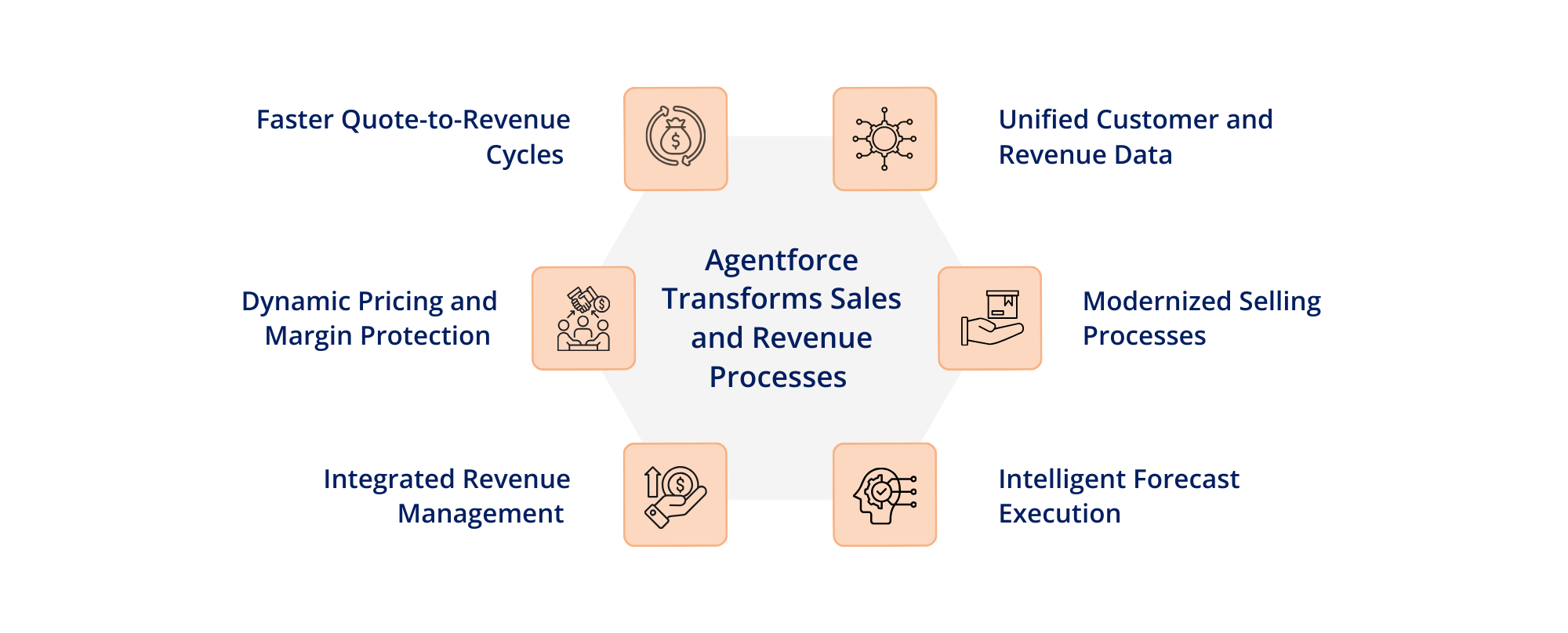
Unified Customer and Revenue Data
Agentforce operates on a single, unified data foundation that brings together customer profiles, sales history, pricing agreements, and more. By eliminating data silos across CRM, quoting tools, and sales, Agentforce gives a complete view of the customer and the revenue context. This unified intelligence enables manufacturers to make accurate decisions at every stage of the sales and revenue lifecycle.
Modernized Selling Processes
The manufacturing sales process is complex, involving long sales cycles, approvals, configurations, and negotiated pricing. Agentforce automates these workflows with AI-driven recommendations for sales teams. It guides sellers on next-best actions, automates quote generation, and eliminates routine steps. This improves the sales team’s productivity while reducing revenue and margin leakage.
Intelligent Forecast Execution
Traditional tools stop at predictive forecasting. Agentforce goes further by evaluating accuracy against live pipeline activity, capacity commitments, and order progress. When risks emerge, Agentforce proactively flags gaps and recommends corrective actions, improving forecast reliability and revenue predictability.
Integrated Revenue Management
Agentforce connects sales commitments with downstream revenue processes by aligning opportunities, orders, and fulfillment data on a single platform. This integration improves visibility into how sales decisions impact order execution and the revenue matrix. As a result, manufacturers gain tighter control over revenue flow, fewer handoffs, and faster deal closures.
Dynamic Pricing and Margin Protection
Rather than enforcing static pricing rules, Agentforce continuously evaluates deal pricing against cost inputs, discounts, and margin thresholds. When deviations occur, it dynamically recommends alternatives or escalates approvals with full context. This ensures revenue growth does not come at the expense of profitability.
Faster Quote-to-Revenue Cycles
Manufacturing deals often stall due to approvals, configuration complexity, or contract reviews. Agentforce accelerates this process by coordinating across pricing rules, approval of workflows, and contract data. It identifies bottlenecks early and triggers action, reducing cycle time and better revenue management.
Business Outcomes
Adopting agentic intelligence in sales and revenue workflows helps manufacturers make real-time decisions and gain execution-driven outcomes. Instead of relying on fragmented data and manual interventions, sales and finance teams operate from a shared understanding of customer demand, pricing, and revenue impact.
- Sales forecasts reflect real demand, pricing conditions, and capacity constraints that reduce revenue loss.
- Automated guidance and approvals shorten quote-to-deal cycles without compromising governance.
- Pricing and discount decisions are continuously evaluated against cost and margin thresholds.
- Sellers spend less time on administrative tasks and more time closing high-value opportunities.
- Early detection of stalled deals, contract deviations, and execution risks protects planned revenue.
How Agentforce Works with Salesforce Manufacturing and Revenue Cloud
Salesforce Manufacturing Cloud provides the operational and commercial backbone required for agentic AI in manufacturing. It unifies account-level sales agreements, forecasts, and performance data across partner channels. Agentforce, built on this foundation, can continuously interpret demand signals, forecast commitments, and production alignment. Agentforce ensures revenue decisions are executed within strict data security and compliance controls on Manufacturing Cloud, while enabling a more transparent and dependable customer experience.
Salesforce Revenue Cloud complements this by managing pricing, quoting, contracts, and billing within a governed revenue framework. Agentforce uses Revenue Cloud data to evaluate deal structures, enforce pricing policies, and automate quote processes. By connecting selling decisions directly to revenue processes, Agentforce ensures profitable revenue management processes.
Conclusion
The gap between sales plans and realized revenue leads to manufacturing losses. When pricing discipline improves, forecasts become reliable; this, in turn, accelerates sales execution, and revenue performance follows. Agentic AI helps manufacturers sell and improve revenue with intelligence and predictive forecasting. Agentforce applies agentic AI across sales and revenue processes to improve predictability, protect profitability, and scale consistent execution. By guiding pricing decisions, reducing approval delays, and aligning sales commitments with operational reality, Agentforce shortens deal cycles and delivers more predictable revenue outcomes.
To fully realize the value of agentic AI in sales and revenue management, manufacturers can partner with Kasmo, a global Salesforce Summit Partner. With deep expertise in Salesforce and manufacturing processes, Kasmo helps organizations design and implement Agentforce solutions. From data unification to deployment and optimization, Kasmo helps to adopt and scale agentic AI to enhance revenue growth.