
Introduction
Walk into any store or scroll through an online marketplace, and you’ll see dozens of similar products competing for attention. For today’s CPG brands, winning isn’t just about shelf presence or price; it’s about how customers experience the brand at every moment. A delayed delivery, an out-of-stock item, a return, or a poor product review can quietly push a loyal buyer to your competitor. These experiences often happen outside a brand’s direct control, yet they define perception and trust.
To understand these details, CPG brands need to adopt customer experience analytics. By analyzing how customers discover products, purchase them, and experience them, brands gain clarity into what truly drives loyalty and churn. Instead of relying on fragmented data or assumptions, CX analytics connects real customer behavior with business outcomes. This helps CPG teams improve product experience, brand trust, and growth. Let’s begin by exploring what customer experience analytics is and how Salesforce helps CPG brands apply it across multi-channel consumer journeys.
What is Customer Experience Analytics?
Customer Experience Analytics is the process of collecting, unifying, and analyzing customer data across every touchpoint to enhance CX. This includes understanding how consumers perceive, engage with, and respond to a brand. In the CPG industry, this goes beyond traditional sales or market research data to include behavioral signals like purchase frequency, product feedback, customer interactions, and brand sentiment.
For CPG brands, this analytics helps connect what happens before, during, and after a purchase. It brings together data from retailers, e-commerce platforms, loyalty programs, customer service, and digital channels to explain why customers choose certain products, abandon others, or stop engaging. By gaining insights from these data, CX analytics enables CPG teams to improve product experience, strengthen brand trust, and drive long-term loyalty.
Customer Touchpoints CPG Brands Must Analyze
CPG customer journeys span multiple channels and moments, many of which are outside direct brand control. Understanding these touchpoints influences customer experience and buying behavior.
Pre-Purchase: Before purchasing, customers interact with product listings, pricing, availability, and reviews across stores and digital platforms. Analyzing search behavior, digital shelf performance, content engagement, and more helps brands to know customer preferences.
Purchase: The purchase experience includes in-store execution, product availability, checkout ease, delivery reliability, and order accuracy. CX analytics helps identify friction, including stock-outs, delayed deliveries, or pricing that impacts conversion and brand perception.
Post-Purchase: After purchasing, customer experience is shaped by product quality, usage, customer support, and return process. Analyzing feedback, complaints, and service delivery allows CPG brands to improve product performance and prevent churn.
Why Customer Experience Analytics Matters for CPG Brands?
Experience-Driven Differentiation: In crowded CPG categories, products alone no longer create an advantage. Customer experience analytics helps brands differentiate by understanding why consumers choose one brand over another.
Fragmented Consumer Journeys: CPG interactions span retailers, eCommerce platforms, D2C channels, and support touchpoints. CX analytics connects these fragmented journeys to reveal friction points that directly impact conversion and loyalty.
Loyalty and Repeat Purchases: CPG growth depends on frequency and retention. Analytics identifies the experience factors and sentiment trends that influence repeat buying behavior, brand switching, and long-term loyalty.
Brand Reputation: Customer sentiment spreads rapidly through reviews, ratings, and social platforms. CX analytics enables early detection of negative experience patterns before they affect brand trust and market performance.
Experience-to-Revenue Impact: CX analytics links customer interactions with operational outcomes like returns, complaints, stockouts, and promotion performance. This enables data-driven decisions that improve both customer satisfaction and profitability.
Steps of Customer Experience Analytics
Customer Experience Analytics follows a structured approach that turns customer interactions into measurable insights and actions.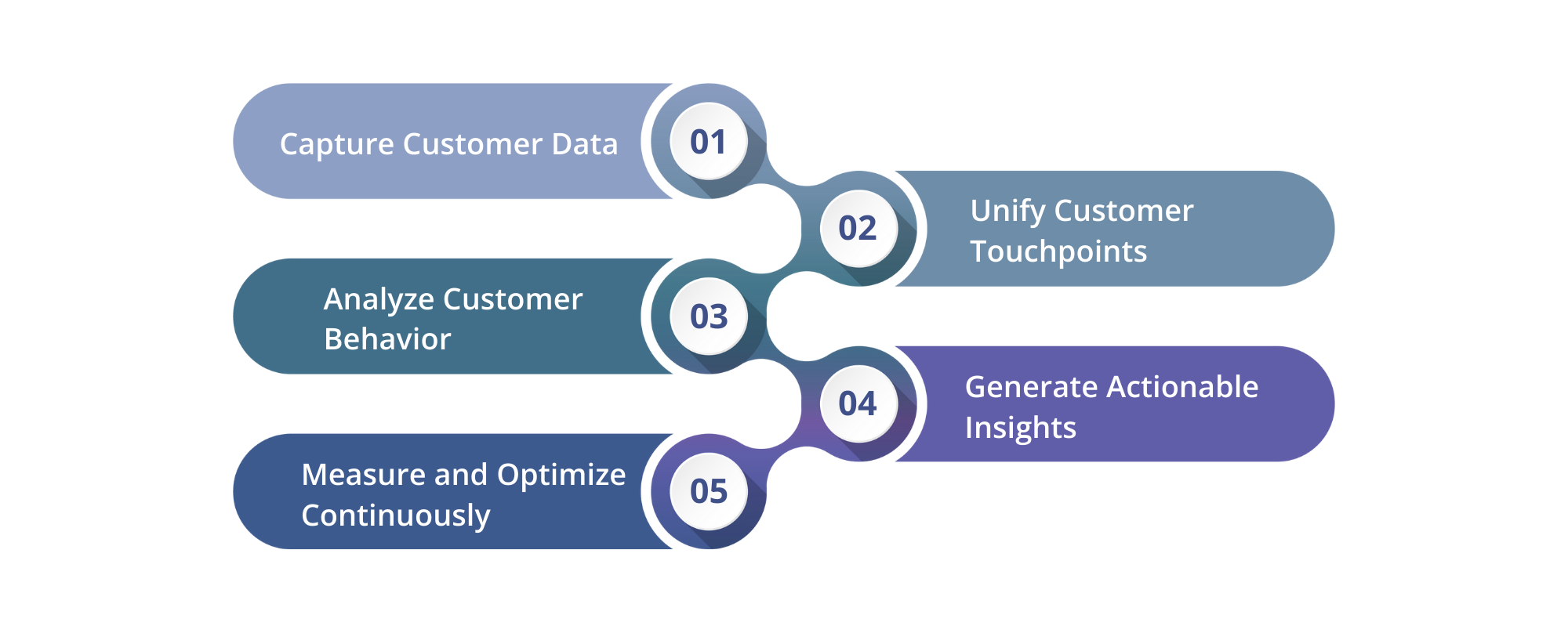
Capture Customer Data
Customer experience analytics begins with collecting data from every interaction a customer has with the brand. For CPG companies, this includes purchase data from retail partners and DTC platforms, website or app behavior, customer service experience, product reviews, loyalty programs, and social media engagement. Capturing both transactional and behavioral data helps deliver better CX.
Unify Customer Touchpoints
Customer data often lives in disconnected systems. Unifying these touchpoints creates a single, consistent customer view that connects interactions across channels. This step is critical for identifying complete customer journeys rather than analyzing isolated events, enabling brands to understand how digital, in-store, and service experiences influence each other.
Analyze Customer Behavior
Once data is unified, analytics help identify patterns in customer behavior. Brands can analyze how customers discover products, what drives repeat purchases, and where drop-offs occur. Behavioral analysis reveals preferences, intent signals, and trends.
Generate Actionable Insights
Insights become valuable only when they lead to action. At this stage, analytics translates findings into recommendations like improving packaging, adjusting pricing strategies, optimizing promotions, enhancing support processes, or refining product assortments. These insights guide cross-functional teams to align decisions with customer needs.
Measure and Optimize Continuously
Customer expectations evolve constantly, making experience analytics an ongoing process. Brands must continuously track performance metrics, monitor changes, and refine strategies based on feedback. Continuous optimization ensures that improvements remain relevant, measurable, and aligned with business growth objectives.
Key Metrics for Customer Experience Analytics
These metrics help quantify customer experience and link it to business outcomes.
Customer Satisfaction Score (CSAT)
This is an essential matrix to measure how satisfied customers are with a specific interaction, product, or experience. Useful for evaluating support, delivery, or product quality.
Net Promoter Score (NPS)
This helps in understanding customer loyalty and the brand’s perception. It includes measuring how likely customers are to recommend the brand to others.
Customer Effort Score (CES)
The Customer Effort Score evaluates how easy it is for customers to complete an action like placing an order, resolving an issue, or returning a product.
Repeat Purchase Rate
Tracks how often customers buy again, indicating loyalty and experience quality in the CPG context.
Customer Churn or Attrition Rate
Identifies how many customers stop buying, helping brands detect experience-related drop-offs early.
How Customer Experience Analytics Helps Improve CPG Performance
Customer experience analytics helps CPG brands move beyond sales figures to understand why customers buy, switch, or disengage. A brand conducting detailed customer journey analytics can optimize product availability, pricing, and packaging based on actual customer behavior. This further helps to prioritize actions that directly improve revenue and brand image.
CX analytics also improves operational efficiency across the CPG value chain. Insights into demand patterns, service complaints, delivery delays, and return reasons help teams identify inefficiencies early. For example, recurring complaints about damaged packaging or late deliveries can be correlated with specific regions, partners, or SKUs, enabling faster corrective action.
Most importantly, customer journey analytics enables more personalized and responsive engagement. Analytics and journey mapping lead to higher campaign effectiveness, stronger customer trust, and improved lifetime value. Over time, continuous CX measurement allows brands to adapt quickly to trends and improve business performance.
Connecting Analytics to Action with AI-Powered Salesforce Capabilities
Salesforce enables CPG brands to analyze customer experience by embedding AI-driven intelligence. Instead of dashboards, Salesforce activates analytics across clouds, ensuring insights drive decisions at every customer’s touchpoint.
Customer Intelligence with Salesforce Data Cloud
Salesforce Data Cloud acts as the foundation for AI-powered by unifying customer data from retail POS systems, eCommerce platforms, loyalty programs, and third-party data sources. It creates unified customer profiles that continuously update. For CPG brands, this means customer behavior, preferences, and purchase patterns are instantly accessible across Sales Cloud, Marketing Cloud, and Service Cloud.
Predictive Insights with Einstein AI
Salesforce Einstein AI applies predictive models and machine learning directly to unified customer data. This helps to easily identify churn risk, predict behavior, and segment customers. In a CPG context, Einstein can forecast demand shifts and recommend optimal promotions.
Personalized Engagement through Marketing Cloud
Insights from analytics flow directly into Salesforce Marketing Cloud to enable personalized, data-driven campaigns. Using Journey Builder, brands can trigger real-time messages based on customer behavior like repeat purchases, cart abandonment, or declining engagement. AI-driven content recommendations and send-time optimization improve campaign effectiveness.
Sales and Account Activation with Sales Cloud
Sales Cloud transforms analytics into insights for sales teams. Einstein recommendations surface next-best actions, account insights, and cross-sell or upsell opportunities directly within the sales workflow. For CPG sales teams working with distributors and retail partners, enables data-backed conversations, account prioritization, and better engagement.
Service Optimization with Service Cloud
Customer experience analytics also enables intelligent service interactions through Service Cloud. AI-driven case classification, sentiment analysis, and automated routing ensure faster resolution and consistent service quality. By linking interactions with purchase and engagement data, agents gain full context to enhance the customer service experience.
Conclusion
Customer experience analytics has become a critical growth lever for CPG brands to gain consumer loyalty. By connecting the entire customer journey, CX analytics transforms scattered data into a clear understanding of what truly drives buying behavior and brand preference. Salesforce’s AI-powered capabilities help these insights connect to sales, marketing, and service workflows. This enables faster decisions, personalized engagement, and positive impact on revenue and retention.
Kasmo helps CPG brands enhance customer analytics using Salesforce. As a trusted Salesforce partner, Kasmo supports end-to-end implementation. We help, from unifying customer data in Salesforce Data Cloud to activating AI-driven insights across Marketing Cloud, Sales Cloud, and Service Cloud. With deep expertise and proven delivery frameworks, Kasmo enables CPG brands to gain better CX insights and improve customer engagement strategies.