Introduction
Commercial success in life sciences is increasingly shaped by the quality of relationships with healthcare professionals. As treatment options expand and clinical decisions become more complex, pharmaceutical and biotech organizations must engage HCPs with relevance, credibility, and scientific value. Every interaction, whether through a sales representative, digital channel, or medical exchange, influences prescribing confidence, therapy adoption, and brand trust.
According to McKinsey, Life sciences companies that have adopted analytics-driven, omnichannel HCP engagement have achieved 5–10% revenue uplift, 3–5% growth in prescribers, and 5–10% higher HCP satisfaction.
As commercial engagement models evolve, life sciences organizations are struggling to maintain relevance across an expanding mix of HCP touchpoints. They are also working with vast volumes of data across CRM systems, digital platforms, and real-world evidence, yet much of this information remains underutilized. This is where data-driven commercial analytics becomes important. This helps organizations understand HCP preferences for broad outreach to deliver personalized, compliant, and timely interactions. Snowflake AI Data Cloud enables this shift by unifying HCP data, supporting advanced data analytics in healthcare, and powering smarter engagement strategies.
In this blog, we explore how life sciences organizations can strengthen HCP engagement using commercial data analytics and Snowflake’s role in enabling this transformation.
The Current State of HCP Engagement in Life Sciences
HCP engagement in life sciences has become significantly more complex and fragmented over the past few years. Physicians and care teams now interact with pharmaceutical and biotech companies across multiple channels, virtual meetings, email, webinars, scientific portals, and peer forums. While this omnichannel expansion has increased reach, it has also diluted impact. Many organizations still rely on static segmentation and historical performance data, making engagement feel repetitive and misaligned with an HCP’s current clinical focus or patient needs.
At the same time, regulatory scrutiny and data privacy requirements continue to tighten, limiting how engagement data can be used and shared. Commercial, medical, and marketing teams often operate in silos, each using different datasets and tools, which results in inconsistent messaging and interactions. As a result, engagement strategies struggle to adapt in real time, and life sciences companies find it increasingly difficult to deliver timely, relevant, and compliant HCP experiences.
Key Challenges in HCP Engagement
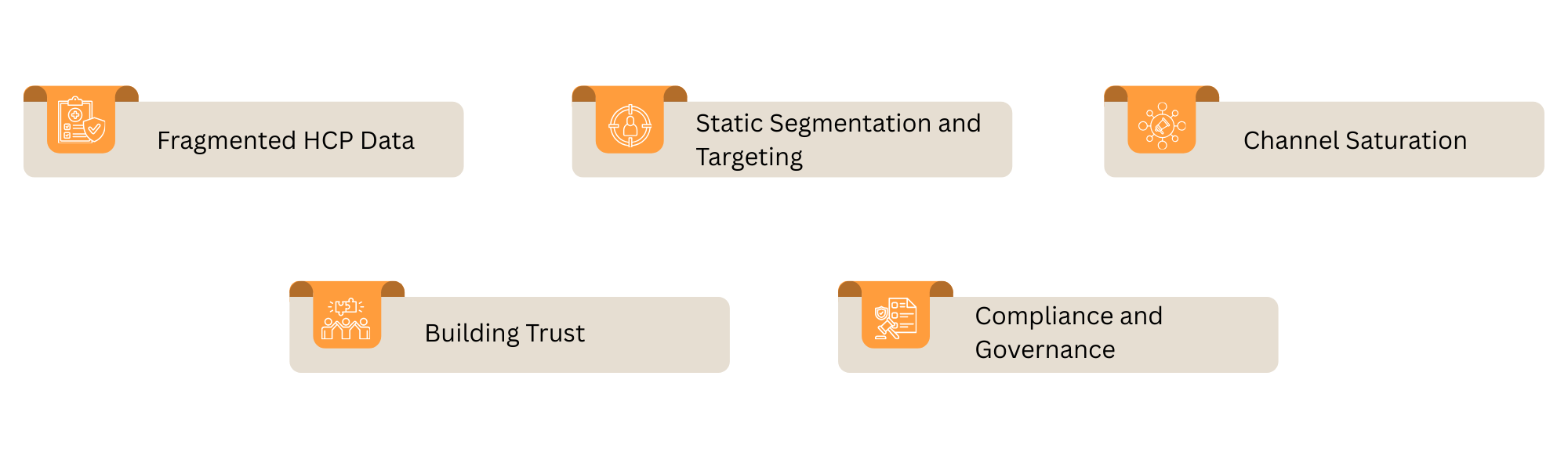
Fragmented HCP Data
Engagement data is spread across CRM systems, marketing platforms, medical information tools, and third-party sources. Without a unified view of the HCP, teams lack the context needed to personalize interactions effectively.
Static Segmentation and Targeting
Many engagement strategies are built on outdated segmentation models that fail to reflect changing prescribing behavior, clinical interests, or engagement preferences, leading to low relevance.
Channel Saturation and Engagement Fatigue
Overuse of certain channels, especially email and virtual interactions, can overwhelm HCPs, reducing responsiveness and trust.
Building Trust
Building trust with HCPs is a long-term challenge that requires consistent, value-driven engagement rather than sales-led outreach. HCPs in pharma expect interactions that prioritize clinical relevance, real-world evidence, and patient outcomes. Understanding HCP’s practice context helps to build professional trust.
Compliance and Governance Constraints
Strict regulatory requirements demand transparency, auditability, and consistency, which can slow innovation and limit the adoption of advanced analytics and AI-driven engagement approaches.
Use Data-Driven Commercial Analytics for HCP Engagement
Commercial data analytics in healthcare enables organizations to move from activity-based engagement to outcome-driven HCP relationships. By analyzing prescribing patterns, engagement history, and content consumption together, commercial teams can improve interactions. This allows sales, marketing, and medical teams to focus their efforts on high-value engagements rather than increasing outreach volume.
Commercial analytics also support personalized, role-relevant engagement at scale. Insights derived from data help tailor messaging based on an HCP’s specialty, patient population, therapeutic interest, and engagement preferences. Field representatives can approach conversations with contextual intelligence, while digital channels deliver content aligned with clinical interests. This helps in improving relevance, credibility, and trust.
Another key benefit is continuous performance optimization. Data-driven strategies provide improved visibility into channel effectiveness, campaign influence, and field execution. Commercial leaders can quickly identify what is working, adjust strategies proactively, and ensure resources are allocated effectively. This results in higher field productivity, stronger alignment within teams, and sustained improvement in HCP engagement quality.
How Snowflake Enables Data-Driven HCP Engagement
Snowflake enables life sciences organizations to unify, analyze, and activate HCP engagement data across commercial, medical, and digital channels. HCP interactions span across CRM systems, marketing automation platforms, claims data, prescription data, and more. Snowflake brings these datasets together in a centralized AI Data Cloud, allowing organizations to create a complete view of each HCP.
By operating directly on governed data, Snowflake supports trusted commercial analytics in healthcare without data duplication. Commercial teams can analyze engagement effectiveness, prescribing trends, and channel performance, while maintaining compliance with industry regulations. This enables faster insight generation, better coordination across sales and marketing teams, and more relevant HCP interactions.
Why Snowflake AI Data Cloud Is Ideal for HCP Analytics
The Snowflake AI Data Cloud supports large-scale, compliant HCP analytics by combining data with embedded AI capabilities. AI-driven models can analyze both structured data (like prescriptions, claims, CRM records) and unstructured data (like emails and call notes) to uncover engagement opportunities, detect patterns, and recommend next-best actions for HCP interactions. By embedding reasoning and natural language queries, Snowflake allows teams to ask questions in plain language. For example, to identify which HCPs are most likely to respond to a particular message or which content formats drive engagement. This helps in smarter targeting, more personalized engagement, and improved HCP relationships.
Snowflake’s AI capabilities, including Cortex Analyst and Cortex Search, allow commercial teams to explore HCP data using natural language, generate insights, and extract intelligence. It also supports advanced segmentation, next-best-action analysis, and engagement performance. Built-in governance and data masking ensure sensitive HCP and patient-related data remains secure and compliant.
How Kasmo Helps Organizations Adopt Snowflake and Improve HCP Engagement
Kasmo helps healthcare organizations use Snowflake’s powerful data and AI capabilities to increase HCP engagement. As a Snowflake Elite Partner, Kasmo works with commercial, marketing, and analytics teams to enable a unified data foundation using Snowflake AI Data Cloud. This creates a governed single source of truth to get deeper visibility into HCP behavior, preferences, and engagement.
Our Snowflake expertise also enables advanced, insight-driven engagement by implementing AI and analytics solutions. This includes building predictive models to identify high-value HCP segments and optimizing channel and content strategies. Through this end-to-end approach, we help organizations eliminate fragmented engagement and adopt personalized and data driven strategies to drive stronger HCP relationships.
Conclusion
Every HCP engagement doesn’t create value, and knowing the difference is a commercial advantage. As life sciences organizations navigate increasingly complex engagement ecosystems, data-driven commercial analytics helps in driving meaningful interactions. Unifying fragmented engagement data and gaining actionable insights helps to know HCP needs, optimize channel strategies, and elevate every interaction from transactional to value-driven.
Snowflake AI Data Cloud helps in improving engagement by providing a unified, governed foundation. Snowflake allows organizations to analyze engagement patterns, prescribing behavior, and content effectiveness. When combined with the right implementation and industry expertise, it empowers commercial, medical, and marketing teams to collaborate better and continuously optimize engagement strategies. The result is a more agile, intelligent, and compliant approach to HCP engagement.