
Introduction
What happens when a customer emails your support team, follows up via chat, and calls the hotline, only to repeat the same issue every time? The answer is simple: customer frustration, churn, and a damaged brand reputation. Today, switching brands is just a tap away; the cost of disconnected support experiences is higher than ever.
Modern customers aren’t just looking for solutions. They expect continuity, speed, and personalization across every interaction. According to PwC, 43% of consumers are willing to pay more for greater convenience, and 42% would pay more for a friendly, welcoming experience. The message is clear: experience now outranks price.
This is where omnichannel customer support becomes a competitive necessity, not an optional initiative. It connects every touchpoint, from phone and chat to social, email, and self-service. This ensures customers feel known and supported at every step. The result? Faster resolutions, higher loyalty, and service teams empowered to deliver meaningful, efficient experiences at scale.
Why Omnichannel Support Matters Now?
Customers interact with brands across multiple channels like social media, email, live chat, SMS, self-service portals, and phone. So, they expect every touchpoint to feel consistent, connected, and personalized. Disconnected channels make customers restate their concerns repeatedly, which disrupts their experience. For example, a customer reporting an issue on WhatsApp shouldn’t have to restate details when escalating to voice support. Whether they start with a chatbot, move to email, or switch to a live agent, omnichannel support makes this possible by connecting at every touchpoint, ensuring consistent communication and personalized service at scale. This ensures service agents have complete visibility into conversations, preferences, and past interactions.
For brands, the benefits of omnichannel support are clear. It increases customer satisfaction, reduces handling time, improves agent productivity, and strengthens loyalty. Connected support systems experience higher first-contact resolution, reduced operational costs, and improved customer lifetime value. It helps service teams in transforming fragmented interactions into meaningful, end-to-end experiences that drive retention and revenue.

Challenges Faced by Brands in Providing Omnichannel Experience
Fragmented Customer Data
Most brands operate across multiple systems, including CRM, ticketing platforms, chat tools, call centers, and social channels. When these systems don’t communicate, the customer’s context remains incomplete or duplicated. The service team lacks visibility in previous interactions, forcing customers to repeat information and slowing down resolution. This fragmentation prevents personalization and creates poor experiences across channels.
Inconsistent Service Across Channels
Many organizations excel in one channel, like email or phone, but struggle to maintain the same quality across others like chat, messaging apps, or social media. Without unified workflows and standardized knowledge bases, responses vary by platform and agent. This leads to unpredictable customer experiences. Scaling consistent service across channels requires strong governance and aligned processes along with technology.
Limited Staff Skills and Training
Even with the right tools, agents may struggle if they aren’t trained to handle multi-channel requests efficiently. Switching between siloed systems increases cognitive load, confusion, and error rates. Agents need a unified workspace, automated suggestions, and access to historical contexts to provide fast and accurate responses. Without this, productivity drops, case resolution delays, and customer frustration rises.
Lack of Insights and Automation
Many service teams rely on manual routing, limited reporting, or outdated dashboards. Without real-time analytics, brands can’t identify channel performance, bottlenecks, or shifting customer behavior. Automation gaps also prevent intelligent routing, proactive outreach, and self-service optimization, resulting in longer resolution times, resource inefficiency, and higher operational costs.
Personalized Support Across Channels
Customers expect personalized, relevant responses to resolve the issue. But personalization becomes challenging when volumes increase across multiple channels. Without AI-powered recommendations, sentiment analysis, and dynamic knowledge surfaces, tailoring responses becomes slow. This limits a brand’s ability to deliver experiences that feel human, seamless, and connected.
How Service Teams Can Deliver True Omnichannel Customer Support
Unified Customer Data Foundation
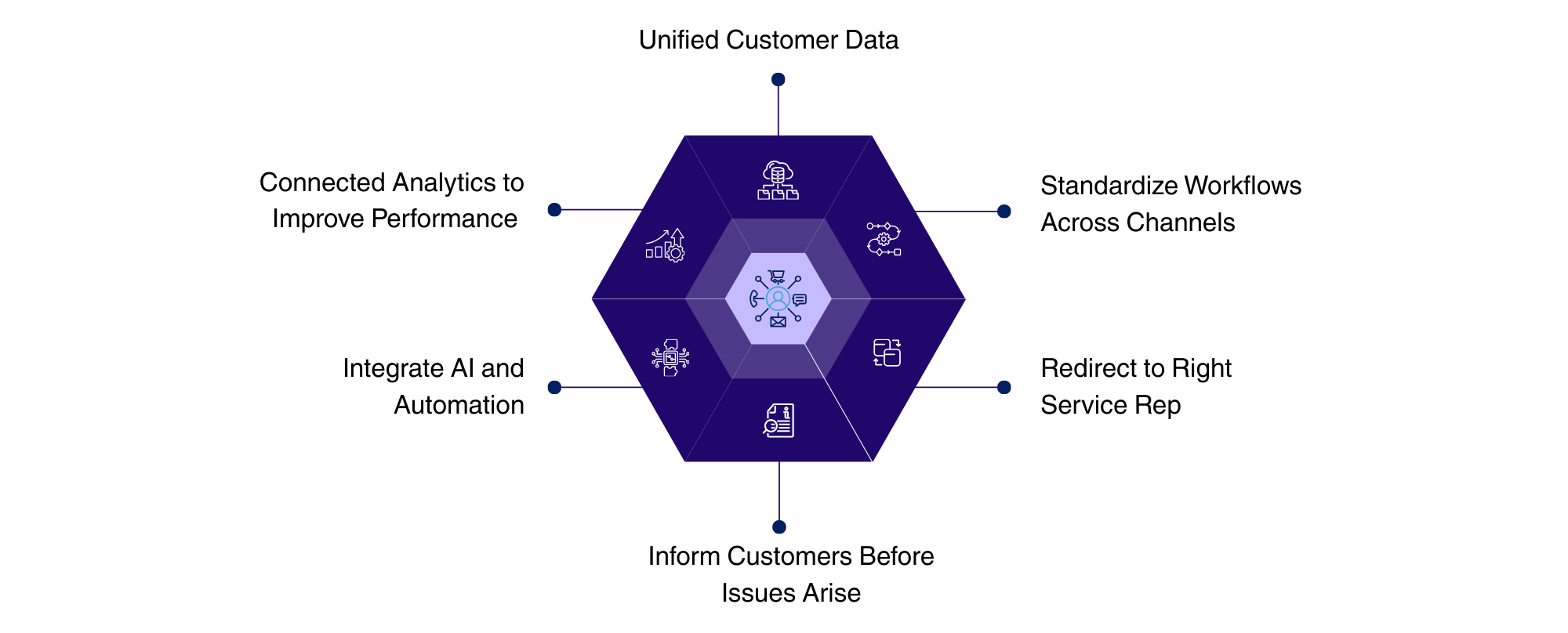
To deliver a seamless omnichannel experience, service teams first need to gain complete visibility into customer data across all touchpoints. This includes purchase history, previous cases, communication logs, behavioral insights, and preferences stored in a single, centralized system. This enables agents to understand who the customer is, why they’re reaching out, and how best to help. Example: If a customer reports a product issue on WhatsApp and later calls support, the agent should instantly see the previous chat conversation and continue from where the customer left off.
Standardize Workflows Across Channels
Consistency is critical. Brands must ensure customer service doesn’t vary based on where the interaction happens. Standardized service-level agreements (SLAs), response templates, tone guidelines, and knowledge article usage help maintain a unified voice and experience. This prevents process gaps, like social messages being answered faster than emails or chatbot responses, clashing with human responses. This shows that service is replicated everywhere the customer chooses to engage.
Redirect to Right Service Rep
Smart routing is essential in reducing wait times and improving first-contact resolution. Adopting skills-based routing, sentiment detection, and contextual insights helps teams to match each incoming request to the best-qualified representative automatically. Rather than assigning cases randomly or strictly based on availability, routing considers expertise, product knowledge, customer tier, previous ownership, and complexity. For instance, a high-risk healthcare compliance question shouldn’t be handled by a trainee; it should be instantly routed to a specialist. Routing accuracy improves outcomes, boosts employee efficiency, and customer satisfaction.
Inform Customers Before Issues Arise
Customers expect to know what is happening in the backend. They appreciate proactive alerts about order delays, subscription renewals, billing issues, or product downtime. Proactive communication also reduces inbound case volume by addressing concerns before they become tickets. For example, if shipping delays are affecting a specific region, an automated notification sent via SMS or email can eliminate thousands of “Where is my order?” messages. Transparency builds trust, and customers stay loyal to brands that keep them informed, not those that leave them wondering.
Integrate AI and Automation Thoughtfully
AI is most effective in supporting human agents. Automation can streamline case categorization and routing while chatbots handle FAQs, order lookups, and troubleshooting. AI can also analyze sentiment, flag high-value customers, and recommend resolutions. Meanwhile, AI-powered suggestions help agents provide accurate responses faster. Example: An AI-powered assistant can surface relevant articles for agents while handling repetitive queries like password resets or order status automatically.
Connected Analytics to Continuously Improve Performance
With omnichannel operations, traditional channel-specific reporting is no longer enough. Teams need unified analytics that reveal trends across the entire journey, response time, resolution rate, CSAT scores, customer self-service deflection efficiency, and channel performance. When insights are connected, they provide patterns on what customers ask for most, which channels drive faster resolutions, and where inefficiencies exist. These insights power continuous improvement, better staffing decisions, and smarter automation strategies.
Salesforce Service Cloud: Powering Modern Omnichannel Service
Salesforce Service Cloud helps deliver seamless omnichannel customer service. It has a platform that unifies data, workflows, automation, and service teams. It brings every customer interaction, across every touchpoint, into a single console, helping agents to have complete context and resolve issues faster. With Service Cloud, brands can activate powerful features such as:
Omni-Channel Routing – Automatically directs cases, chats, calls, and social messages to the right agent based on skills, availability, and priority, reducing wait times and boosting first-contact resolution.
Agent Workspace – Service agents no longer switch between tools. All customer data, past interactions, and knowledge articles appear in one place, helping them deliver consistent support across voice, chat, email, messaging apps, and self-service.
AI-Powered Assistance – Einstein AI surfaces recommended answers, detects sentiment, summarizes case history, and automates repetitive tasks, helping agents focus on high-touch interactions.
Self-Service and chatbots – Customers get instant support through knowledge bases and conversational bots. This helps to reduce ticket volume and even maintain experience quality.
Real-Time Analytics – Managers gain visibility into service KPIs, channel performance, customer satisfaction metrics, and bottlenecks across the entire support ecosystem.
Conclusion
Omnichannel support is a core expectation shaped by modern customer behaviors and rising service standards. As brands handle conversations across social platforms, messaging apps, email, voice, chat, and self-service, the need for connected experiences has never been more urgent.
Brands can transform fragmented interactions into seamless journeys by adopting automation and standardizing workflows. Salesforce Service Cloud strengthens this transformation by helping service teams to deliver accurate, personalized, and proactive support at every touchpoint. Businesses that adopt AI-enabled omnichannel service gain a clear competitive edge with smarter operations, more loyal customers, and sustained revenue growth.