
Introduction
Imagine a financial system where AI agents monitor transactions, detect fraud, approve credit decisions, and guide customer interactions. While intelligence promises efficiency and speed, it also raises a critical question about how institutions maintain trust while scaling AI innovation.
The urgency of this shift is evident in industry research. According to the Capgemini Research Institute, organizations that scale AI agents could realize up to 50% of the potential benefits, while the remaining may capture only around 10% of the value. This gap highlights that the real opportunity lies not just in adopting AI but in implementing it responsibly with strong governance and secure data practices.
In this blog, we explore how institutions can balance trust with Agentic AI innovations in financial services and the role of Salesforce in this journey.
The Agentic AI Innovation vs Trust Challenge in Finance
Financial institutions are enabling digital transformation where Agentic AI systems influence core financial operations. These AI agents can analyze vast amounts of financial data, automate actions, and execute complex workflows across areas like fraud detection, credit risk analysis, compliance monitoring, and customer service. This shift allows fintech innovation and helps companies to operate faster and deliver more intelligent financial services. As AI systems gain greater autonomy in handling sensitive financial processes, institutions must address a critical challenge of how to build customer trust and manage AI innovations in financial services.
Unlike many other industries, financial services operate within a tightly regulated environment where decisions must be transparent, auditable, and compliant with strict governance standards. When AI-driven systems participate in financial decision-making, organizations must ensure that these systems operate with clear accountability, strong data governance, and security. Without these safeguards, even highly advanced AI innovations can face inaccurate decisions, regulatory violations, or compromised customer data.
Why Trust Is the Most Critical Currency in Financial Services
Trust has always been the foundation of the financial services industry. Customers, regulators, and market participants rely on financial institutions to safeguard sensitive data and ensure accurate financial transactions. As AI becomes deeply embedded within financial systems, it is essential to build customer trust. Institutions must ensure that AI-driven decisions are transparent, explainable, and aligned with regulatory expectations. If customers or regulators cannot understand how an AI system arrived at a decision, whether approving a loan, detecting fraud, or recommending an investment, it erodes confidence in the institution.
For this reason, financial organizations must treat trust as a core design principle in Agentic AI adoption rather than an afterthought. This includes implementing strong governance frameworks, ensuring data quality and lineage, monitoring AI performance, and human oversight for high-impact decisions. These AI strategies help to unlock the full potential of Agentic AI while protecting the credibility and stability of the financial ecosystem.
How Financial Institutions Can Balance AI Innovation with Trust
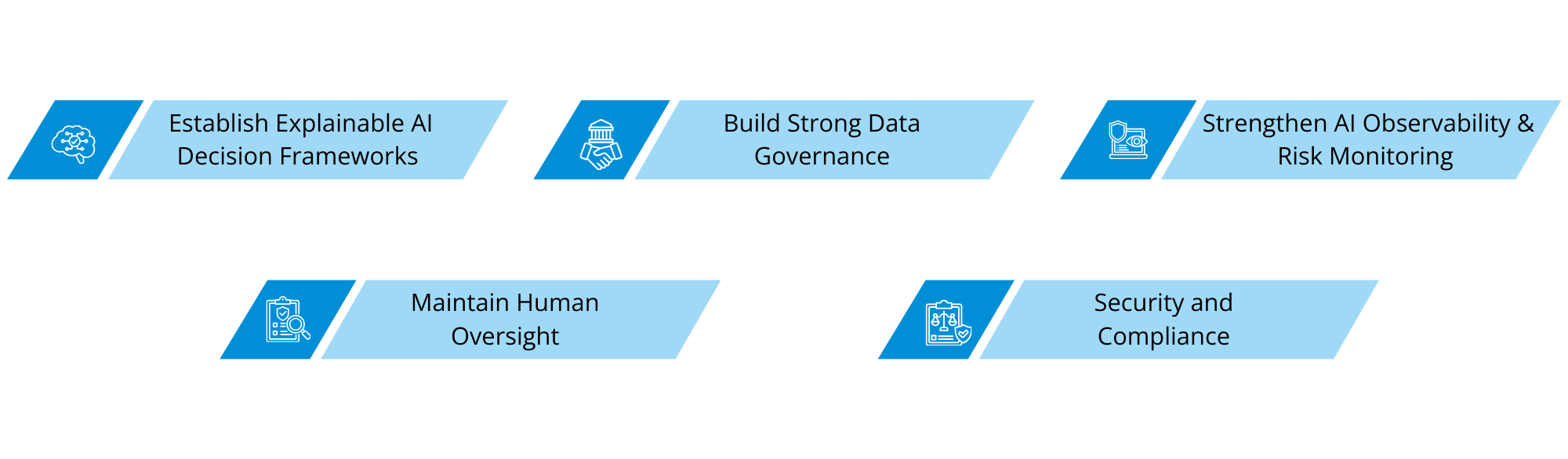
Establish Explainable AI Decision Frameworks
Adopting agentic AI innovations in financial services areas like credit underwriting, fraud detection, and investment advisory requires transparency. For example, if an AI agent flags a transaction as fraudulent or rejects a loan application, institutions must be able to explain the factors that influenced that decision. This explanation is essential for internal risk teams and also to meet regulatory expectations.
To achieve this, organizations are increasingly integrating explainable AI models and decision frameworks into their systems. These frameworks help financial institutions trace how AI agents process data, evaluate risk signals, and generate recommendations. By ensuring that every AI-driven decision is interpretable and auditable, institutions can deploy intelligent automation while preserving transparency and accountability across financial operations.
Build Strong Data Governance
Agentic AI systems rely heavily on large volumes of financial and behavioral data to operate effectively. When the underlying data lacks quality or governance, AI-driven decisions can become unreliable or biased. Financial institutions must therefore invest in robust data governance frameworks that ensure data accuracy, consistency, and security across the enterprise.
This includes implementing structured metadata management, standardized data definitions, and unified semantic models that allow AI agents to interpret financial metrics correctly. For instance, when an AI system evaluates indicators like credit exposure or liquidity risk, it must rely on consistent data definitions across departments. By maintaining well-governed and context-rich data environments, financial organizations enable AI agents to generate insights that are both reliable and aligned with regulatory standards.
Strengthen AI Observability and Risk Monitoring
As AI agents become integrated into mission-critical financial processes, organizations must treat AI-related risks with the same level of scrutiny. This requires implementing comprehensive AI risk management frameworks that continuously monitor AI performance, detect anomalies, and other risks.
Financial institutions are increasingly adopting systems that track model performance, monitor data drift, and identify unusual AI behavior in real time. These capabilities help organizations detect issues early, prevent inaccurate decisions, and maintain operational resilience. By embedding AI monitoring and risk assessment directly into financial workflows, institutions can confidently scale AI innovation without compromising stability or regulatory compliance.
Maintain Human Oversight
While Agentic AI in fintech can automate complex workflows, complete autonomy in financial decision-making is rarely appropriate. High-impact decisions like credit approvals, investment allocations, or regulatory reporting require human judgment and accountability.
In this model, AI agents analyze large datasets, identify patterns, and generate recommendations, while human experts validate the final decision. This collaborative approach improves efficiency while ensuring that financial decisions remain aligned with ethical standards, regulatory requirements, and institutional policies. By combining AI intelligence with human expertise, organizations can scale innovation while balancing trust.
Security and Compliance
Financial institutions handle highly sensitive customer and transactional data, making security a critical component of any AI strategy. As AI agents interact with financial data, organizations must ensure strict access controls, data protection mechanisms, and compliance frameworks are in place.
This includes implementing secure data environments and continuous monitoring of how AI systems access and use financial information. Also, maintain comprehensive audit trails that track how data flows into AI models and how decisions are generated. These capabilities allow organizations to demonstrate compliance with regulators while ensuring that AI-driven innovation does not compromise security.
The Salesforce Advantage for Trusted AI in Financial Services
Deploy Intelligent AI Agents with Agentforce
Salesforce Agentforce introduces agentic AI in fintech and adopts its capabilities directly into financial workflows, allowing organizations to automate complex processes. These AI agents can analyze customer interactions, transactions, and operational data to assist teams with tasks like fraud investigation, case resolution, and financial advisory support. This helps banks and fintech companies improve operational efficiency and response times.

Enable Financial Services Cloud
Salesforce Financial Services Cloud provides a purpose-built platform designed for banks, wealth management firms, and fintech organizations. By unifying customer financial data, relationship insights, and interaction history, the platform allows institutions to gain a unified view of each client. With AI-powered insights integrated into the platform, financial teams can identify customer needs earlier, recommend suitable financial solutions, and improve engagement across digital and human channels.
Einstein Trust Layer for Secure
Salesforce Einstein Trust Layer, a secure architecture, acts as a control layer between enterprise data and large language models. This framework empowers Agentforce and Einstein AI to ensure that financial data remains protected. One of the most important capabilities of the Einstein Trust Layer is zero data retention. This means the sensitive financial data used in AI prompts is not stored or used to train external models. This helps fintech companies to prevent data leakage while allowing the use of generative AI technologies.
Conclusion
Acceleration of Agentic AI innovations in financial services requires trust. Intelligent AI agents can transform operations across fraud detection, compliance monitoring, customer engagement, and financial advisory services. But, in an industry where transparency and data security are essential, AI adoption must be guided by strong governance frameworks and responsible data practices. Salesforce, with capabilities like Agentforce, Financial Services Cloud, and the Einstein Trust Layer, provides the foundation for deploying AI agents that operate securely and in alignment with regulatory expectations.
Kasmo, as a trusted Salesforce Summit partner, helps financial institutions design and implement AI-driven solutions that align with both innovation and compliance requirements. With deep expertise in Salesforce platforms and financial services, Kasmo supports organizations in implementing trusted Agentic AI features in the financial ecosystem.