
Introduction
Today’s life sciences organizations are rethinking clinical data management with increasing data volumes. Fragmented trial systems, manual validation processes, and rule-based checks often lead to delayed query resolution and heightened regulatory risk across the clinical trial lifecycle. To overcome these challenges, clinical teams need advanced technologies and automation processes. This is where AI is reshaping the future of clinical data management.
According to McKinsey, 64% of organizations implementing gen AI use cases are likely to expect positive ROI, signaling strong confidence in AI’s ability to deliver real operational impact. In clinical trials, AI helps beyond data cleaning toward continuous intelligence, like automating standardization, predicting risk, and enabling teams to use data effectively. A governed, scalable Snowflake data platform makes AI both practical and compliant, transforming how clinical data is managed and used. In this blog, we explore in detail AI in clinical data management, the role Snowflake plays in enabling this shift, and how organizations can build future-ready strategies.
What Is Clinical Data Management?
Clinical Data Management (CDM) is the discipline responsible for collecting, cleaning, validating, and managing data generated during clinical trials. This is essential to ensure accuracy, consistency, and compliance with regulatory standards. It manages the entire trial lifecycle, from study setup and data collection to database lock and regulatory submission. Clinical data is gathered from multiple sources like Electronic Data Capture (EDC) systems, laboratory systems, imaging platforms, ePRO/eCOA tools, wearables, etc. The primary objective of CDM is to transform this raw, fragmented data into a reliable, analysis-ready dataset to support trial integrity.
In practice, clinical data management involves complex activities including data standardization, query management, reconciliation, audit trail maintenance, and compliance. As trials become more decentralized and data volumes grow, CDM teams are expected to maintain data quality.
Where AI Changes the Clinical Data Management Lifecycle
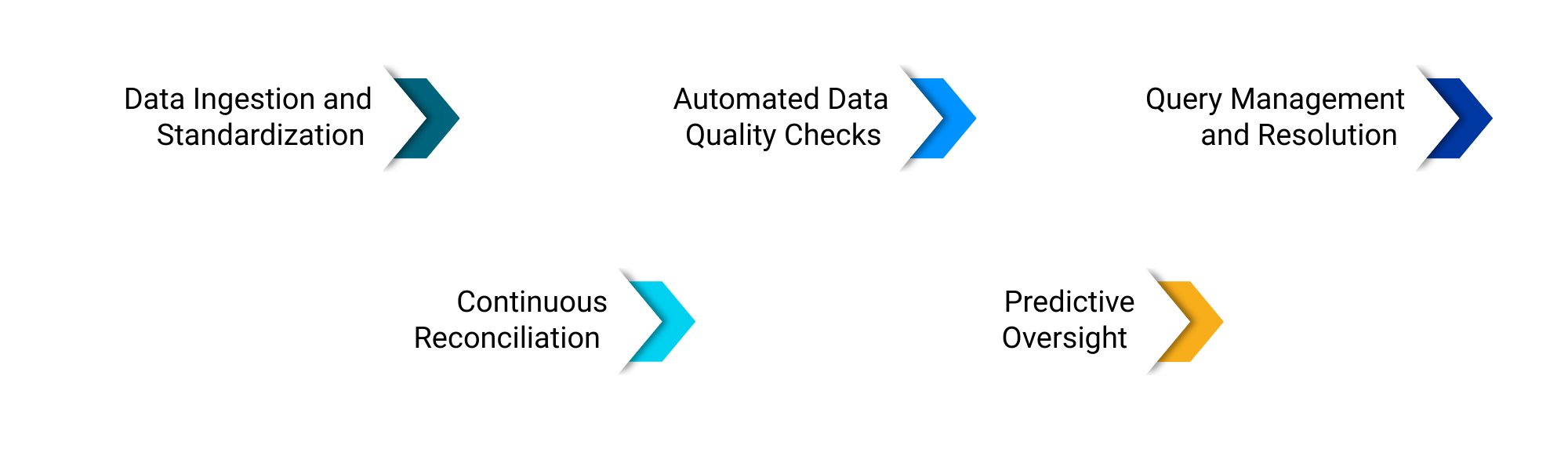
AI in clinical data management (CDM) enhances the CDM lifecycle by automating and enhancing each stage of how clinical data is collected, validated, reviewed, and prepared for analysis. Instead of relying on rule-heavy, manual workflows, AI enables CDM teams to reduce times and improve data reliability. Below are the key stages where AI drives change.
Data Ingestion and Standardization
AI streamlines the ingestion of clinical data from diverse sources, including EDC systems, labs, ePRO tools, and more. ML models automatically map incoming data to CDISC standards (SDTM/ADaM), normalize units, and detect schema mismatches early. This reduces manual transformation effort and ensures data is trial-ready, even as data sources and formats increase.
Automated Data Quality Checks
Traditional data validation relies on predefined edit checks that often miss complex or cross-domain issues. AI enhances data cleaning by continuously scanning datasets to identify outliers, inconsistencies, missing values, and unusual patterns across visits, sites, and patients. These models flag high-risk records, allowing CDM teams to focus on critical data issues.
Query Management and Resolution
AI improves query generation by prioritizing discrepancies based on clinical relevance, historical patterns, and likelihood of impact on primary endpoints. Natural language processing (NLP) enables automatic drafting of clear, context-aware queries to sites. Over time, AI learns from past resolutions to reduce repetitive queries, shorten query cycles, and accelerate database locks.
Continuous Reconciliation
Clinical data often needs reconciliation between EDC, labs, safety systems, and external vendors. AI automates cross-system reconciliation by matching records and identifying unresolved discrepancies. This reduces manual reconciliation cycles, improves traceability, and ensures consistent data across systems for analyses and submissions.
Predictive Oversight
AI enables predictive monitoring by identifying sites, patients, or data domains that are likely to generate future data quality or compliance issues. It supports ongoing audit readiness by tracking data changes, anomalies, and resolution timelines with full audit trails. This allows CDM teams to maintain inspection-ready databases continuously.
How Snowflake Enables AI-Driven Clinical Data Management
Snowflake enables AI-driven clinical data management by providing a single, governed platform where all clinical trial data can be securely unified and analyzed without fragmentation. Clinical data from multiple data sources can be ingested and harmonized within Snowflake while preserving raw, curated, and analysis-ready layers. This unified architecture is critical for AI in clinical data management, as models rely on consistent context across domains. By eliminating data silos and duplicate pipelines, Snowflake ensures that AI operates on a trusted, up-to-date clinical dataset across studies and trials.
A key differentiator is that Snowflake allows AI and advanced analytics to run directly where regulated clinical data resides. Using Snowflake Cortex and built-in ML capabilities, organizations can apply AI to detect data anomalies, identify outliers, and surface emerging trends across sites or patient cohorts. Snowflake’s native security model, including role-based access controls, data masking, and encryption, supports compliance with GxP, HIPAA, and 21 CFR Part 11 requirements. This makes it possible to apply generative AI to clinical data.
Beyond analytics, Snowflake transforms how clinical data management teams interact with trial data. Natural-language querying enables CDM, clinical operations, and data reviewers to ask questions on recurring data issues and other topics to gain AI-generated insights. Because Snowflake scales elastically and processes data continuously, AI-driven checks can run in near real time as new data arrives. This reduces late-stage data surprises, accelerates query resolution, and shortens the path to database lock. In this way, Snowflake does not just support AI in clinical data management; it operationalizes it as a core capability across the entire clinical trial lifecycle.
Building a Future-Ready Clinical Data Management Strategy
Modern clinical trials require a clinical data management strategy that has an intelligence-driven operating model. A future-ready strategy starts with designing a unified data foundation that can ingest, standardize, and govern diverse clinical data sources in near real time. This foundation helps in ensuring that data is inspection-ready at every stage of the trial.
Clinical data workflows need to adopt AI to continuously upgrade emerging trends across sites and patients. AI-driven insights help clinical data managers focus on oversight, decision-making, and trial optimization. A future-ready strategy also prioritizes collaboration and accessibility across clinical functions. Clinical operations, biostatistics, safety, and regulatory teams must work on shared goals. Natural-language interfaces and self-service analytics reduce dependency on technical teams, allowing stakeholders to explore data and answer operational questions independently. This shared intelligence layer improves cross-functional alignment and decision-making.
Future-ready clinical data management must be designed for scalability and adaptability. As protocols evolve, new data sources are added, or regulatory policies change; the strategy should support rapid adjustments. Cloud-native platforms like Snowflake, modular data models, and reusable AI frameworks ensure that organizations can scale across studies and therapeutic areas while maintaining consistency and quality.
Conclusion
AI in clinical data management is advancing how data volumes and compliance are handled with growing complexity. As trials become more decentralized, data-rich, and time-sensitive, it is essential to adopt AI-powered strategies. This helps to build unified data foundations, detect issues earlier, and resolve queries faster. By bringing intelligence to clinical data, Snowflake empowers teams to gain potential value from data. This helps in turning continuous oversight, quality checks, and natural-language insights into standard operating capabilities.
Kasmo helps life sciences organizations to seamlessly adopt and use the Snowflake platform. As a True Blue Elite Partner, Kasmo designs and implements tailored Snowflake solutions for clinical organizations. From unifying multi-source clinical data and applying specific features for CDM, we empower teams to automate processes. This results in a future-ready CDM operating model that prioritizes accuracy, compliance, and efficiency in clinical trials.