
Introduction
Modern enterprises generate massive volumes of information every day from financial transactions, sales interactions, marketing activities, human resources systems, and customer touch points. Although organizations collect all this information, very few are able to convert it into timely and intelligent decisions. This limitation exists because most teams depend on separate tools, fragmented dashboards, and manual reports that slow down business movement.
Snowflake Intelligence changes this reality by introducing a unified conversational system that understands your business and responds with clarity. It goes far beyond traditional analytics. It can interpret questions, analyze structured data, understand documents, identify patterns, and perform actions that normally require human intervention. The system brings context awareness, accuracy, and decision speed into one platform.
With Snowflake Intelligence, your teams can ask questions in natural language. The system interprets the intent, connects to the relevant domain, retrieves information from curated data models, processes documents, applies historical understanding, runs predictive models when needed, and delivers a well structured response. It can also generate reports, prepare summaries, and send information to the concerned stakeholders without manual effort.
This creates a powerful decision engine that supports every department. Finance receives real time insights into profitability and spending patterns. Sales understands pipeline performance and customer movement. Human resources teams monitor workforce metrics and employee well being. Marketing departments gain deeper visibility into campaign performance and content effectiveness. All of this is powered by a single Snowflake environment with strong governance and security.
Snowflake Intelligence is not only an analytical upgrade. It is a complete transformation in the way enterprises interact with their information. It brings analytics, document intelligence, predictive insights, and automated execution into a unified experience that is accurate, fast, and ready for the future.
Overview of the Snowflake Data Platform
Snowflake offers an advanced cloud based data and artificial intelligence platform where all business information can live together. It stores both structured information such as tables and numerical records along with unstructured information such as documents, presentations, forms, and reports. This combination allows enterprises to manage data across domains like finance, sales, human resources, and marketing in a single governed environment.
Snowflake Intelligence builds on this foundation by combining semantic models, document search capabilities, and custom operational tools into one orchestrated engine. This brings a new level of intelligence into the organization where insights and actions happen seamlessly.
Understanding Domain Wise Intelligence
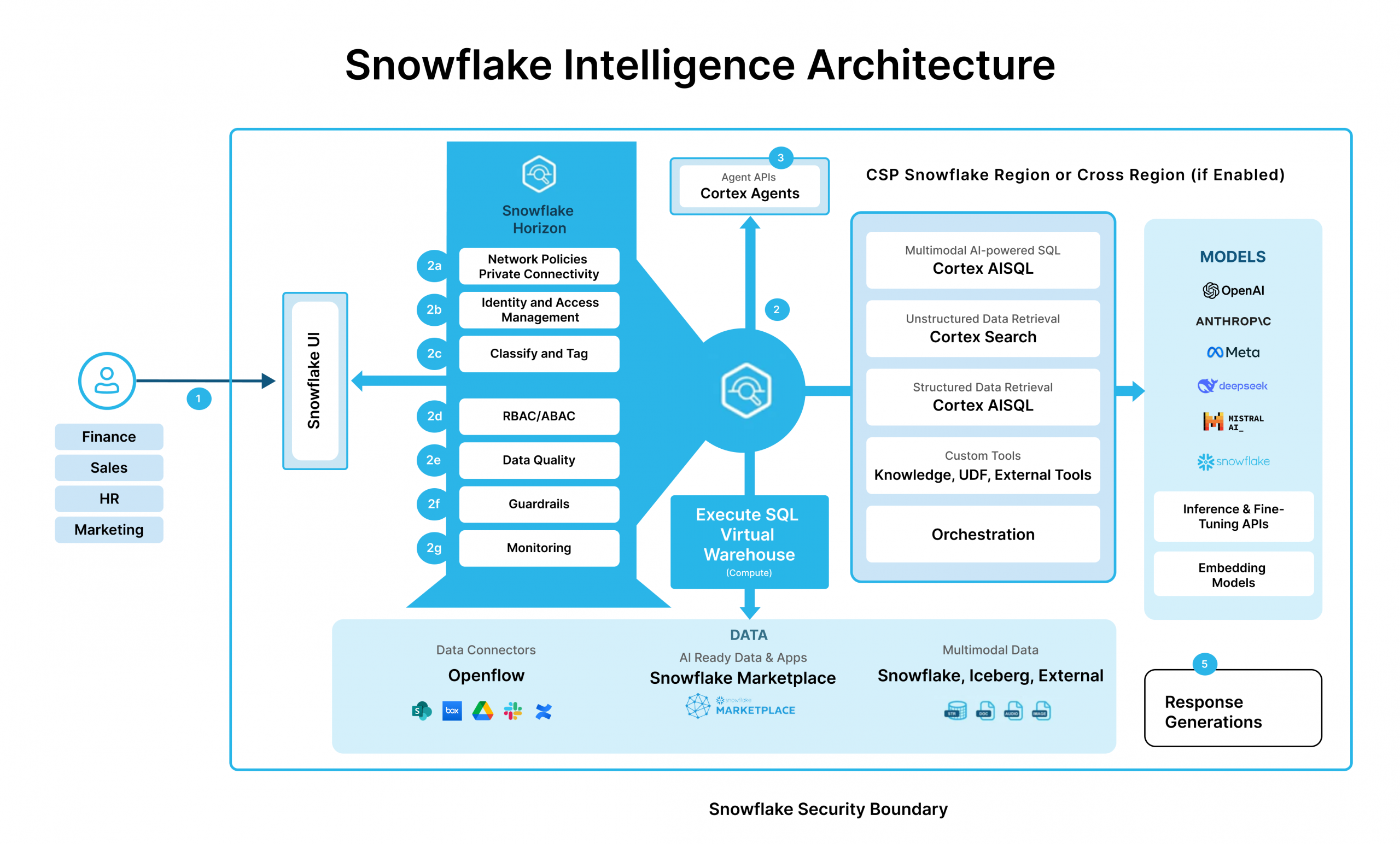
Domain-Wise Intelligence means creating a dedicated “brain” for each business area — such as Finance, Sales, HR, or Marketing — inside your Snowflake environment.
Each domain gets:
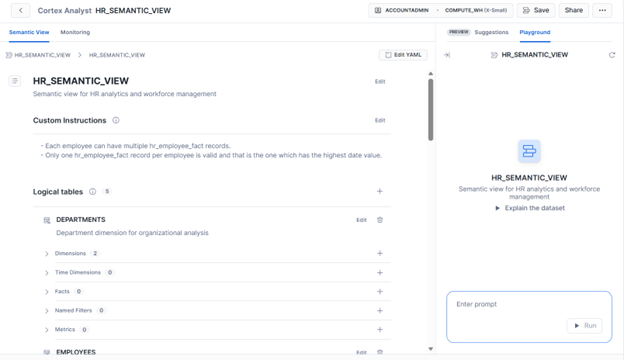
– A Cortex Analyst semantic model (for structured data)
– A Cortex Search service (for unstructured documents)
– A set of custom tools (for actions like sending emails, generating reports, training models, and gathering web data)
The agent routes every query to the appropriate domain using retrieval pipelines and semantic matching. Structured data is analyzed contextually, while document search surfaces relevant PDFs, contracts, and collateral across all domains.
Snowflake Database: Four dedicated schemas—finance, sales, HR, and marketing—manage structured tables and document within the same platform.
- Finance: Ledgers, transactions, budget docs.
- Sales: Pipelines, contracts, invoices.
- HR: Employee records, policies, performance reviews.
- Marketing: Campaign metrics, creative assets, presentations.
 Step 1: Creating a Cortex Analyst (Semantic Model)
The Cortex Analyst component is used to understand structured data. It allows business users to ask natural-language questions like:
- What are our top 5 products by revenue in 2025? Show me their performance by region.
- How are our employees distributed across locations? What are the performance differences by location?
- Compare marketing spend to actual closed revenue by channel. Which channels drive the highest value customers?
- Calculate our customer acquisition cost by marketing channel. Which channels deliver the most profitable customers?
Step-by-Step Guide:
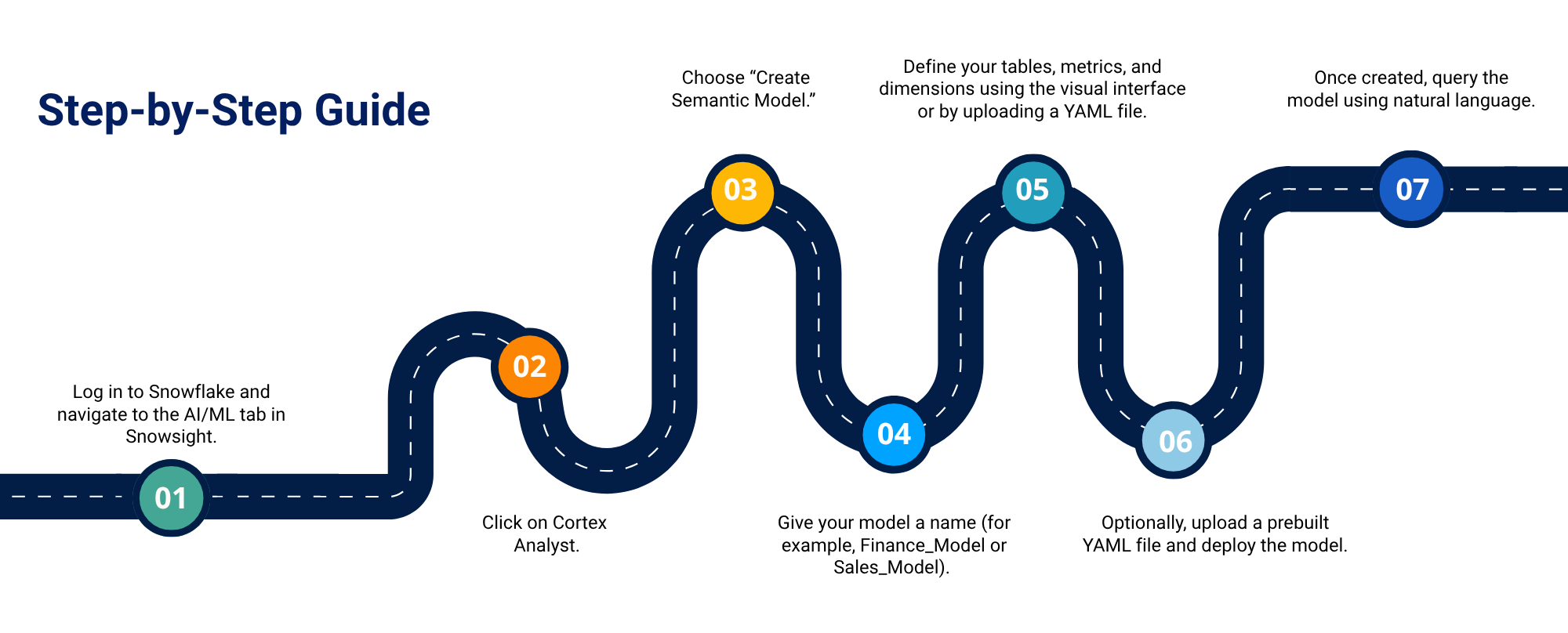
1. Log in to Snowflake and navigate to the AI/ML tab in Snowsight.
2. Click on Cortex Analyst.
3. Choose “Create Semantic Model.”
4. Give your model a name (for example, Finance_Model or Sales_Model).
5. Define your tables, metrics, and dimensions using the visual interface or by uploading a YAML file.
6. Optionally, upload a prebuilt YAML file and deploy the model.
7. Once created, query the model using natural language.
Step 2: Creating a Cortex Search for Unstructured Data
While Cortex Analyst handles structured tables, Cortex Search lets you query and reason over unstructured data like documents, PDFs, emails, or meeting notes.
Step-by-Step Guide:
1. Load your documents into the table.
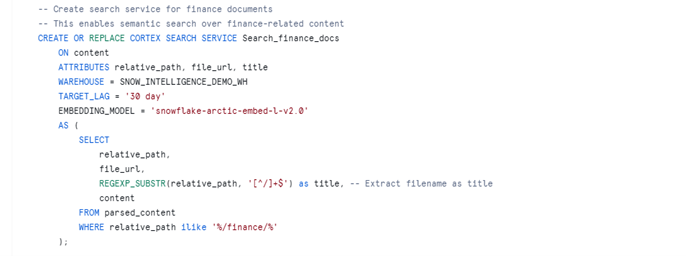
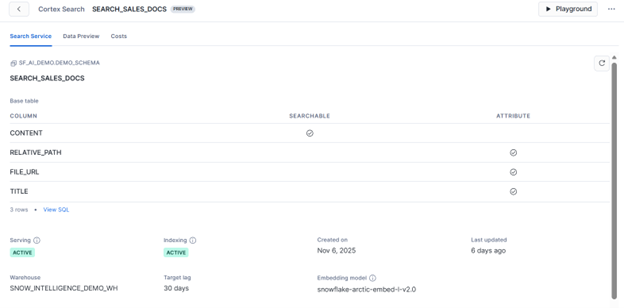
2. Create a Cortex Search Service using your provided script. Alternatively, you can use Snowsight AIML → Cortex Search → select your data and schema, and then create the Cortex Search Service.
3. Access Cortex Search in Snowsight and start querying unstructured data with natural language.
Now, your domain’s unstructured data becomes instantly explorable and analyzable.
Code:
Step 3: Integrating Custom Tools for Intelligent Actions
After enabling both Cortex Analyst (for structured data) and Cortex Search (for unstructured), we extend the domain intelligence with custom tools. These tools allow the agent to perform real actions beyond analysis — such as sending emails, running ML models, creating PDFs, or fetching live web data.
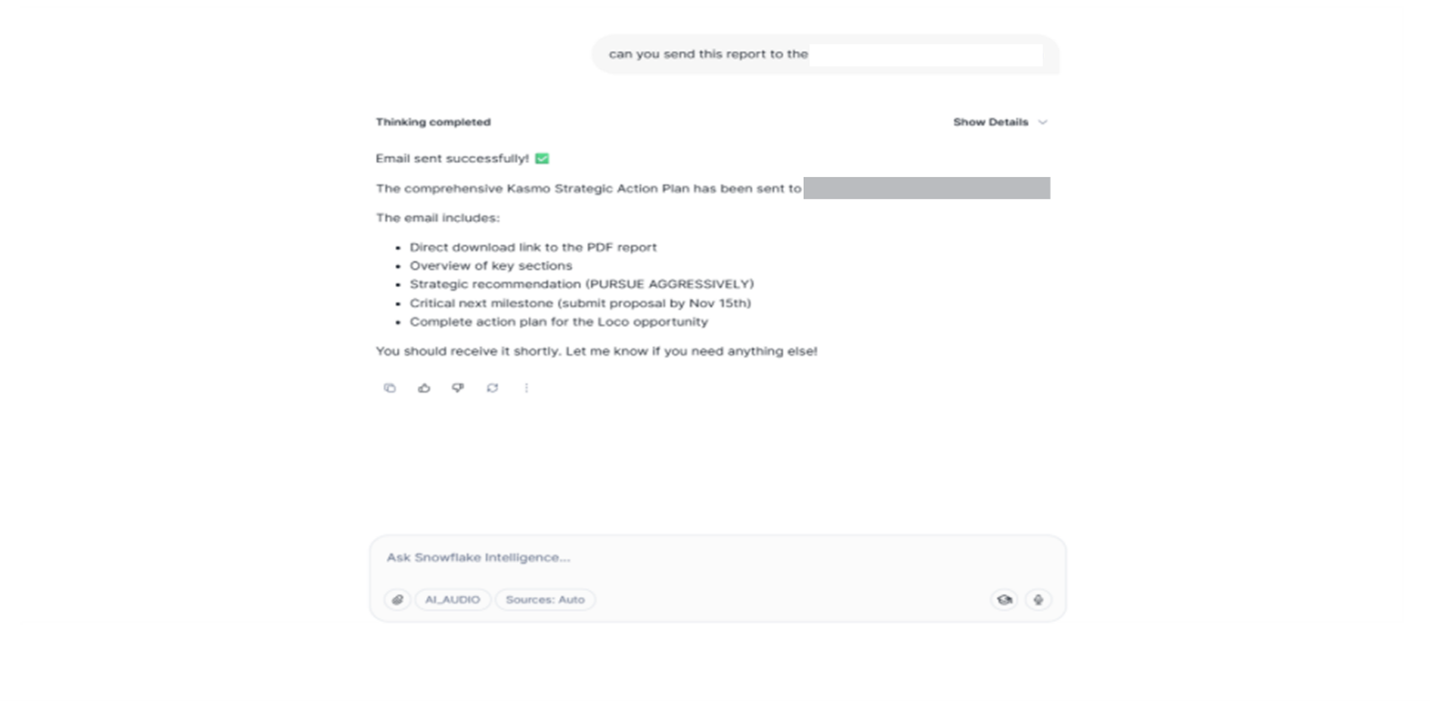
1. Email Send Tool
This tool allows the intelligence system to send alerts or reports directly via email. For example, “Send a cost variance alert to the Finance Head.”
A stored procedure or external function integrated via Snowpark or API sends the email automatically based on business triggers.

2. Machine Learning (ML) Model Tool
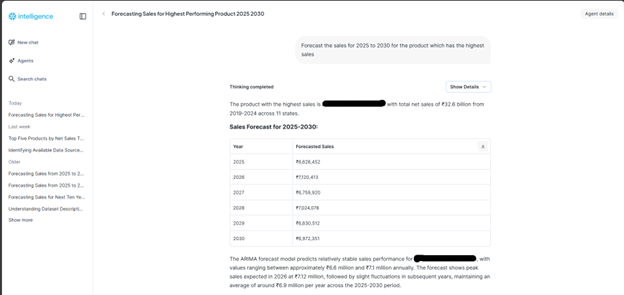
The ML tool enables the agent to predict or classify using pre-trained models within Snowflake. For example, “Predict next month’s revenue using the trained Finance Forecast model.”
This is built using Snowpark ML and registered as a function so the agent can call it to perform real-time predictions.
3. PDF Report Generation Tool
This tool enables automatic report creation in PDF format and storage in a Snowflake stage. The system collects the required data, formats it, uploads it to a Snowflake stage, and provides a secure URL for download or sharing.
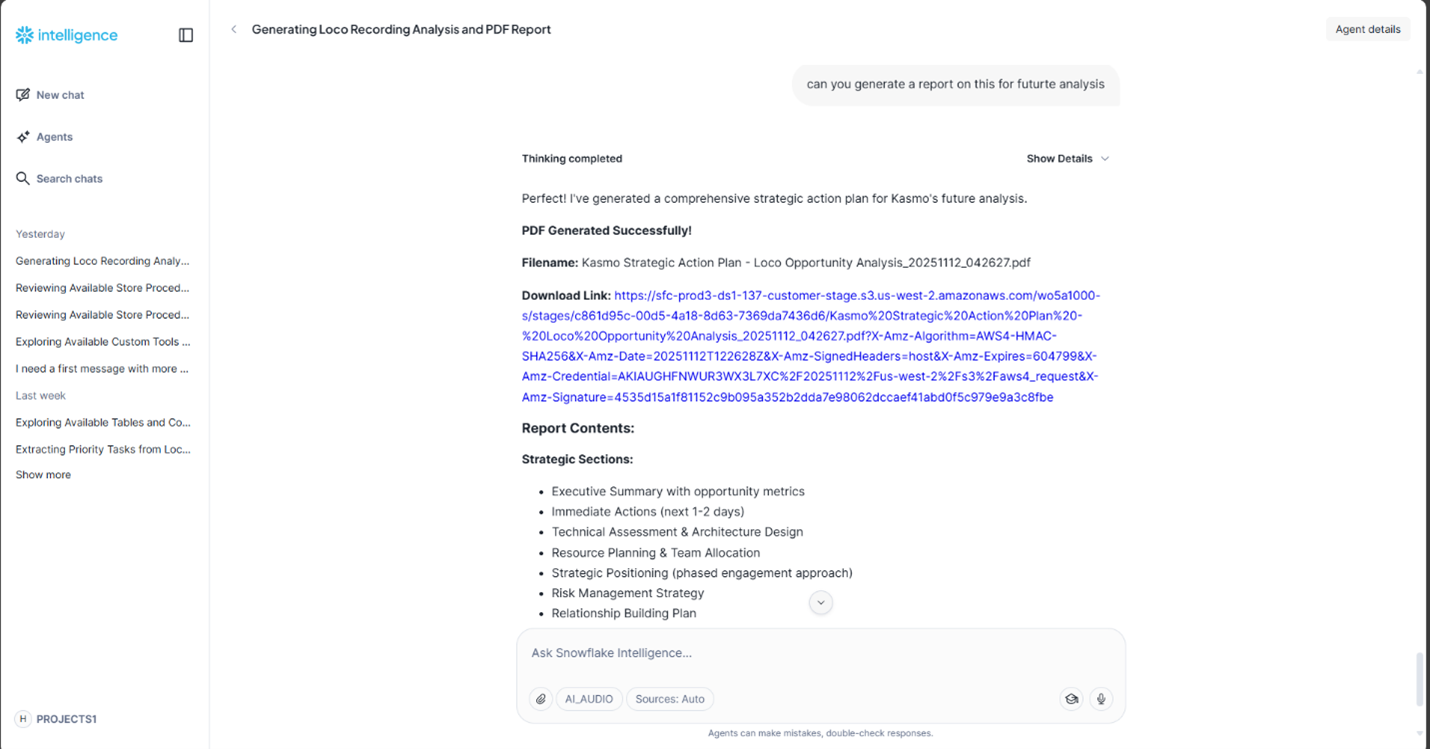
4. Web Scraping Tool
With the Web Scraping tool, you can enrich your data with external insights such as competitor information, pricing data, or market trends. This is implemented via Snowpark Python or external functions that fetch live web data into Snowflake tables for enhanced analytics.
Step 4: Orchestrating Everything with Snowflake Intelligence
Once Cortex Analyst, Cortex Search, and your custom tools are ready, we bring them together under Snowflake Intelligence — the central intelligence orchestrator.
This orchestration layer allows all components to work seamlessly together. When a user submits a request, Snowflake Intelligence automatically determines which components to use and in what sequence, based on your instructions.
For example, when a user asks:
“Why did sales drop in Q3, and can you email me the detailed report?”
The Snowflake Intelligence orchestrator will:
- Use Cortex Analyst to query structured sales data.
- Use Cortex Search to extract supporting insights from unstructured data (like meeting notes or emails).
- Call the ML Model Tool to predict sales trends for the upcoming quarter.
- Generate a PDF Report summarizing the findings.
- Use the Email Tool to automatically send the report to the requester.
Within the Snowflake Intelligence interface, there is a dedicated Orchestration option where you can configure these workflows. The orchestrator follows your defined instructions, intelligently sequencing each step to deliver comprehensive, actionable insights – all within Snowflake.
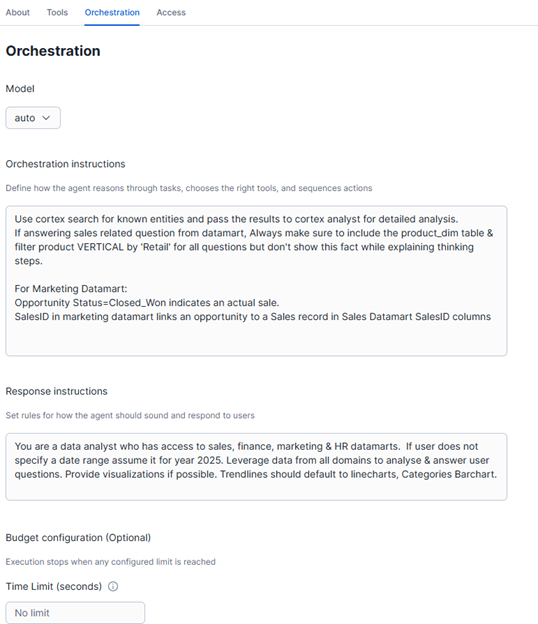
Improving Decisions with Verified Queries in Snowflake Intelligence
Verified Queries in Snowflake Cortex Analyst provide a reliable way to deliver accurate, consistent, and business-aligned insights. By approving and standardizing SQL logic just once, organizations can significantly improve decision-making while keeping setup extremely simple and low-effort.
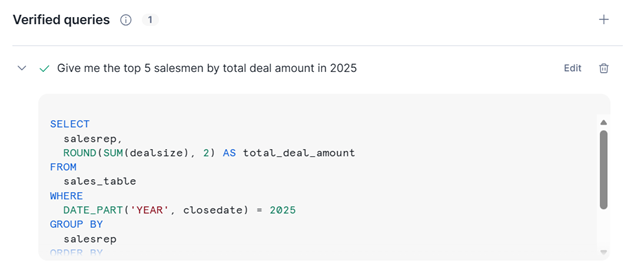
How Easy It Is to Add Verified Queries
- Simple, no-code setup – Verified Queries can be added directly through the Cortex Analyst UI without any coding effort.
- Approve once, reuse everywhere – Once a query is marked as verified, Analyst automatically reuses it for similar questions.
- Intuitive mapping – Linking natural language questions to SQL patterns is guided and supports drag-and-drop mapping.
- Low maintenance – Updates and corrections can be quickly managed from the Verified Queries dashboard.
- Reusable templates – Create reusable SQL templates that support multiple business scenarios and reporting needs.
How Verified Queries Improve Accuracy
- Consistent SQL output – Analyst always prioritizes your validated SQL, ensuring the same correct logic is applied every time.
- Reduced hallucinations – Eliminates errors caused by the LLM generating incorrect joins, missing filters, or invalid logic.
- Business logic enforcement – Guarantees application of key rules (e.g., FY logic, IMT/Others logic, BU-based filters, date rules).
- Higher trust and transparency – Stakeholders rely on results that are certified, accurate, and business-approved.
- Better performance – Reusing validated queries ensures optimized execution and fewer query failures.
- Fewer review cycles – Since SQL logic is pre-validated, QA efforts drop significantly.
- Standardized results – All teams get consistent answers for the same question, improving governance and reliability.
Sample Question and Answer from the Snowflake Intelligence:
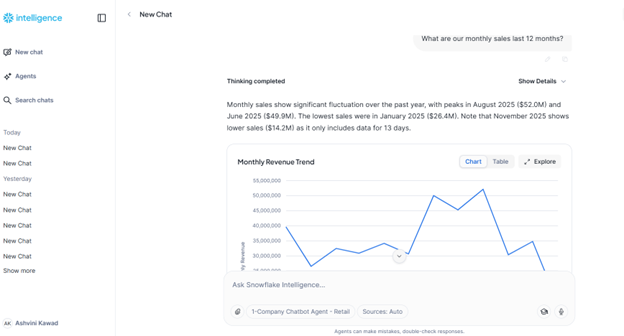
Business Impact
- Efficiency: One agent, no silos—rapid cross-domain decisions.
- Agility: Easily adapt agent skillset as business evolves.
- Automation: Routine reporting and analysis, directly from chat or dashboard.
- Security & Compliance: Centralized governance with granular role controls.
How Snowflake Intelligence Is Easy
- Natural Language Interface: Ask complex questions in plain English (or other languages) via a simple chat-like UI — no SQL, coding, or technical expertise required.
- Minimal Setup for Users: Business users log in (often via ai.snowflake.com or integrated tools like Slack) and start querying immediately — no need to navigate complex dashboards or learn Snowsight.
- Quick Agent Creation: Admins or data teams can create customized agents (e.g., for sales, finance, or documents) in minutes using a guided UI — just point at data sources, no heavy configuration or coding.
- No-Code/Low-Code Focus: Powered by Snowflake Cortex Agents, it automatically handles reasoning, SQL generation, data retrieval, and visualizations (tables, charts, explanations).
- Built-in Security & Governance: Inherits existing Snowflake roles, row-level security, and access controls — users only see permitted data, with no extra compliance setup needed.
- Fast Onboarding & Self-Service: Designed as “the easy button” for enterprise AI — non-technical users get instant insights, reducing dependency on data teams.
- Seamless Integration: Works with existing Snowflake data (structured + unstructured), third-party sources, and improves over time with feedback — no ML expertise required.
- Overall Accessibility: One of the easiest ways to make enterprise data conversational for everyone — if you’re on Snowflake, just enable it and create your first agent to get started.
Kasmo Advantage — Your Partner in Snowflake Intelligence
At Kasmo, we help organizations build custom domain intelligence systems inside Snowflake, tailored to their exact needs.
We bring:
- Deep expertise in Cortex Analyst, Cortex Search, and AI/ML integration.
- End-to-end implementation — from data ingestion to agent orchestration.
- Experience across multiple industries and domains.
- Proven templates for Finance, Sales, HR, and Marketing — and the flexibility to build intelligence for any domain.
As an example, for a retail industry client, we worked with their data to build a Streamlit dashboard. Using the same dataset, we developed Snowflake Intelligence, and by comparing insights between the dashboard and the intelligence system, we verified that the values matched accurately (90–95%), confirming the reliability and consistency of our solution.
Additionally, we’ve developed custom tools for automated email communication, enabling seamless integration of Snowflake intelligence into client workflows.
For a manufacturing company, we delivered Snowflake-powered intelligence that drove measurable efficiency and insight gains with 90–95% accuracy:
- Team Efficiency Gains: Simplified workflows by enabling quick, natural-language answers to metric-related questions, reducing manual effort.
- Scalable Insights: Enabled real-time metric analysis and trend identification through conversational AI, supporting data-driven decisions at scale.
At Kasmo, we turn your Snowflake data into actionable intelligence that drives decisions, automates processes, and enhances business outcomes.
Conclusion
Snowflake Cortex is transforming how enterprises interact with data — unifying structured analytics, document search, and AI-driven tools in one governed platform.
By leveraging Cortex Analyst, Cortex Search, and custom tools, Kasmo delivers Domain-Wise Intelligence Systems that empower every business function with insight and automation.
No matter your domain — Finance, Sales, HR, Marketing, Supply Chain, or beyond — Kasmo can help you design, build, and operationalize your own Snowflake Intelligence ecosystem.
As Snowflake Intelligence evolves, anticipate deeper workflow automations, advanced natural language understanding, and direct connections to your ERP, CRM, or HRIS systems. The unified agent model ensures your investment is future-proof—ready to absorb new domains and functionalities with minimal engineering overhead.
Snowflake Intelligence shifts organizations to a single-agent model, harmonizing analytics, automation, and collaboration across all vital domains. This architecture supports faster decisions, seamless integrations, and scalable intelligence—future-ready for the modern enterprise.