
Introduction
In manufacturing sales, a single missed line in a Request for Quote (RFQ) can turn a promising deal into a costly mistake. RFQs often arrive packed with technical specifications, delivery constraints, compliance clauses, and commercial conditions. But sales teams are expected to interpret them quickly, price accurately, and respond before competitors do.
As RFQ volumes grow and timelines shrink, manual review and spreadsheet-driven CRM updates are not efficient. Agentic AI introduces a new way to handle manufacturing quotes by reasoning across complex documents, extracting what matters, and converting requirements directly into actionable Salesforce data. In this blog, we explore how manufacturing RFQs work, why they are uniquely complex, the limitations of traditional RFQ processing, and how Kasmo’s RFQ Summarization Solution, built on Agentforce, helps sales teams move from document overload to smarter deal execution.
What Is a Request for Quote (RFQ)?
A Request for Quote (RFQ) is a formal document that manufacturers use to ask suppliers or vendors for pricing and delivery details for specific products or services. In manufacturing, RFQs are typically issued when the buyer already knows what they need and wants to compare suppliers based on cost, lead time, quality standards, and commercial terms.
An RFQ usually includes information like product specifications, quantities, delivery schedules, technical requirements, compliance standards, and contract conditions. Sales teams must carefully review these details to determine whether they can meet the requirements and at what price. A fast, accurate RFQ response often plays a critical role in winning manufacturing deals, especially when timelines are tight and competition is high.
What Makes Manufacturing RFQs So Complex?
Manufacturing RFQs is complex because they go far beyond simple price requests. They often span multiple pages and include highly technical details that require input from sales, engineering, operations, finance, and legal teams. Each RFQ may specify custom product configurations, material requirements, performance tolerances, certifications, and regulatory standards.
Another challenge is that additive manufacturing quotes and RFQs are usually shared in unstructured formats like PDFs, emails, drawings, and spreadsheets. Sales teams must manually extract key details, interpret technical language, and ensure nothing is missed. Any misunderstanding or overlooked requirement can lead to incorrect pricing, compliance issues, or delivery delays. This complexity makes manufacturing RFQs time-consuming to analyze and difficult to manage without intelligent automation.
Limitations of Traditional RFQ Review and CRM Updates
Manufacturing quotes are dense, technical, and time-consuming. When RFQ review and CRM updates rely on manual or semi-manual processes, several structural limitations emerge that slow sales cycles, increase risk, and reduce competitiveness.
Manual RFQ Analysis
Traditional RFQ review requires sales or pre-sales teams to manually read lengthy documents, extract requirements, and interpret technical specifications. In manufacturing, where RFQs often include complex configurations, tolerances, and compliance clauses, this process is slow and prone to oversight. Critical details like special materials, delivery constraints, or penalty details can be missed, leading to inaccurate quotes or downstream rework.
Lack of Standardization Across RFQs
RFQs vary significantly by customer, region, and supplier format. Some arrive as PDFs, others as scanned documents, spreadsheets, or email attachments. Traditional methods rely on human judgment to normalize this information, which leads to inconsistent interpretation and documentation. Without AI-driven extraction and normalization, comparing RFQs or building repeatable quoting processes becomes difficult.
Delayed and Incomplete CRM Updates
Updating CRM systems after RFQ review is often a manual, secondary task. Sales teams must re-enter customer details, requirements, timelines, and opportunity data into the CRM, leading to delays and incomplete records. As a result, pipeline visibility suffers, forecasts become unreliable, and downstream teams operate with outdated or fragmented information.
Limited Insight and Prioritization
Traditional RFQ handling treats all requests similarly, regardless of deal size, complexity, or strategic value. There is no built-in mechanism to assess RFQ viability, margin potential, or historical win probability. Without AI-driven analysis, teams cannot smartly prioritize high-value RFQs, resulting in wasted effort on low-probability or low-margin opportunities.
Poor Scalability as RFQ Volumes Increase
As manufacturing organizations grow or expand into new markets, RFQ volumes increase rapidly. Manual review processes do not scale efficiently and require additional headcount to maintain response times. AI-powered RFQ processing enables organizations to handle higher volumes without proportional increases in resources, ensuring speed, consistency, and accuracy at scale.
Key Capabilities of Agentforce in Request for Quote Process
Salesforce Agentforce introduces agentic AI capabilities that fundamentally change how manufacturing organizations analyze RFQs, extract requirements, and convert them to sales opportunities. Rather than acting as a simple summarization tool, Agentforce operates as an intelligent agent, capable of reasoning across documents, data, and workflows.
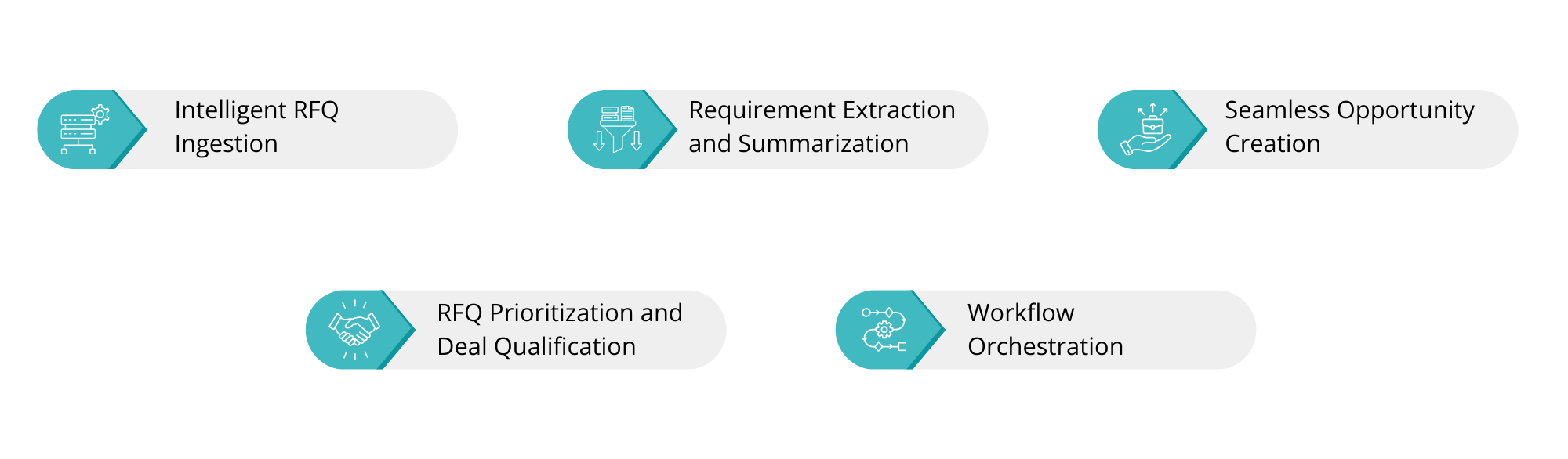
Intelligent RFQ Ingestion
Agentforce can ingest multiple formats of additive manufacturing quotes in RFQ, including PDFs, scanned documents, emails, and spreadsheets. Using advanced document intelligence, it understands the full context of the RFQ by identifying product specifications, quantities, delivery timelines, pricing, and special conditions. Unlike rule-based tools, Agentforce reasons across sections of the document, ensuring that interdependent requirements are interpreted correctly.
Requirement Extraction and Summarization
Once the RFQ is ingested, Agentforce automatically extracts key requirements and presents them in a structured summary tailored for manufacturing sales teams. This includes technical parameters, commercial terms, customer constraints, and evaluation criteria. The summarization is not generic; it is purpose-built to highlight the information sales engineers and estimators need to generate accurate quotes quickly, eliminating hours of manual review.
Seamless Opportunity Creation
Agentforce directly updates Salesforce CRM by mapping RFQ in procurement data to relevant objects like Accounts, Opportunities, Products, and Custom RFQ fields. Customer details, requested quantities, and commercial terms are automatically captured, ensuring CRM records are accurate. This removes duplicate data entry, improves pipeline visibility, and enables faster handoffs between sales, engineering, and finance teams.
RFQ Prioritization and Deal Qualification
Beyond summarization, Agentforce evaluates RFQs based on predefined business rules and historical Salesforce data. It can assess deal complexity, estimated value, margin potential, and alignment with past wins or losses. This enables sales leaders to prioritize high-value RFQs and focus resources on potential opportunities.
Workflow Orchestration
Agentforce does not stop at insights; it triggers the next best actions within Salesforce. Based on the RFQ analysis, it can route the opportunity to the right sales engineer, notify stakeholders, request missing information, or initiate quote workflows.
Kasmo’s RFQ Summarization Solution Built on Agentforce
Kasmo’s RFQ Summarization Solution, built on Salesforce Agentforce, is an AI-powered assistant designed to help manufacturing sales teams quickly understand, evaluate, and act on complex Request for Quote (RFQ) documents. Instead of spending hours manually reading PDFs, sales reps can rely on agentic AI to summarize and structure RFQ information. This helps in accelerating lead qualification and improving response speed.
How the Solution Works
The process begins when a user uploads a request for proposal or request for quotation PDF directly to a Lead record in Salesforce and clicks “Summarize” to initiate processing.
Once triggered, the AI agent reads the uploaded PDF and generates a concise summary of the project requirements. At the same time, it prepares to extract key project details like budget, location, scope, and timelines.
Using the ‘Document ID’, the system retrieves the uploaded file and analyzes its content. The AI prompt processes the PDF to produce both a business summary and structured project data. This includes proposal date, submission deadline, evaluation date, budget, location, and description. The system then checks whether the RFQ requirements align with Salesforce products and updates the lead record with all extracted details.
Finally, the user receives a clear, ready-to-read RFQ summary. Lead fields are automatically populated with key project information, enabling faster lead qualification without the need to manually review lengthy RFQ documents.
Benefits of Kasmo’s RFQ Summarization Solution
Kasmo’s RFQ Summarization solution is designed specifically for the manufacturing sales team. This helps in faster responses, higher productivity, and improved pipeline quality without increasing operational overhead. Its benefits include-
- 70–80% reduction in RFQ reading and analysis time, enabling sales teams to respond to manufacturing customers faster and accurately.
- Up to 3× faster lead qualification, allowing teams to process more RFQs and scale operations without adding headcounts.
- Improved data accuracy through automated extraction of critical RFQ details and seamless CRM updates, reducing manual errors.
- Better opportunity prioritization by intelligently matching RFQ requirements with relevant manufacturing offerings, helping teams focus on the most viable and high-value deals.
Conclusion
Manufacturing RFQs are no longer just pricing requests; they are complex decision documents. They directly impact revenue, margins, and customer trust. Relying on manual review and fragmented CRM updates makes it difficult for sales teams to prioritize the right opportunities or respond within competitive timelines. Agentic AI introduces a smarter approach by embedding intelligence into the RFQ lifecycle.
Kasmo’s Request for Quote (RFQ) Summarization Solution built on Agentforce helps to deliver measurable impact for manufacturing sales teams. By automating RFQ ingestion, requirement extraction, and summarization, the solution enables faster responses and higher-quality quotes.