
Introduction
Retail customer experience is no longer shaped by isolated interactions or past purchase history alone. Customers actively express intent through searches, conversations, comparisons, and real-time behavior, and they expect brands to understand and respond immediately. Traditional personalization models struggle to keep pace because they react to actions without understanding goals or context. Agentic personalization emerges as the next evolution that transforms retail customer experience from rule-based interactions into intelligent, intent-driven journeys.
In this blog, we explore what agentic personalization is, how agentic systems work in practice, the benefits they deliver across the customer journey, and how Salesforce Agentforce helps in customer experience transformation.
Defining Agentic Personalization
Agentic personalization is an advanced personalization approach where intelligent systems actively understand customer intent, make decisions, and take action in real-time. Unlike real-time personalization, which relies on predefined rules, static segments, or past behavior, agentic personalization focuses on interpreting why a customer is engaging. It continuously analyzes signals like browsing behavior, search queries, conversational inputs, and historical interactions. This helps to determine the customer’s intent and context within the customer journey.
What sets agentic personalization apart is its ability to operate autonomously within defined business and governance rules. These AI-driven agents decide the next best action, like delivering a personalized message or recommending the right product without manual intervention. As customer behavior evolves, the system adapts instantly and provides consistent experiences.
For Example, a retail customer browsing running shoes on a website may trigger a simple rule-based response: the system recommends similar shoes or sends a generic discount email later. The experience is based only on past clicks or predefined segments, without understanding why the customer is browsing. When customers opt for omni channel shopping, the personalization often breaks, leading to repetitive or irrelevant messages.
With agentic personalization, the system interprets intent. If the same customer searches for “marathon shoes for beginners” and compares delivery timelines, the AI understands a goal-driven intent. It can immediately recommend beginner-friendly options in stock nearby, suggest a fitting appointment, offer training-related content, and notify a store associate. This system creates a seamless and intelligent customer journey.
Why is Intent Essential for Personalization?
Intent is the foundation of meaningful personalization because it explains why a customer is engaging, not just what they are doing. Large Language Models (LLMs) and Deep Learning for Personalized Recommendations (DLPR) enable systems to interpret intent by analyzing how customers express needs. LLMs process natural language from searches, chats, and voice inputs to extract semantic intent (for example, urgency, preferences, constraints, and goals). Then DLPR models learn complex relationships between customers, products, and context across massive datasets. Together, they improve personalization to deliver an excellent retail customer experience.
LLM models are essential for translating unstructured inputs into structured intent signals. When a customer types ‘budget-friendly laptop for remote work with long battery life’, an LLM can break this into explicit intent attributes, price sensitivity, use case, and performance requirements. DLPR models then use these attributes alongside historical behavior, inventory data, and similar user patterns to generate precise, ranked recommendations.
When personalization is intent-driven, interactions become relevant and timely. It helps to respond appropriately by prioritizing availability, recommending alternatives, or guiding the customer to the next step. Intent is also essential for continuity across channels. It provides a unifying layer that provides hyper personalized experiences across every customer touchpoint. Instead of restarting the experience, businesses can recognize intent and continue the conversation to enhance trust and reduce friction.
How Agentic Personalization Works in Retail?
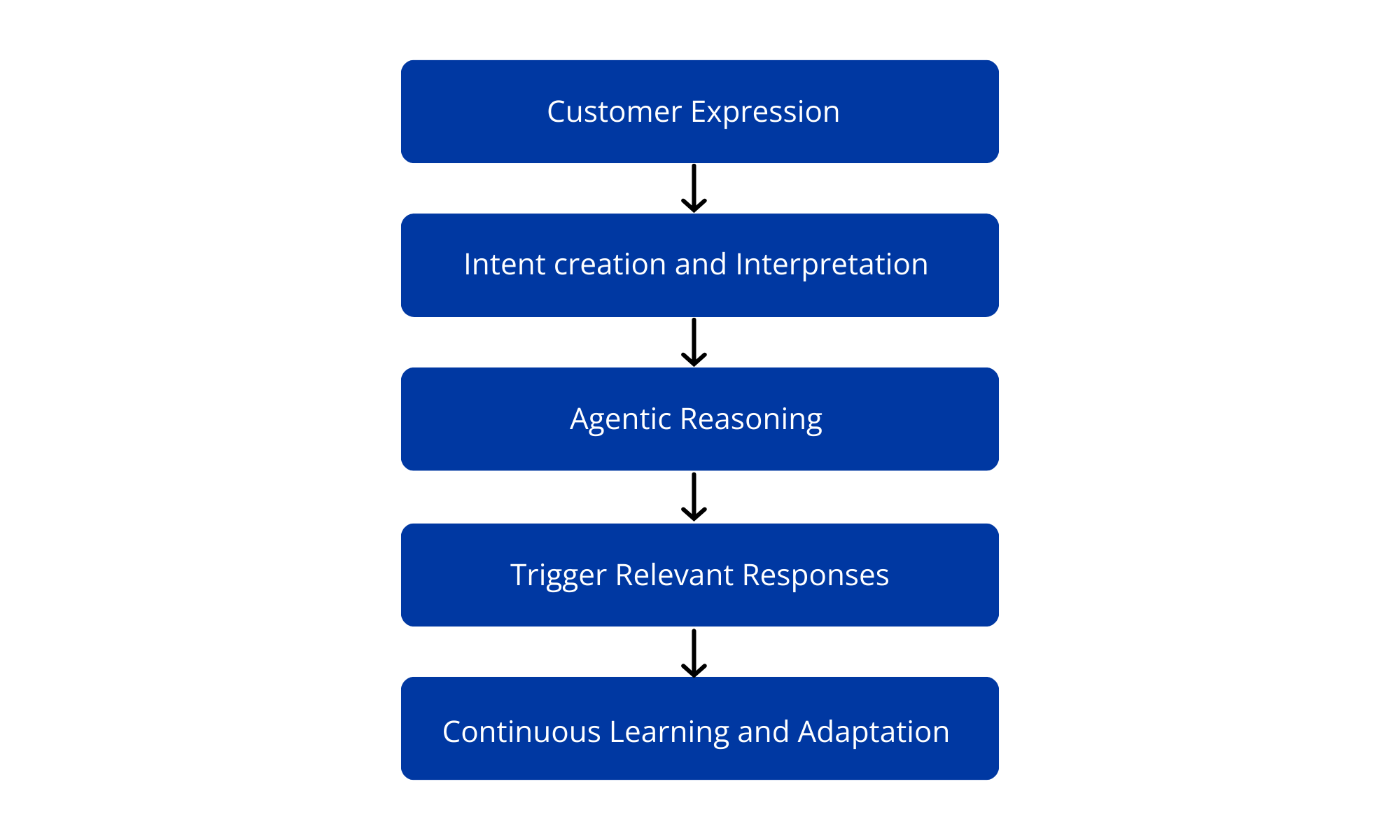
Agentic personalization in retail operates through a sequence of intelligent, connected capabilities that allow systems to understand intent, decide next-best actions, and act autonomously across channels. Below are the key components and how each works in practice.
 Customer Expression
Agentic personalization starts when a customer expresses intent through natural language or behavior. This can include search queries, chat messages, voice inputs, product comparisons, or browsing patterns. These expressions contain contextual meaning, for example, urgency, preferences, constraints, or goals, that are essential to enhance retail customer experience.
Intent Capture from Multi-Source Signals
Agentic personalization starts with capturing signals from across the retail ecosystem, search queries, product views, cart actions, chat conversations, store interactions, and service requests. LLMs analyze natural-language inputs to extract intent attributes, and behavioral data provides context on where the customer is in the journey.
Intent Interpretation Using LLMs and Deep Learning
Once signals are captured, LLMs interpret customer intent at a semantic level, understanding why the customer is engaging. At the same time, deep learning personalized recommendation models (DLPR) analyze historical data, similarity patterns, and contextual variables like seasonality, availability, and pricing. This step refines intent into actionable intelligence, ranking products, predicting likelihood to buy, and identifying the best possible outcomes for both the customer and the business.
Decision-Making Through Agentic Reasoning
After intent is identified, agentic systems decide the next best action autonomously. AI agents evaluate multiple options, product recommendations, offers, content, service support, or human escalation. This decision-making layer ensures real-time personalization and aligns with retailer objectives.
Trigger Relevant Responses
Based on intent and decisioning, the agent triggers the most relevant response in real time. This could include-
- Personalized product recommendations
- Context-aware content or offers
- Effective service assistance
- Store associate prompts or follow-ups
These responses are aligned with both the customer’s intent and the exact channel to help retailers create context-aware experiences. This drives better engagement, conversion, and loyalty.
Continuous Learning and Adaptation
Agentic personalization continuously learns from outcomes. Deep learning models update predictions based on customer responses, while LLMs refine intent interpretation as language and behavior evolve. If a customer ignores a recommendation or shifts behavior, the system refines its approach automatically. This feedback loop ensures personalization improves over time without manual reconfiguration.
Benefits of Agentic Personalization in Retail Customer Experience
Agentic personalization delivers measurable benefits for retail by understanding intents and autonomous decision-making. It enhances customer interactions with a context-aware and goal-driven approach. Key benefits include:
Intent-Driven Recommendations: Agentic personalization uses LLMs and DLPR to understand customer intent in real time. This helps deliver highly relevant product suggestions rather than generic recommendations.
Autonomous Decision-Making: AI agents act on behalf of the retailer to take the next-best actions like messaging, promotions, or inventory suggestions. A well-trained model might require very little or no human intervention at all.
Omni channel Shopping Experience: Personalization follows customers across web, mobile, in-store, and service channels, ensuring continuity and context-aware interactions throughout the customer journey.
Conversational Intelligence: Enables natural, context-aware interactions across chat, voice, and messaging platforms, allowing customers to engage seamlessly while the AI understands intent and responds intelligently.
Scalable and Adaptive Personalization: Deep learning models continuously learn from behavior and feedback quickly. This allows agentic systems to adapt to changing preferences, trends, or stock availability with high accuracy.
How does Salesforce Agentforce help in Agentic Personalization?
Salesforce Agentforce enables agentic personalization by allowing organizations to design, deploy, and govern AI agents that can observe customer signals, reason over data, and act across the entire customer journey. These agents are powered by Salesforce Data Cloud, which unifies customer, behavioral, and transactional data, giving agents a complete, continuously updated view of each customer. This unified data foundation ensures that personalization decisions are based on context, intent, and history.
A key strength of Agentforce is its ability to combine LLMs, Einstein AI, and Flow to drive next-best actions dynamically. Agentforce agents can interpret natural-language inputs from customers across channels, detect intent, and decide the most relevant response. Because these agents operate natively across Salesforce clouds, including Marketing Cloud, Sales Cloud, Service Cloud, and Commerce Cloud, they ensure continuity across touchpoints. This allows agentic personalization to move seamlessly from digital engagement to sales and service without breaking context.
Agentforce also embeds personalization directly into operational workflows. Using Salesforce Flow, agents can orchestrate complex, multi-step actions such as inventory checks, pricing validation, promotion eligibility, and service scheduling in real time. For retail scenarios, an Agentforce agent can detect buying signals in Commerce Cloud, validate product availability, trigger a personalized offer through Marketing Cloud, and notify a sales or service advisor. With all these advanced features, Agentforce also adheres to governance and security policies. Organizations can define guardrails that control what agents can recommend, execute, or escalate. This balance of autonomy and control makes Agentforce ideal for scaling agentic personalization in retail.
Conclusion
Modern retail customers expect brands to recognize intent instantly and respond with relevance, not repetition. By combining real-time intent understanding, autonomous decision-making, and continuous learning, agentic systems enable customer experience transformation in retail. Salesforce Agentforce provides the enterprise foundation to operationalize agentic personalization for retailers. With unified data from Salesforce Data Cloud, built-in AI through Einstein, and workflow automation via Flow, Agentforce helps to deploy governed AI agents. This ensures consistent and secure personalization that drives higher engagement, conversion, and long-term loyalty.
Kasmo helps retailers to design, implement, and scale agentic personalization using Salesforce Agentforce. With deep expertise across Salesforce clouds and AI-driven customer journeys, we help organizations enable agentic AI powered customer engagement.