
Introduction
Process manufacturers today are operating in a world where even small disruptions can ripple across production, inventory, and customer commitments. Consider a specialty chemicals manufacturer managing long-term contracts while raw material prices fluctuate weekly and customer demand shifts without warning. Leaders across the industry recognize this pressure. A 2025 Deloitte survey of 600 manufacturing executives found that 80% plan to invest 20% or more of their improvement budgets in smart manufacturing initiatives. This clearly shows that traditional, disconnected systems can no longer support modern process manufacturing strategies.
But investing in tools and technologies is only part of the story. The real challenge lies in integration, connecting sales forecasts, customer agreements, partners, and operational execution into a single, coordinated flow. Without this integration, even advanced systems operate in silos, limiting their impact. Process manufacturers need platforms that unify commercial and operational data to enable faster decisions, stronger collaboration, and consistent service outcomes.
In this blog, we explore how Salesforce Manufacturing Cloud addresses these challenges and helps process manufacturers enable agentic execution.
What Is Process Manufacturing?
Process manufacturing is a production approach used to create finished goods by combining raw materials through formulas, machinery, or chemical reactions. Unlike discrete manufacturing, where individual components are assembled into finished products, process manufacturing focuses on continuous or batch-based transformation of materials into outputs.
Industries like pharmaceuticals, chemicals, food and beverages, and specialty materials rely heavily on process manufacturing. Successful manufacturing strategies depend on managing variables like batch size, production cycles, shelf life, and more, while maintaining cost efficiency and operational stability.
Key Challenges in Traditional Process Manufacturing
Traditional methods lack manufacturing automation and often struggle to keep pace with growing operational complexity. One major challenge is limited visibility across planning, production, and inventory, especially when demand forecasts are disconnected from actual production capacity. This misalignment leads to overproduction, stockouts, or excess waste that directly weaken process manufacturing strategies.
Another critical challenge lies in managing variability and compliance simultaneously. Changes in raw material availability, batch yields, or quality parameters require rapid adjustments. Using manual processes and static systems affects production. This makes it difficult to respond quickly without disrupting production schedules or risking compliance. As a result, decision-making delays and limits the ability of manufacturers to optimize costs and improve efficiency.
Why Process Manufacturing Strategies Are More Complex
Volatile Raw Material Availability and Pricing
Process manufacturers rely heavily on raw materials like chemicals, APIs, agricultural inputs, or specialty ingredients that are often subject to global market fluctuations. Changes in availability or pricing directly affect production costs and batch planning. So, manufacturers must continuously adjust sourcing and inventory decisions. This volatility forces manufacturing strategies to balance cost optimization with production continuity.
Quality Compliance Requirements
Strict regulatory frameworks govern process manufacturing industries, particularly in pharmaceuticals, chemicals, and food. Compliance requirements around traceability, batch integrity, and quality validation add layers of complexity to operations. So, it is essential to integrate compliance considerations into every planning and execution strategy.
Shorter Product Life Cycles and Higher Customization
Customer demand is shifting toward more specialized, customized products with shorter life cycles. For process manufacturers, this means managing more SKUs, smaller batch sizes, and frequent formula adjustments without compromising efficiency. Manufacturing automation and efficient platforms are the key to achieving this.
Supply Chain Disruptions
Global supply chains have become more vulnerable to disruptions like transportation delays, geopolitical risks, and supplier instability. As production often depends on tightly sequenced material flows, these disruptions can halt entire batches or facilities.
How Salesforce Manufacturing Cloud Advances Process Manufacturing
Salesforce Manufacturing Cloud provides a data-driven layer that synchronizes demand forecasts, sales agreements, and actuals with downstream planning systems. For process manufacturing environments, this enables tighter alignment between demand signals and production planning.
Unified Demand and Supply Visibility
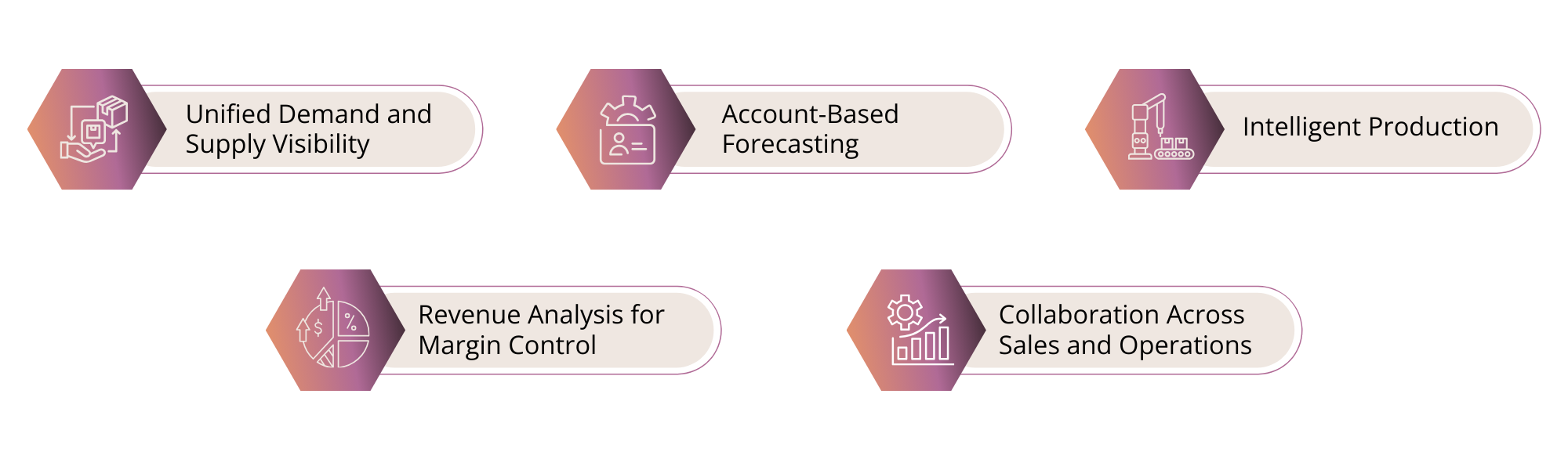
Salesforce Manufacturing Cloud connects demand forecasts, customer commitments, and supply planning into a single data model. This unified view is critical to align production volumes with fluctuating demand while accounting for batch constraints and material availability. By aligning sales agreements, forecasted quantities, and actual orders in real time, manufacturers gain visibility into changes early that help to adjust production plans and inventory levels.
Account-Based Forecasting
Process manufacturing often depends on long-term customer contracts and volume-based agreements rather than one-time orders. Manufacturing Cloud supports account-based forecasting that helps to manage committed volumes, variable demand, and negotiated pricing. This helps sales and operations teams collaborate more effectively, reducing errors and supporting more reliable processes.
Intelligent Production
Manufacturing Cloud integrates with ERP and planning systems to provide accurate, up-to-date signals. While overproduction leads to waste, underproduction risks of stockouts. Real-time visibility into demand changes allows planners to rebalance batch sizes, adjust safety stock, and optimize raw material usage. This advancement helps in effective production planning and controls inventory availability.
Revenue Analysis for Margin Control
Margin volatility is a common challenge in process manufacturing due to fluctuating raw material costs and variable yields. Salesforce Manufacturing Cloud provides revenue intelligence capabilities that track planned versus actual revenue and margins at a granular level. This helps to identify margin erosion early, assess the financial impact of pricing or cost changes, and take corrective action before profitability is affected.
Collaboration Across Sales and Operations
Manufacturing Cloud creates a shared workspace where sales, operations, and finance teams collaborate on forecasts, commitments, and performance metrics. For process manufacturers, this cross-functional alignment reduces miscommunication between demand planning and production execution. Teams can quickly respond to market changes, regulatory constraints, or supply disruptions with a coordinated, data-driven approach.
Why Process Manufacturers Need Manufacturing Cloud
Process manufacturers operate in an environment where small demand shifts can have outsized operational and financial consequences. Traditional planning approaches often lack the agility to absorb changes without creating downstream disruptions. Manufacturing Cloud addresses this gap by providing visibility into demand and performance trends, enabling manufacturers to detect risks early and respond before they impact production continuity or margins.
Manufacturing Cloud strengthens sales execution by analyzing forecasts versus actual demand. This allows sales leaders to identify underperforming contracts, adjust volume commitments, and protect margins as raw material costs fluctuate. The result is a more predictable revenue stream that supports stable production planning and control.
Partner coordination is essential as it involves contract manufacturers, distributors, and third-party suppliers. Manufacturing Cloud enables structured collaboration by analyzing performance metrics across internal teams and partners. This reduces misalignment between demand signals and production capacity, helping manufacturers respond faster.
Beyond sales and partnerships, Manufacturing Cloud also helps in improving service and operational outcomes. By connecting demand data with service insights, teams can respond more effectively to customer issues and resolve them quickly. At the same time, operational teams benefit from clearer demand signals, reducing last-minute production changes, excess inventory, and manual reconciliation. Together, this drives higher service levels and enhances customer trust.
Agentforce: Bringing Agentic Intelligence into Process Manufacturing
Agentforce extends Salesforce Manufacturing Cloud by introducing agentic AI that can actively support and execute workflows. This helps manufacturers eliminate dashboards and alerts to intelligent agents that can monitor demand changes, detect forecast deviations, and trigger actions. Agentforce can recommend actions like adjusting committed volumes, flagging margin risks due to raw material price shifts, or initiating cross-team workflows in production schedules.
According to Salesforce, Agentforce in manufacturing helps to increase ROI by 30% ROI. What makes Agentforce especially valuable is its ability to operate within governed, enterprise-grade workflows. Agents can work autonomously on routine decisions while keeping humans in control of high-impact actions. This allows manufacturers to scale decision-making, reduce response time, and continuously optimize manufacturing strategy without increasing operational complexity or risk.
Conclusion
Process manufacturing demands alignment between customer commitments, production planning, and operational execution. Salesforce Manufacturing Cloud addresses this need by connecting account-based forecasts, sales agreements, and actual demand into a unified system of record. This helps manufacturers manage longer production cycles, stronger margin control, and improved collaboration across sales, operations, and service teams.
Kasmo helps process manufacturers unlock the full value of Salesforce Manufacturing Cloud through implementation and integration expertise. From aligning Cloud with ERP, planning, and quality systems to designing data models, Kasmo ensures the platform fits operational realities. With deep Salesforce specialization and manufacturing domain knowledge, Kasmo enables organizations with faster adoption and long-term success.