Introduction
Sales teams today struggle with simple but costly challenges. Most of the sales rep’s day is spent updating CRMs, chasing approvals, responding to emails, and hunting for information across Slack threads and spreadsheets. According to Salesforce’s Sales Report, reps spend over 70% of their time on non-selling tasks, time that should be spent nurturing opportunities and closing deals.
This fragmented workflow directly hits productivity, and so does the movement of leads and opportunities. When opportunity updates live in one system, customer conversations in another, and internal collaboration somewhere else, sales teams lose connection. Even high-performing reps lose momentum when they’re forced to navigate disconnected workflows instead of focusing on conversations that actually move the pipeline forward. Slow follow-ups, missed signals, delayed approvals, and inconsistent pipeline visibility hinder sales team productivity.
But here’s the solution: most of the conversations that move a lead forward or unblock an opportunity happen in Slack. It’s where sales teams collaborate, share insights, push for approvals, and make decisions. Connecting Sales Cloud with Slack brings pipeline management directly into the flow of work. Sales teams get real-time deal insights, opportunities update automatically, and next steps trigger without switching between tools. This helps in accelerating deal cycles and reducing the admin drag that slows down revenue.
In this blog, we explore how Sales Cloud and Slack together remove workflow friction, automate deal movement, and help sales teams close more deals.
What Salesforce and Slack Integration Really Means for Sales Teams?
Salesforce and Slack integration connect your CRM directly into the platform where your sales team already collaborates. Slack becomes the place where leads, opportunities, account updates, and deal alerts appear instantly, without reps needing to switch tools. Salesforce Sales Cloud, plugged into Slack, fixes the pipeline chaos created by scattered systems. Sales reps get instant visibility into lead activity, opportunity health, and customer conversations without opening multiple tabs. Reps no longer waste time searching for information, and managers can review progress, coach reps, forecast accurately, and guide high-value deals.
Automation does heavy lifting behind the scenes. Routine tasks like updating fields, logging activities, sending nudges, or triggering follow-ups happen inside Slack, reducing manual data entry and ensuring the pipeline stays clean and current. Even approvals, deal alerts, and cross-team coordination flow seamlessly through Slack, keeping the entire sales motion aligned. So, integrating Slack with Sales Cloud creates a connected, high-productivity workspace where deals move quickly and improve sales pipeline management.
For example, with Salesforce Slack integration, sales teams can access account details directly within Slack. Any updates required in Salesforce CRM, like lead status, can be completed without leaving the Slack interface. This seamless workflow saves time and keeps pipeline information up-to-date.

Automated Slack Notifications to Help Sales Teams
Integrating Salesforce Sales Cloud with Slack enables sales teams to stay informed about opportunities, deals, and high-priority cases. Automated notifications ensure nothing slips through the cracks, helping reps act quickly, maintain pipeline hygiene, and improve sales productivity. Here’s a breakdown of the key Slack notifications and how they work:
Approaching Opportunity Close Date: A daily notification is sent 7 days before an opportunity’s close date to the owner. This reminder helps reps to actively follow up with clients and ensure deals progress on time.
Opportunity Changes: Whenever key fields like Amount, Close Date, or Stage are updated, the notification is sent to the relevant channel linked to that opportunity. This keeps the team informed about critical changes, enabling faster collaboration and decision-making.
Opportunity Next Step Unchanged: If the next step field of an opportunity remains empty or unchanged, a daily notification is sent to the opportunity owner. This encourages reps to update actionable next steps, keeping deals on track and reducing stalled opportunities.
Opportunity Stage Unchanged: In case of an unchanged opportunity stage, a daily alert is triggered, notifying the opportunity owner. This helps identify deals that may be stuck and prompts timely action to move them forward.
Deals to Watch: Notifications are sent to the channel when an opportunity meets two conditions: when the probability is more than 50% and the amount is not null. This helps to identify high-potential deals and pay attention to opportunities most likely to convert.
Deals Won: When an opportunity reaches 100% probability, a notification is sent asynchronously to the associated Slack channel. This instantly notifies wins and informs the team of successful deal closures.
New High-Priority Cases and Opportunity: When a case is created with priority, the relevant channel is notified immediately. Similarly, whenever a new opportunity is created, a notification is sent to the synced account.
Salesforce Sales Cloud and Slack Integration for Better Sales Pipeline Management
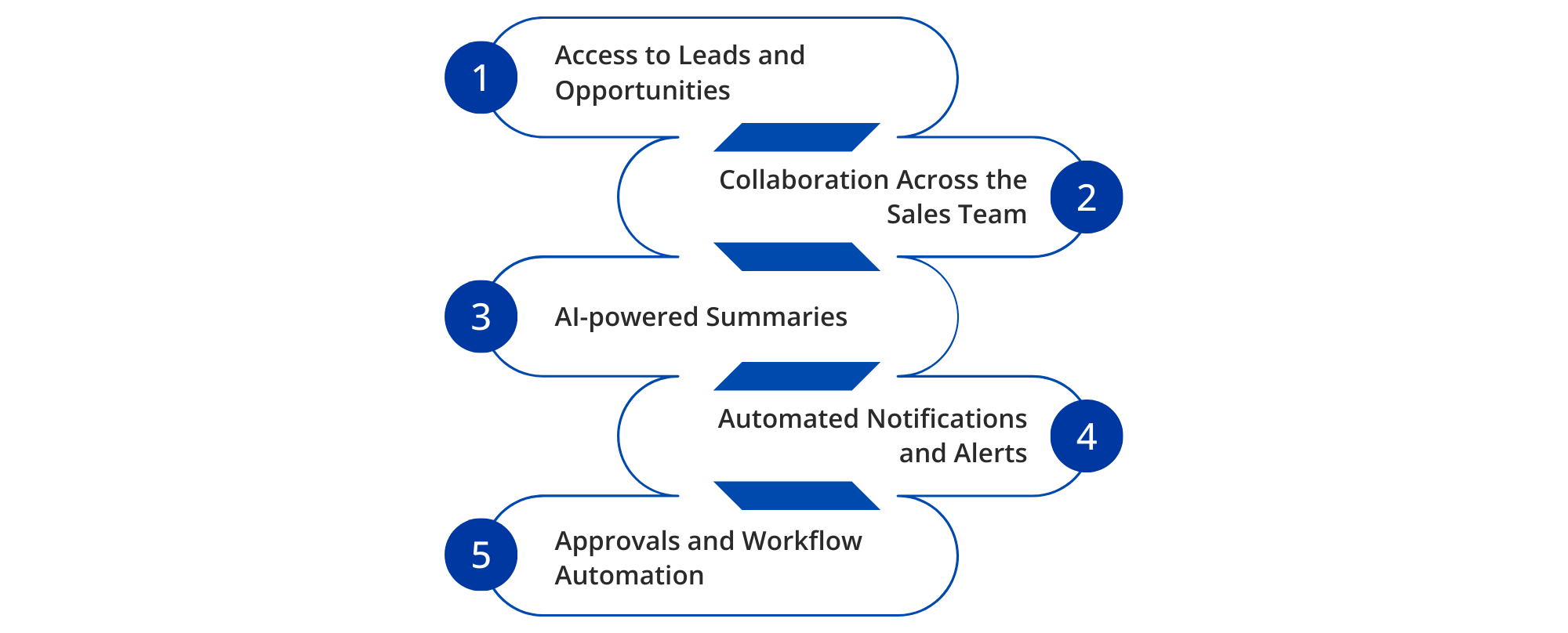
Access to Leads and Opportunities
Integrating Sales Cloud with Slack allows sales reps to access lead, contact, and account information directly from Slack. Sales reps can instantly update lead status, opportunity details, or other information directly within the Slack interface, keeping data always up to date. Clear visibility helps sales reps prioritize high-value leads, respond to customer actions faster, and manage pipelines efficiently.
Higher Collaboration Across the Sales Team
Slack provides a collaborative environment where sales reps, managers, and cross-functional teams can communicate. Sales Cloud integration helps to provide updates on deals, next steps, and customer interactions that can be shared instantly in relevant channels. So, teams collaborate seamlessly, stay aligned on the status of each opportunity, and strategize deals effectively.
AI-powered Summaries
Sales teams get a quick and clear understanding of what’s happening across accounts and opportunities without digging through long conversations or scattered updates. By automatically highlighting important themes, potential risks, and recent activities, reps can stay aligned with customer needs and step into deal discussions fully informed. This lowers response time, improves decisions, and closes deals faster.
Automated Notifications and Alerts
The integration automates notifications for critical events like deal stage changes, lead assignments, or upcoming tasks, delivering them directly into Slack. Reps no longer have to manually check Salesforce for updates, which saves time and eliminates missing potential deals. This help sales reps move opportunities forward and avoid pipeline bottlenecks.
Simplified Approvals and Workflow Automation
Approvals for pricing, discounts, proposals, or other deal-related decisions can be requested and completed entirely within Slack. This saves time spent on email chains or meetings for every decision, accelerating the deal cycle. Workflow automation also handles routine follow-ups and status updates, reducing manual effort and errors in the pipeline.
Automating Your Sales Workflows in Slack with Agentforce
Agentforce enhances the Salesforce Sales Cloud and Slack experience by changing manual sales tasks into automated workflows. Drawing from conversational data in Slack and customer data in Salesforce, Agentforce automates the sales process. Agentforce handles different sales actions like preparing executive briefings, drafting proposals, and routine tasks like sending reminders, updating opportunity stages, or triggering alerts based on deal changes.
What makes Agentforce even more powerful is its ability to take action, not just provide information. Agents can create or update Salesforce records, spin up a new Slack channel, send a direct message, or collaborate automatically based on rules you set. This eliminates pipeline blind spots, accelerates deal movement, and ensures your sales team operates with the efficiency of an AI-enhanced workflow. Agentforce helps every sales rep operate like a high-performing seller by ensuring nothing falls through the cracks.
Win More Deals and Maximize Your Team’s Effectiveness
Modern sales teams can’t afford to lose deals to slow follow-ups, scattered updates, and manual processes. By bringing Salesforce Sales Cloud and Slack together and enhancing the workflow with Agentforce, sales organizations eliminate the friction that drains productivity and delays revenue. Every rep gains instant access to leads, opportunities, and account updates. Also, automated alerts and AI-generated insights ensure faster deals and conversion rates.
This connected and automated sales funnel streamlines operations and elevates how sales teams work. Agentforce amplifies Sales Cloud efficiency by acting as a digital teammate that handles routine tasks, surfaces insights, and drives actions directly within Slack. This results in a faster, smarter, and more predictable sales engine. For organizations ready to build a high-velocity pipeline and empower their sales teams to operate at their best, integrating Sales Cloud, Slack, and Agentforce brings a potential upgrade.