Introduction
For years, marketing analytics has told teams what happened. Now, it’s being asked to decide what happens next. Gartner’s forecast that 90% of marketing analytics workflows will be GenAI-augmented by 2028 reflects a growing demand for analytics that move beyond insights into intelligent action.
As customer data grows across channels and touchpoints, traditional analytics struggles to keep pace with speed, context, and personalization demand. Even with advanced dashboards, marketers are often left interpreting results after the moment has passed. GenAI-powered analytics can recommend next-best actions, automate adjustments, and learn from outcomes. This helps in turning analytics into an always-on intelligence layer rather than a retrospective tool.
This evolution is giving rise to agentic AI-powered marketing analytics, where intelligent agents don’t just surface insights but orchestrate actions across campaigns, journeys, and channels. In this blog, we explore how agentic AI is advancing analytics in marketing, the challenges it solves, and how Salesforce Agentforce brings this intelligence into everyday marketing operations.
What Is Marketing Analytics?
Marketing analytics is the process of collecting, measuring, and analyzing marketing data to understand how campaigns, channels, and customer interactions contribute to business outcomes. It helps organizations make data-driven decisions by revealing what works, what doesn’t, and why. By analyzing data from multiple touchpoints, digital campaigns, social media, email, websites, and CRM systems, marketing analytics helps to understand customer behavior, preferences, and engagement patterns.
At its core, marketing analytics gains insights into measurable results like lead generation, conversion rates, customer acquisition cost, and lifetime value. It enables marketers to optimize campaigns, allocate budgets more effectively, personalize customer experiences, and demonstrate marketing’s impact on revenue. It helps to analyze large volumes of data to gain actionable insights that support strategic planning and continuous improvement.
Types of Marketing Analytics
Descriptive Analytics: This analytics focuses on understanding past performance and explains what happened. It summarizes historical data through reports and dashboards to show what happened, like campaign performance, traffic trends, or engagement rates.
Diagnostic Analytics: Explains why something happened. It examines data relationships and patterns to identify root causes behind performance changes like drops in conversion rates or spikes in churn.
Predictive Analytics: It uses historical data and statistical models to forecast future outcomes. It answers the question- what is likely to happen. Marketers use it to anticipate customer behavior, campaign results, or demand trends.
Prescriptive Analytics: It recommends actions and explains what should be done based on insights and predictions. It helps marketers determine the best next steps, like optimizing channel mix, messaging, or budget allocation.
Key Challenges in Marketing Analytics
Marketing analytics faces growing challenges as data volumes, channels, and customer expectations continue to expand. One of the major issues is data fragmentation. Marketing data is spread across multiple platforms, including CRM systems, advertising tools, social media channels, web analytics, and marketing automation platforms. Due to these disconnected systems, marketers cannot create a unified view of the customer journey. As a result, insights are often incomplete and inconsistent, which limits insights into campaign performance and customer behavior.
Another major challenge is turning insight into action. Even when analytics tools surface valuable insights, acting on them often requires manual intervention, complex workflows, and coordination across teams. Traditional analytics focuses on reporting and dashboards rather than decision-making or execution. Marketers also struggle with data quality issues, slow analysis cycles, and overreliance on historical data. This hinders personalized experiences, affects campaign optimization, and customer loyalty programs.
How Agentic AI Transforms Analytics in Marketing
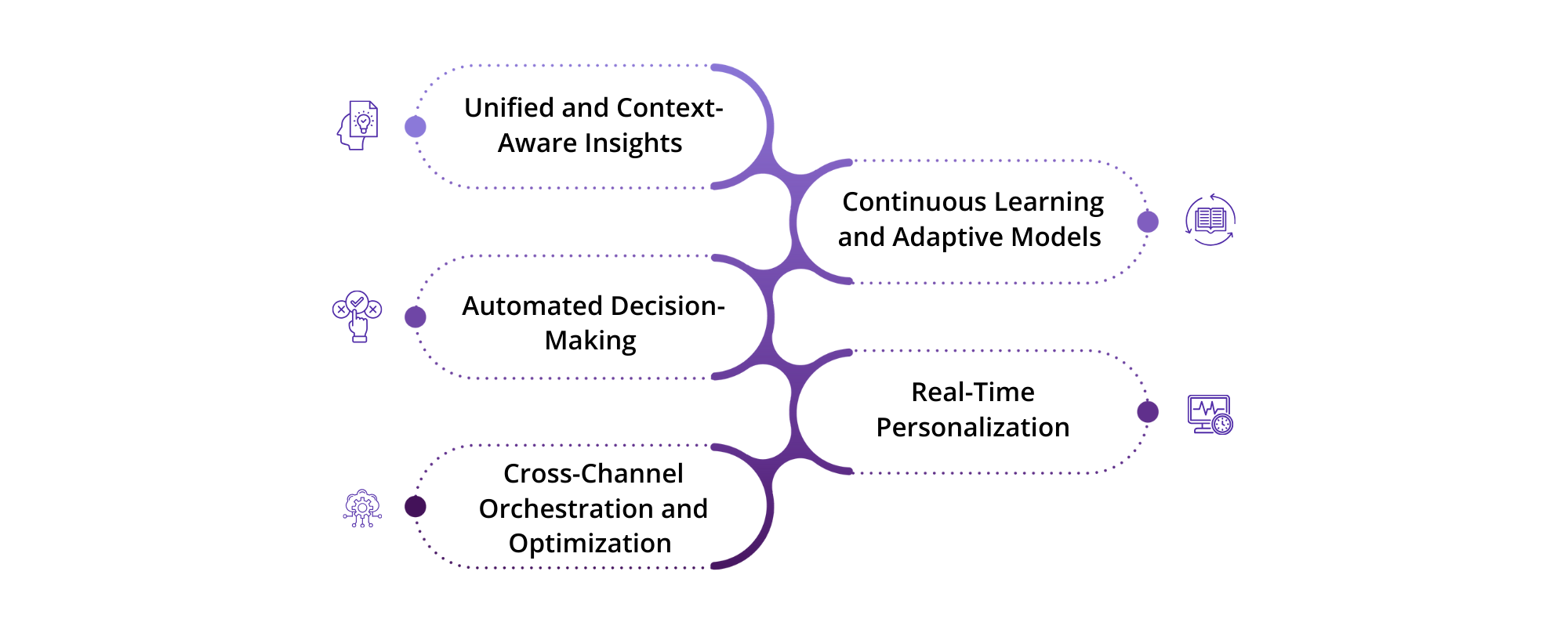
Agentic AI changes marketing analytics by moving beyond insight generation to autonomous, goal-driven decision-making. Instead of simply showing what happened or predicting what might happen, agentic AI systems observe data, reason across multiple signals, and take next-best actions within defined guardrails.
Unified and Context-Aware Insights
Agentic AI connects data from CRM, marketing platforms, customer interactions, and external signals to build a complete and contextual understanding of the customer journey. This eliminates data silos and ensures analytics are real-time and unified customer data.
Continuous Learning and Adaptive Models
Agentic AI systems learn continuously from campaign outcomes, customer responses, and market trends. As new data flows in, models adapt automatically, improving predictions, recommendations, and actions over time. This eliminates the need for frequent manual retraining and ensures analytics evolve alongside customer behavior and business strategies.
Automated Decision-Making
Agentic AI can automatically identify opportunities or risks and take action, like adjusting campaign targeting, reallocating budgets, or triggering personalized messages. This reduces manual effort and speeds up response times.
Real-Time Personalization
Agentic AI enables one-to-one personalization at enterprise scale by analyzing individual preferences, intent, and engagement patterns. Analyzing live behavioral signals provides real-time personalization across channels. Marketing actions are specific to individual customers, delivering more relevant and timely experiences.
Cross-Channel Orchestration and Optimization
Modern marketing spans multiple touchpoints, and agentic AI analytics coordinates decisions across all of them. It evaluates performance across email, web, mobile, social, and paid media, ensuring actions taken in one channel align with others. This orchestration capability prevents fragmented experiences and helps maximize campaign effectiveness rather than optimizing channels in isolation.
Introducing Agentforce: Bringing Agentic AI to Marketing Analytics
Salesforce Agentforce extends marketing analytics from insight generation to autonomous, intelligent execution. Built on the Salesforce Platform and integrated with Marketing Cloud, Data Cloud, and Einstein AI, Agentforce enables the marketing team to continuously optimize performance. Instead of static reports and manual analysis, Agentforce helps to deploy AI agents that monitor data, make decisions, and orchestrate outcomes across the customer journey.
Below are the keyways Agentforce brings agentic AI into marketing analytics:
Unified Analytics with Data Cloud and Customer 360
Agentforce uses Salesforce Data Cloud to access a unified Customer 360 view across marketing, sales, service, and commerce. AI agents analyze real-time and historical data, including engagement signals, behavioral events, transactional data, and preferences. This unified context allows analytics to move beyond channel-level metrics and deliver customer-centric insights that reflect the entire lifecycle.
Autonomous Insight-to-Action with Einstein and Agentforce
Agentforce combines Einstein analytics with pre-built Agentforce capabilities to help in execution. AI agents can identify underperforming segments, predict drop-offs, or detect shifts in engagement, and then automatically trigger relevant actions within Marketing Cloud. This reduces manual analysis and accelerates optimization.
Customer Journey Optimization in Marketing Cloud
With native integration into Marketing Cloud Engagement and Journey Builder, Agentforce enables journey optimization. AI agents monitor performance at each journey stage and adapt paths, timing, or messaging in real time based on customer behavior. This ensures marketing analytics directly influence live experiences rather than post-campaign reviews.
No-Code Agent Configuration for Marketing Teams
Agentforce allows marketers and analysts to configure AI agents using no-code and low-code tools. Teams can define goals, guardrails, and decision logic without relying heavily on data science or IT resources. This democratizes advanced analytics and agentic benefits while maintaining enterprise controls and scalability.
Governed and Compliant Analytics
Agentforce is built with Salesforce’s trusted AI framework, ensuring role-based access, auditability, and explainability. Marketing analytics decisions made by AI agents can be traced, reviewed, and aligned with compliance, consent, and brand guidelines. This makes Agentforce suitable for regulated industries and enterprise-scale marketing operations.
Conclusion
Analytics in marketing isn’t just understanding what happened; it includes continuously deciding what to do next. As customer journeys become more dynamic and data volumes grow, traditional dashboards and manual analysis fall short. Agentic AI-powered marketing analytics shifts analytics from a passive, report-driven function to an active decision engine that monitors performance, adapts strategies in real time, and directly influences customer engagement. With Agentforce, marketers can continuously optimize, ensuring every interaction is timely and relevant.
Salesforce Agentforce enables this shift by connecting unified customer data, real-time intelligence, and autonomous execution within a governed platform. Agentforce ensures insights are not just observed but acted upon. This allows marketing teams to improve ROI, respond faster to changing behavior, and deliver personalization across channels.
How Kasmo Helps with Agentforce Implementation
Kasmo helps organizations design and implement Agentforce solutions that align analytics with real marketing outcomes. Our Salesforce-certified experts configure Data Cloud, Marketing Cloud, and Agentforce to ensure accuracy. We define agent goals, guardrails, and workflows for your marketing strategy. With deep expertise in Salesforce and analytics, Kasmo accelerates adoption and helps teams gain measurable value from Agentforce-powered marketing analytics.