
Introduction
Every business today is drowning in customer data but lacks a clear understanding of its customers. As data lives in multiple systems, teams operate in silos, AI models work with incomplete signals, and customer experiences become inconsistent and disconnected. “PwC reports that while 84% of executives have increased spending on customer loyalty, a striking 83% admit they still lack the tools to understand what truly drives customer purchases.” Most companies aren’t suffering from a lack of data; they’re suffering from a lack of connected, usable, and actionable data.
Disconnected data doesn’t just slow teams down; it creates blind spots across the entire customer journey. Marketing can’t personalize effectively; sales operate without full context, service agents lack historical insights, and AI systems struggle to make accurate predictions. To truly understand customers and power intelligent engagement, businesses need a single, trusted data foundation that unifies every touchpoint. In this blog, we explore how Salesforce’s Data 360 helps in effective data unification and enhances customer experience.
What is Salesforce’s Data 360?
Salesforce Data 360 is a data platform designed to unify all enterprise data, including CRM, web, mobile, transactional, operational, marketing, service, and external, into a single, connected source of truth. Data 360 also connects this unified data into Salesforce’s Agentforce 360 Platform to provide complete visibility into the customer journey. Data 360 brings everything together using native connectors and zero-copy integrations, allowing companies to ingest data from warehouses without duplicating or moving it. This enables smarter automation, sharper analytics, personalized experiences, and more accurate AI-driven insights. With Data 360, every team can tap into the full power of your company’s data, boost productivity, and deliver meaningful customer value at every touchpoint. In essence, Data 360 turns scattered enterprise data into a living, continuously updated asset that fuels every customer touchpoint.
Why Data 360 Is a Better Choice Than Traditional Data Lakes
Traditional data lakes store large volumes of data, but they cannot do real-time activation or seamless business consumption. Companies end up with a cold storage layer where data is available for analytics but not easily operationalized for sales, service, or marketing workflows. Data 360 is effective in solving this, as it directly connects data to where business teams work, making unified data instantly usable without complicated ETL pipelines, custom APIs, or long integration cycles.

Source: Gartner
Unlike data lakes, which struggle with identity resolution, governance, and harmonization across multiple formats, Data 360 provides built-in capabilities to standardize data, resolve duplicates, and maintain governed, compliant customer profiles out of the box. Most importantly, Data 360 activates unified data, powering intelligent journeys, automations, next-best-actions, and AI agents. While data lakes help you store information, Data 360 helps you use it and build connected customer experiences, operational efficiency, and intelligent decision-making.
How Does Salesforce Data 360 Work?
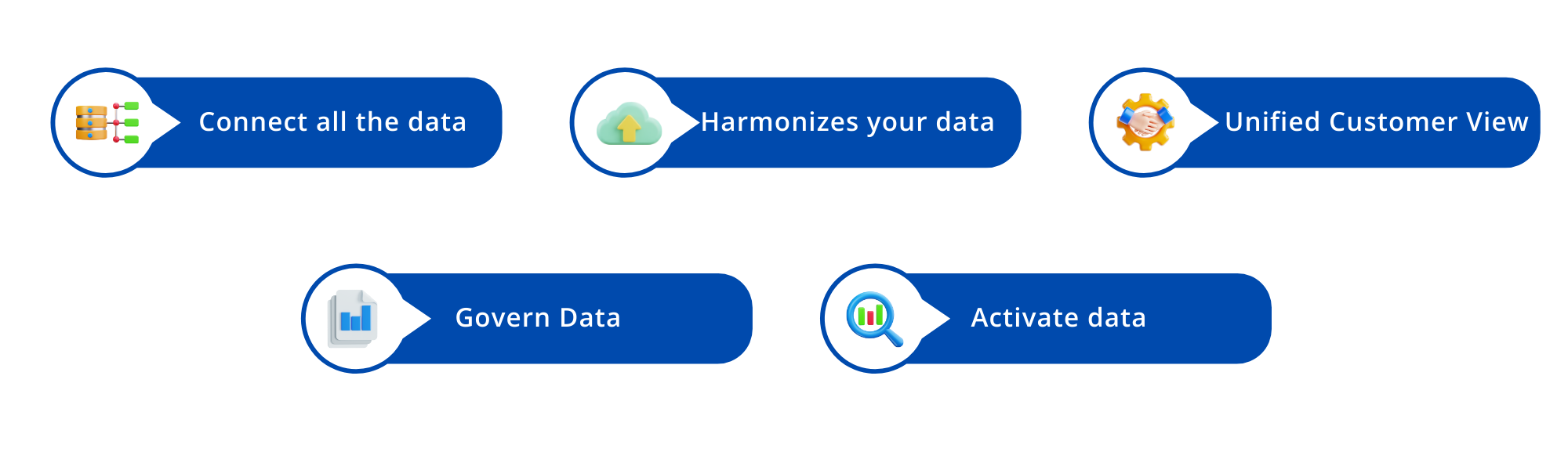
Data 360 sits at the core of Agentforce 360, powering every interaction with clean, connected, and governed customer data. It brings together information from every app and system, harmonizes it into a shared structure, and ensures it’s ready for AI-driven engagement. The key steps include-
Connect All the Data
With Data 360, businesses can link data from virtually any system, whether it’s from legacy databases, modern data warehouses, CRM, marketing, or external third-party apps. It supports both structured data (tables, logs) and unstructured data (documents, chat transcripts, images, events), using different connectors. Data 360 uses secure, zero-copy connections with modern data platforms, allowing data to be shared both ways without moving or duplicating it. It ingests data instantly, empowering teams and AI agents to respond with personalized, timely actions instead of relying on stale or batch-processed information.
Harmonizes Your Data
Once data is connected, Data 360 transforms and standardizes it. It converts data from any system into native Salesforce objects and fields, using a consistent metadata framework. Through identity resolution, it matches records across systems, e.g., different phone numbers, misspelled names, and multiple email addresses to build a unified customer profile. Salesforce simplifies data harmonization with point-and-click tools and ready-to-use data bundles that automatically map your information into a consistent structure.
Data becomes even more powerful when layered with metrics, definitions, and business meaning. Governed semantic models ensure every team uses the same KPIs, and AI-assisted modeling accelerates transformation. This helps to provide precise recommendations and predictions. This harmonized dataset often becomes the ‘single source of truth’ for customer identity, behavior, history, and interactions.
Unified Customer View
Salesforce Data 360 gives every customer-facing team a complete, real-time picture of each customer. This helps marketing, sales, service, and commerce teams to operate with the same accurate understanding of customer history, preferences, and interactions. With low-code tools, businesses can quickly turn raw data into meaningful insights and predictions to anticipate customer needs and personalize engagement.
Data 360 also helps teams create smarter metrics and segments effortlessly. Teams gain advanced insights and create user indicators like lifetime value, purchase likelihood, and engagement levels, without heavy technical work. Its segmentation capabilities allow businesses to explore and define high-value customer groups in an intuitive interface, enabling targeted campaigns and better decision-making. Together, these capabilities transform scattered data into actionable intelligence.
Govern Data
Data 360 governance provides a unified way to manage both structured and unstructured data, making it easier to apply rules and standards across everything your business captures. Teams can create and enforce data policies with simple clicks and ensure every dataset follows consistent guidelines. It also strengthens protection for sensitive information by preventing potential risks and offering flexible control over encryption keys, so data stays secure while remaining accessible to the right users.
Activate data
Data 360 allows putting unified customer data into action across both Salesforce apps and external platforms. Businesses can trigger automated workflows whenever customer data changes, ensuring timely and relevant actions. Beyond internal systems, Data 360 enables omni-channel activation, gaining insights across external destinations, advertising platforms (Google, Facebook, Amazon), or messaging apps like WhatsApp. This enables personalized, real-time interactions that respond instantly to customer behavior and preferences, helping businesses engage effectively across every channel.
Use Cases: What Businesses Can Actually Achieve with Data 360
Salesforce Data 360 brings together information from every touchpoint, providing a complete picture of each customer. With this unified perspective, organizations can take targeted actions that drive engagement, loyalty, and growth.
Prevent Customer Churn: Data 360 unifies customer data and analyzes patterns. This helps in detecting reduced purchases, skipped interactions, or negative feedback. So, businesses can manage retention campaigns, personalized outreach, and loyalty incentives. This reduces churn and retains high-value customers before they switch to competitors.
Hyper-Personalized Experiences: With a complete, 360° view of each customer, businesses can tailor messaging, recommendations, and offers based on real-time behavior and preferences. For example, if a customer browses specific products online, agents or marketing systems can instantly deliver personalized suggestions via email, app notifications, or chat. True personalization increases engagement, customer satisfaction, and ultimately drives higher conversion rates.
Optimize Marketing Campaigns: Marketing teams often struggle with fragmented data and unclear ROI. Using Data 360, campaigns can be launched across multiple channels, tracked in real-time, and adjusted dynamically based on performance metrics. Businesses can understand customers better, check which messages resonate, and ensure campaigns are always relevant to the audience.
Customer Support and Service: Data 360 equips agents with a complete history of each customer’s journey, including past purchases, service tickets, and interactions across channels. This allows agents to resolve issues faster, anticipate customer needs, and maintain a consistent, informed service experience across phone, email, chat, and in-person interactions.
Upsell and Cross-Sell Opportunities: Data 360 analyzes customer data and identifies relevant products or services for upselling and cross-selling. Personalized recommendations can be delivered in real-time through email, in-app notifications, or during service interactions. This increases sales and also strengthens customer relationships.
Enable Agentforce: Salesforce Data 360 fuels Agentforce with clean, unified, and real-time customer data to operate on. Without a harmonized customer profile, AI agents cannot take context-aware actions, automate decisions, or deliver personalized engagements. This allows Agentforce to reason, act, and collaborate across different teams. Data 360 helps to make enterprise AI agents ready and improve customer journeys.
Conclusion
Delivering exceptional customer experiences today requires more than channels and touchpoints. It requires a single, intelligent understanding of every customer. Salesforce Data 360 helps to create a unified customer data and AI-ready foundation. This also provides Agentforce with harmonized profiles, shared semantics, and real-time data flows that feed directly. So, businesses can deploy AI agents that act with full context and automate across marketing, sales, service, and commerce. Data 360 transforms scattered information into a strategic engine powering responsiveness, relevance, and customer loyalty.
Kasmo helps organizations bring this vision to life with deep expertise across Salesforce Data Cloud, Data 360, and Agentforce implementations. As a trusted Salesforce partner with proven experience in building unified customer data foundations, Kasmo enables enterprises to modernize data pipelines and operationalize AI agents. Starting with designing and developing, integrating and maintaining, our teams ensure that Data 360 and the AI powers business value.