Introduction
In today’s retail landscape, a single disruption — whether a delayed shipment or a disconnected warehouse system — can ripple across the entire supply chain, directly impacting profitability and customer trust. What determines whether a retailer absorbs the shock or suffers the fallout isn’t luck; it’s visibility. Yet many organizations still operate with fragmented data spread across inventory systems, logistics platforms, procurement tools, and store operations, making fast, confident decisions nearly impossible.
Despite the urgency to modernize, progress remains limited. According to Gartner, just 23% of supply chain leaders report having a formal supply chain AI strategy in place within their organizations. This gap highlights that retailers recognize the importance of intelligence and automation but lack the unified data foundation required to power it. To transform supply chain operations, businesses must first connect and govern their data. This is where Snowflake’s Data Cloud comes in, providing a centralized and secure platform that brings together supply chain data.
The Core Challenges in the Retail Supply Chain Management
Retail supply chains operate in a constant state of volatility. Demand shifts overnight due to seasonality, promotions, social trends, or unexpected disruptions. Working with fragmented systems results in limited visibility, delayed insights, and reactive decision-making. Inventory either sits idle in one location while stockouts hurt sales in another, or replenishment decisions are made based on outdated forecasts. This disconnect between demand sensing and supply execution creates inefficiencies that directly impact revenue and CX.
Compounding this complexity are rising customer expectations and operational pressures. Consumers expect faster deliveries, seamless returns, and consistent product availability across channels. At the same time, retailers must manage supplier variability, transportation constraints, labor shortages, and compliance requirements. Add to this the challenge of omnichannel fulfillment, like buy online, pick up in store (BOPIS), curbside delivery, and marketplace integrations. Without a centralized, data-driven foundation, retailers struggle to balance cost optimization, agility, and resilience.
Why Data Matters: The Strategic Advantage of a Unified Data Foundation
In today’s retail environment, data is the backbone of a competitive advantage. A unified data foundation enables retailers to enable intelligent, real-time decision-making across supply chain management.
Visibility Across the Value Chain
A unified data platform consolidates information from suppliers, warehouses, transportation providers, stores, and e-commerce systems into a unified source. This eliminates blind spots and enables leaders to monitor inventory levels, order status, and fulfillment performance. With complete visibility, retailers can address disruptions well before it occurs
Demand Planning and Forecasting
When historical sales data, promotional plans, seasonal trends, and external factors are integrated, forecasting models become significantly more accurate. Retailers can reduce overstock and align inventory with actual demand patterns. This improves working capital efficiency while maintaining high service levels.
Faster Decision-Making
Data silos slow down analysis and create inconsistencies across departments. A unified foundation ensures that merchandising, omnichannel supply chain, finance, and operations teams work from the same real-time insights. This accelerates planning and improves cross-functional collaboration and decision-making.
Enhanced Operational Efficiency
Centralized data enables automation across replenishment planning, logistics optimization, and supplier performance tracking. Advanced analytics can identify bottlenecks, inefficiencies, and recommend corrective actions. This drives lower transportation costs, optimized warehouse utilization, and improved on-time delivery rates.
Resilience and Risk Management
With integrated data, retailers can simulate disruption scenarios and evaluate mitigation strategies in advance. Real-time alerts and predictive analytics allow teams to shift sourcing, reroute shipments, or rebalance inventory before customer service is impacted.
Bringing in Snowflake: The Data Cloud Advantage
Resilience in the retail supply chain begins with real-time, end-to-end data visibility that provides demand planning and forecasting, inventory gaps, and fulfillment risks before they escalate. This is where Snowflake’s Data Cloud becomes a strategic enabler to unify disparate data and support advanced use cases like predictive forecasting and supplier performance monitoring.
At its core, the Snowflake Data Cloud unifies data from disparate sources, including Point of Sale (POS), ERP systems, inventory and warehouse platforms, supplier data feeds, etc., into one governed environment. This unified foundation eliminates silos, reduces reconciliation overhead, and improves accuracy.
Unified Data Across Functions
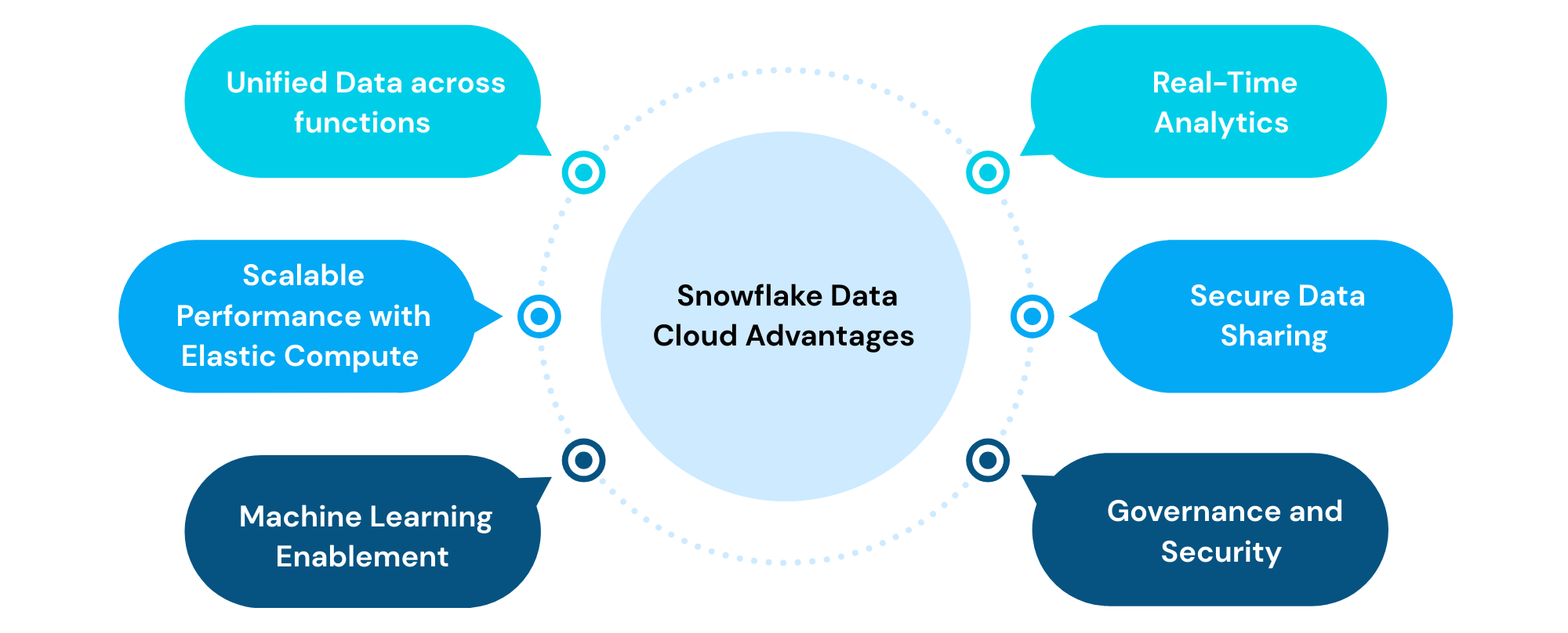
Snowflake consolidates data from demand planning, procurement, warehousing, logistics, store operations, and customer touchpoints into a common data model. This shared supply chain data management ensures consistency. Allowing finance, merchandising, supply chain, and operations to draw insights from the same trusted dataset. With this unified view, retailers can track inventory levels, supplier lead times, and fulfillment performance in real time, enabling timely and coordinated action.
Real-Time Analytics
Snowflake supports real-time ingestion and querying, enabling dashboards and alerts that reflect what is happening now, not what happened hours ago. For example, if a regional warehouse experiences unexpected stock depletion, Snowflake enables real-time visibility that triggers replenishment actions before a stockout impacts sales.
Scalable Performance with Elastic Compute
Retail supply chains generate massive volumes of data, from clickstream logs and sensor feeds to order histories and inventory transactions. Snowflake separates storage from compute to fasten queries independently and run concurrently without performance degradation. This helps retailers run complex omnichannel supply chain simulations, demand forecasts, and optimization algorithms effectively.
Secure Data Sharing
Retail supply chain management extends beyond internal departments; they include suppliers, partners, logistics providers, and third-party marketplaces. Snowflake’s Secure Data Sharing enables retailers to share governed, real-time data with supply chain partners without moving or copying data.
Machine Learning Enablement
Snowflake integrates with advanced analytics tools, machine learning frameworks, and AI engines, allowing retailers to develop predictive models. This helps forecast demand variability, detect anomalies, and simulate supply disruptions. Retailers can deploy data-driven algorithms that anticipate risks and optimize decisions, like cross-dock scheduling or dynamic replenishment.
Governance and Security
Snowflake’s security framework includes role-based access controls, encryption, and auditing, ensuring sensitive customer or supply chain data remains protected while still accessible to authorized stakeholders. This helps retailers comply with data privacy regulations and internal policies.
Best Practices for Implementing Snowflake in the Retail Supply Chain
A successful Snowflake implementation in the retail supply chain requires a clear strategy, strong data governance, and alignment with business outcomes. Retailers should focus on measurable operational improvements like demand accuracy, inventory optimization, and decision-making.
Start with High-Impact Use Cases: Prioritize areas like demand forecasting, inventory visibility, or supplier performance where Snowflake can deliver quick, measurable value.
Unify and Cleanse Data Sources: Integrate ERP, POS, and logistics data into a standardized model to eliminate silos and ensure consistent reporting.
Enable Real-Time Data Processing: Eliminate batch reporting by implementing continuous data ingestion for faster and more effective decision-making.
Data Governance and Security: Apply role-based access controls and compliance policies to protect sensitive operational and supplier data.
Cross-Functional Collaboration: Ensure supply chain, merchandising, finance, and IT teams work from the same Snowflake-powered dashboards and analytics environment
Conclusion
Retail supply chains are measured by resilience, speed, and intelligence. As volatility becomes the norm, retailers need a unified, real-time data foundation that connects demand signals, inventory movement, supplier performance, and more. Snowflake’s Data Cloud empowers this transformation by eliminating silos, scaling analytics, and collaborating securely across supply chain partners. The result is a smarter and agile retail supply chain execution.
As a Snowflake Elite Partner, Kasmo helps retailers develop and adopt Snowflake solutions aligned to their business goals. From building unified data architectures and real-time pipelines to enabling advanced analytics and governance frameworks, our team ensures seamless adoption. By partnering with us, retailers can operationalize Snowflake’s capabilities, transforming their supply chain into a resilient, intelligent, and future-ready growth engine.